

Pakistan’s Punjab to toughen laws against kite flying— state media 

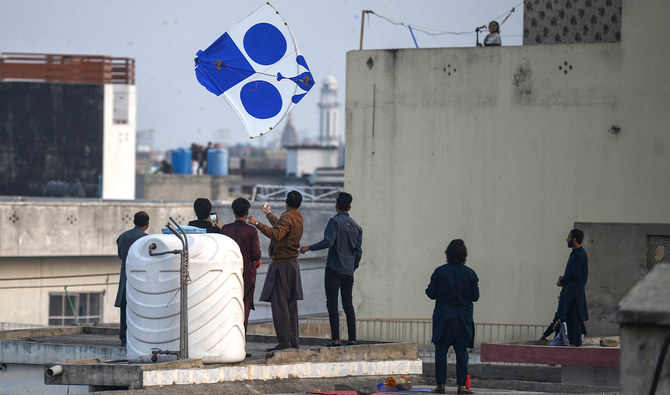
Youths fly kites on a rooftop during the Basant Kite Festival despite a ban imposed by authorities in 2007 following a spate of accidents, in Rawalpindi on February 18, 2022. (AFP/File)
Short Url
Updated 27 June 2024
Follow

Pakistan’s Punjab to toughen laws against kite flying— state media 

  • Punjab to set six months to three years, fine of Rs500,000 ($1795) for kite makers
  • Razor-sharp wires used to fly kites have caused numerous injuries, deaths in Punjab

ISLAMABAD: The government in Pakistan’s most populous Punjab province has decided to amend the Kite Flying Prohibition Ordinance 2001 to deter people from taking part in the activity, the state-run Associated Press of Pakistan (APP) reported on Thursday. 

Kite flying has long been a passion in South Asia and for decades, the Basant— a kite flying celebration— would transform Pakistan’s skies into a glittery kaleidoscope of hundreds of thousands of kites to commemorate the advent of spring. 

But in 2005, the Supreme Court banned the celebration after 19 people died from decapitation by stray strings. Thick strings or razor-sharp wires reinforced with glass and chemicals so they can better attack opponents’ kites and slice their strings, have been known to knock out power lines and, in some cases, tangle around a human neck or limb, causing serious injury or death.

“To prevent kite flying in Punjab, the government has decided to amend the Kite Flying Prohibition Ordinance 2001,” APP said, adding that the Punjab Law Department has sent a draft of the amendments to the Chief Minister’s Office in consultation with the Standing Committee on Law.

Quoting sources, the state media said that the amended ordinance suggests an imprisonment term for kite makers from six months to three years and a fine of up to Rs500,000 ($1795). 

The ordinance in its present form has set an imprisonment term of three years and a fine of Rs100,000 ($359) for those who make kites and fly them. 

“Also in the ordinance, there will be a fine for the children while the parents of the children have also been recommended to be punished,” APP said. 

The ban on kite flying has been lifted several times over the years for the period of Basant, but the sport still caused deaths as kite fliers continued to use wire or modified strings.


Pakistan’s seafood exports to China rise 24% to $240 million in 2025

Updated 31 December 2025
Follow

Pakistan’s seafood exports to China rise 24% to $240 million in 2025

  • The Chinese embassy cites strong growth in agricultural trade with Pakistan
  • Islamabad aims to expand food exports amid effort to boost foreign reserves

ISLAMABAD: Pakistan’s seafood exports to China rose 24% year-on-year to $240 million in the first 11 months of 2025, the Chinese embassy in Islamabad said on Wednesday, highlighting growing agricultural trade between the two countries.

China is one of Pakistan’s largest seafood export markets, alongside destinations such as Thailand, Vietnam and countries in the Middle East. Pakistan exports fish, shrimp and other marine products sourced from coastal areas in Balochistan and Sindh, including Gwadar, Pasni and Karachi, with shipments typically consisting of frozen fish, frozen shrimp and a smaller volume of processed seafood.

The figure cited by the Chinese embassy fits into a longer upward trend, supported by rising Chinese demand, improvements in cold-chain logistics and market access approvals for Pakistani exporters.

“Pakistan’s seafood exports to China hit [nearly] $240 million from Jan-Nov 2025, soaring by 24% compared with the same period in 2024, which fully shows the strong vitality of the agricultural trade between China & Pakistan,” the embassy said. “[China looks] forward to more export of high-quality Pakistani products to China in the future.”

China is Pakistan’s closest regional ally and a key destination for its agricultural and food exports, which Islamabad has been seeking to expand to bolster foreign exchange earnings.

The two countries enjoy strong strategic and economic cooperation, with Chinese support seen as vital to Pakistan’s efforts to diversify its export base beyond textiles and reduce reliance on external financing.

Beijing and Islamabad are also working closely on energy and infrastructure projects as part of broader efforts to enhance regional connectivity and support industrial development in Pakistan.