

Only 1,000 tons of Gaza aid from Cyprus distributed: US aid officials

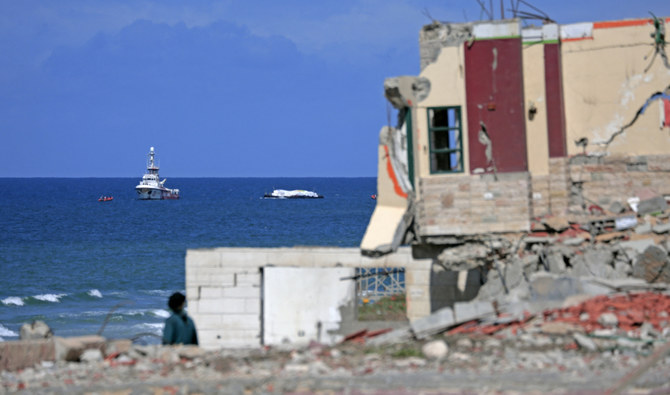
The Open Arms maritime vessel that set sail from Larnaca in Cyprus carrying humanitarian aid approaches the coast of Gaza City on March 15, 2024. (AFP/File)
Short Url
Updated 27 June 2024
Follow

Only 1,000 tons of Gaza aid from Cyprus distributed: US aid officials

NICOSIA: Only 1,000 tons of the 7,000 tons of humanitarian aid shipped to war-ravaged Gaza from Cyprus have been distributed because of insecurity, US aid officials said on Wednesday.

The remaining 6,000 tons was on shore in secure conditions but has yet to be distributed because of an upsurge in violence and looting, the officials said.

The sea corridor linking Cyprus with the Gaza Strip opened in March, delivering a fraction of the basic supplies needed to sustain the Palestinian territory’s 2.4 million people.

The maritime aid route has faced obstacles, including security concerns at a US military-built pier and the distribution of aid upon arrival.

“I have never seen a more challenging or complex environment for the humanitarian community to work,” said USAID’s Doug Stropes.

“There is currently a security review on the lawlessness and gang activity,” he said, referring to information received from partners on the ground.

Cyprus Foreign Minister Constantinos Kombos said that despite the challenges, the aid effort to Gaza would continue.

“There is a constant flow of vessels and sending to the other side,” he said.

“There are of course certain challenges, challenges that relate to everything going on in Gaza, but we continue the effort.

“It is not going to be an easy task.

“We are, after all, operating in what is a war zone and we are doing everything we can in cooperation with our partners to ensure that this has an impact on the daily lives of people on the ground.”

The US ambassador to Cyprus, Julie Fisher, said Washington was committed to exhausting “every possible avenue to alleviate the suffering of the Palestinian people who are facing catastrophic levels of food insecurity.”

The Gaza war began with Hamas’s October 7 attack on southern Israel that resulted in the deaths of 1,195 people, mostly civilians, according to an AFP tally based on Israeli figures.

The militants also seized about 250 hostages, 116 of whom remain in Gaza although the army says 42 are dead.

Israel’s retaliatory offensive has killed at least 37,718 people, also mostly civilians, according to data from Hamas-run Gaza’s health ministry.



Germany blames Russia for cyberattack on air safety, election interference

Updated 4 sec ago
Follow

Germany blames Russia for cyberattack on air safety, election interference

  • “We have been able to clearly identify the handwriting behind it and prove Moscow’s responsibility,” said the spokesman
  • “Our intelligence findings prove that the Russian military intelligence service GRU bears responsibility for this attack“

BERLIN: Germany on Friday accused Russia of a cyberattack targeting its air traffic control and spreading disinformation ahead of February’s general election, charges dismissed by Russia as “absurd” and “baseless.”
A German foreign ministry spokesman said security services had proof that hacker groups run by Russia’s military intelligence service GRU were responsible for the attack and influence operations.
“Based on comprehensive analysis by the German intelligence services, we have been able to clearly identify the handwriting behind it and prove Moscow’s responsibility,” said the spokesman.
“We can now clearly attribute the cyberattack against German Air Safety in August 2024 to the hacker collective APT28, also known as Fancy Bear,” he told a regular press briefing.
“Our intelligence findings prove that the Russian military intelligence service GRU bears responsibility for this attack,” added the spokesman.
He also said Russia had sought to influence February’s parliamentary election, which was won by the conservatives of Chancellor Friedrich Merz, with the far-right AfD scoring its best-ever result in second place.
“Second, we can now state definitively that Russia, through the Storm 1516 campaign, sought to influence and destabilize the most recent federal election,” he added at a press conference.
The spokesman said a GRU-supported Moscow think tank and other groups had spread artificially generated or deepfake images and other content, and that the goal was to divide society and “undermine trust in democratic institutions.”
The Russian embassy in Berlin said in a statement sent to AFP that it “categorically rejected” that Russia was behind any of the activity.
“The accusations of Russian state structures’ involvement in these incidents and in the activities of hacker groups in general are baseless, unfounded and absurd,” the statement said.
According to security sources, much of the material spread by the Storm 1516 campaign involved spurious claims about Merz and other prominent politicians such as former foreign minister Annalena Baerbock and former vice chancellor Robert Habeck, both prominent Greens party members.
AFP’s German Fact Check service debunked two of the other claims in the campaign aimed at subverting trust in elections; namely that the AfD had been left off ballots in the city of Leipzig and that votes for the party in Hamburg were destroyed before they could be counted.

- ‘Pay a price’ -

The foreign ministry spokesman said Germany had “absolutely solid proof” that Russia was behind the operations but added that he could not go into detail because this would involve discussing the work of German intelligence services.
The head of the BfV domestic intelligence agency Sinan Selen said in a statement that “the ‘Storm-1516’ campaign shows in a very concrete way how our democratic order is being attacked.”
“This disinformation ecosystem includes pro-Russian influencers with a wide reach, conspiracy theories and right-wing extremist circles,” Selen said.
The German foreign ministry spokesman warned that Berlin would take “a series of countermeasures to make Russia pay a price for its hybrid actions, in close coordination with our European partners.”
Germany would support “new individual sanctions against hybrid actors on a European level,” he said, without saying who they were.
He added that from January, EU countries would “monitor cross-border travel by Russian diplomats within the Schengen Area. The aim is to facilitate better information exchange and minimize intelligence risks.”
Governments across Europe are on high alert over alleged Russian espionage, drone surveillance and sabotage activities, as well as cyberattacks and disinformation campaigns.
Germany has been Ukraine’s second-biggest supplier of aid since Russia launched its 2022 full-scale invasion and has accused Moscow of being behind drone flights near several European airports in recent months.