

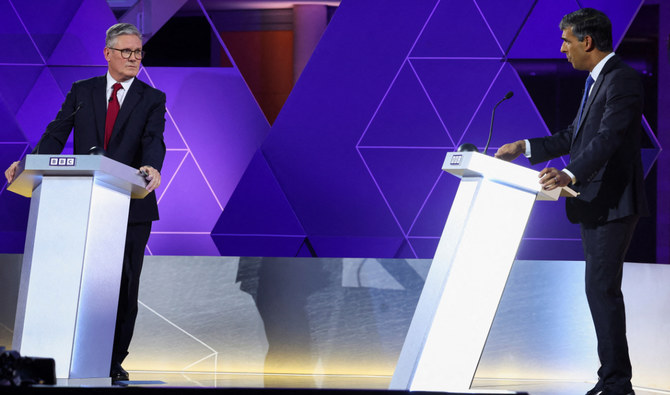
Sunak, Starmer clash in final TV debate before election

Britain’s Prime Minister and Conservative Party leader Rishi Sunak, and Labour Party leader Keir Starmer attend a live TV debate, hosted by The BBC, in Nottingham, on June 26, 2024, in the build-up to the UK general election on July 4. (AFP)
Short Url
Updated 27 June 2024
Follow

Sunak, Starmer clash in final TV debate before election

LONDON: The two men bidding to be British prime minister faced off late on Wednesday in a bad-tempered, last head-to-head TV debate before the country’s general election next week.

With Keir Starmer’s Labour opposition enjoying a huge poll lead, the verbal tussle in Nottingham, central England, was premier Rishi Sunak’s last big opportunity to give his Conservatives a fighting chance on July 4.

The debate turned personal at times with Sunak accusing Starmer of “taking people for fools” over Labour’s plans to reduce immigration, while Starmer accused the wealthy Sunak of being “out of touch.”

Sunak repeatedly urged voters not to “surrender” to Labour on everything from borders to taxes, while Starmer repeated his mantra that the election represents an opportunity to “turn the page” after 14 years of Tory rule.

The two also locked horns about a betting scandal that has ensnared several senior Tories and a Labour candidate, and overshadowed talk about key policies in the campaign’s final days.

Starmer pledged to “reset politics, so that politics returns to public service,” accusing Sunak of showing a lack of leadership over the furor.

Sunak, who promised to restore “integrity, professionalism and accountability” when he was named Tory leader and prime minister in 2022, said he had been “furious” when he learned about the allegations.

“I’ve been crystal clear: anyone who has broken the rules should not only face the full consequences of the law, I will ensure that they’re booted out of the Conservative Party,” he added.

But in a sign of the public’s low opinion of politicians, one audience member’s question — “are you two really the best we’ve got?” — got loud applause.

Labour has been more than 20 points ahead in surveys for over 18 months, as Britons appear weary of Tory rule dominated by austerity, Brexit and party infighting.

Sunak has failed to reduce the deficit since he called the election on May 22, six months earlier than legally required.

His rain-sodden announcement outside Downing Street was an ominous portent of what was to come.

The Tory leader has since run a lacklustre campaign featuring blunders, and caused uproar for skipping the main D-Day anniversary with other world leaders in northern France.

He has been criticized for belatedly taking action over the betting row, which this week saw the Conservatives withdraw support from two candidates being probed by the Gambling Commission regulator for allegedly betting on the election date.

One, Craig Williams, who served as Sunak’s close aide during the last parliament, is alleged to have staked £100 ($127) three days before Sunak called the vote.

The other, Laura Saunders, is married to the Tories’ director of campaigns, who took a leave of absence when the claims became public.

The party’s chief data officer also stepped back from duties over allegations he placed dozens of bets on the election date.

Separately, Labour suspended a candidate after he bet on himself losing the election, while five police officers are also being investigated.

The regulator is thought to be looking into whether anyone had privileged information when they placed their bets.

Such flutters are allowed in the UK but using insider knowledge to make them is against the law.

The tawdry row has summed up an underwhelming campaign that has failed to galvanize the public, with polls suggesting a good chunk of the electorate made up their minds months ago.

Labour’s poll lead increased hugely in October 2022, when Sunak’s predecessor Liz Truss spooked markets and tanked the pound with billions of pounds of unfunded tax cuts.

Voters were already showing signs of becoming fed up with the Tories following the “Partygate” scandal over illegal Downing Street Covid lockdown parties, which precipitated ex-premier Boris Johnson’s fall from power.

Sunak has made a number of headline-grabbing announcements during the campaign, such as national service for teenagers, but they have failed to move the polls.

Arch-Euroskeptic Nigel Farage’s decision to run for the hard-right Reform UK party has also made his job more difficult.

Starmer, in contrast, has played it safe as he tries to preserve Labour’s lead and return the party to power for the first time since 2010.

He has stopped short of announcing new policies, instead trying to reassure voters that Labour will responsibly marshal the economy and repeating his mantra that Britain is crying out for “change.”

Despite the poll lead, Labour still requires a record swing to win a majority of one, owing to the Conservatives’ landslide win under Johnson at the 2019 election.


US and Ukraine ‘a lot closer’ on peace deal, Trump says after meeting with Zelensky

Updated 58 min 14 sec ago
Follow

US and Ukraine ‘a lot closer’ on peace deal, Trump says after meeting with Zelensky

  • Zelensky sees agreement on security guarantees for Ukraine
  • Hurdles to a comprehensive peace deal remain
  • Trump spoke with Putin ahead of meeting on Sunday

PALM BEACH, Florida: US President Donald Trump said on Sunday that he and Ukrainian President Volodymyr Zelensky were “getting a lot closer, maybe very close” to an agreement to end the war in Ukraine, though both leaders acknowledged that ​some of the thorniest details remain unresolved.
The two leaders spoke at a joint press conference late Sunday afternoon after meeting at Trump’s Mar-a-Lago resort in Florida. Trump said it will be clear “in a few weeks” whether negotiations to end the war will succeed.
Zelensky said an agreement on security guarantees for Ukraine has been reached. Trump was slightly more cautious, saying that they were 95 percent of the way to such an agreement, and that he expected European countries to “take over a big part” of that effort with US backing.
Zelensky has said previously that he hopes to soften a US proposal for Ukrainian forces to withdraw completely from the Donbas region of eastern Ukraine, a Russian demand that would mean ceding some territory held by Ukrainian forces.
Both Trump and Zelensky said on Sunday the future of the Donbas had not been settled. “It’s unresolved, but it’s getting a lot ‌closer. That’s a ‌very tough issue,” Trump said.
Just before Zelensky and his delegation arrived at Trump’s Florida residence, Trump ‌and ⁠Russian ​President Vladimir ‌Putin spoke in a call described as “productive” by the US president and “friendly” by Kremlin foreign policy aide Yuri Ushakov.
Ushakov, in Moscow, said Putin told Trump a 60-day ceasefire proposed by the European Union and Ukraine would prolong the war. The Kremlin aide also said Ukraine needs to make a decision regarding the Donbas “without further delay.” And he said the Russian government had agreed to establish working groups to resolve the conflict that will focus on economic and security concerns.


Meeting follows Russian attacks on Kyiv
Zelensky arrived at Mar-a-Lago early Sunday afternoon, as Russian air raids pile pressure on Kyiv. Russia hit the capital and other parts of Ukraine with hundreds of missiles and drones on Saturday, knocking out power and heat in parts of Kyiv. Zelensky has described the weekend attacks ⁠as Russia’s response to the US-brokered peace efforts, but Trump on Sunday said he believes Putin and Zelensky are serious about peace.
The US president said he will call Putin again after meeting with Zelensky. Zelensky ‌had previously told journalists he plans to discuss the fate of the contested Donbas ‍region with Trump, as well as the future of the Zaporizhzhia nuclear ‍power plant and other topics.

Russia claims more battlefield advances 
Putin said on Saturday Moscow would continue waging its war if Kyiv did not seek ‍a quick peace. Russia has steadily advanced on the battlefield in recent months, claiming control over several more settlements on Sunday.
While Kyiv and Washington have agreed on many issues, the issue of what territory, if any, will be ceded to Russia remains unresolved. While Moscow insists on getting all of the Donbas, Kyiv wants the map frozen at current battle lines.
The US, seeking a compromise, has proposed a free economic zone if Ukraine leaves the area, although it remains unclear ​how that zone would function in practical terms.
US negotiators have also proposed shared control over the Zaporizhzhia nuclear plant. Power line repairs have begun there after another local ceasefire brokered by the International Atomic Energy Agency, the agency said on ⁠Sunday.
Russia controls all of Crimea, which it annexed in 2014, and since its invasion of Ukraine nearly four years ago has taken control of about 12 percent of its territory, including about 90 percent of the Donbas, 75 percent of the Zaporizhzhia and Kherson regions, and slivers of the Kharkiv, Sumy, Mykolaiv and Dnipropetrovsk regions, according to Russian estimates.
Putin said on December 19 that a peace deal should be based on conditions he set out in 2024: Ukraine withdrawing from all of the Donbas, Zaporizhzhia and Kherson regions, and Kyiv officially renouncing its aim to join NATO. Zelensky’s past encounters with Trump have not always gone smoothly, but Sunday’s meeting follows weeks of diplomatic efforts. European allies, while at times cut out of the loop, have stepped up efforts to sketch out the contours of a post-war security guarantee for Kyiv that the United States would support.
On Sunday, ahead of the Mar-a-Lago visit, Zelensky said he held a detailed phone call with British Prime Minister Keir Starmer. Trump and Zelensky will hold a phone call with European leaders at some point during the Florida meeting, Trump said. The 20-point plan was spun off from a Russian-led 28-point plan, which emerged from talks between US special envoy Steve Witkoff, Trump’s son-in-law Jared Kushner ‌and Russian special envoy Kirill Dmitriev, and which became public in November.
Subsequent talks between Ukrainian officials and US negotiators have produced the more Kyiv-friendly 20-point plan.