


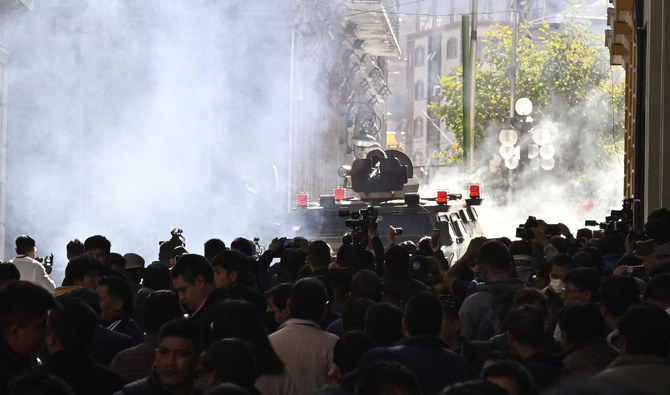

LA PAZ, Bolivia: Led by a top general vowing to “restore democracy,” armored vehicles rammed the doors of Bolivia’s government palace Wednesday in what the president called a coup attempt, then quickly retreated — the latest crisis in the South American country facing a political battle and an economic crisis.
Within hours, the nation of 12 million people saw a rapidly moving scenario in which the troops seemed to take control of the government of President Luis Arce. He vowed to stand firm and named a new army commander, who immediately ordered the troops to stand down.
Soon the soldiers pulled back, along with a line of military vehicles, ending the rebellion after just three hours. Hundreds of Arce’s supporters then rushed the square outside the palace, waving Bolivian flags, singing the national anthem and cheering.
The soldiers’ retreat was followed by the arrest of army chief Gen. Juan José Zúñiga, after the attorney general opened an investigation.

Police officers stand guard at Plaza Murillo in La Paz on June 26, 2024 following a failed coup attempt against Bolivian President Luis Arce. (AFP)
Government Minister Eduardo del Castillo said that in addition to Zúñiga, former navy Vice Adm. Juan Arnez Salvador was taken into custody.
“What was this group’s goal? The goal was to overturn the democratically elected authority,” del Castillo told journalists in announcing the arrests.
The apparent coup attempt came as the country has faced months of tensions and political fights between Arce and his one-time ally, former leftist president Evo Morales, over control of the ruling party. It also came amid a severe economic crisis.
The clashes have paralyzed the government’s efforts to deal with the economic crisis. For example, Morales’ allies in Congress have consistently thwarted Arce’s attempts to take on debt to relieve some of the pressure.
Zúñiga referenced that paralysis during the rebellion, telling reporters the military was tired of the infighting and was seeking “to restore democracy.”
“We are listening to the cry of the people because for many years an elite has taken control of the country,” he said, adding that politicians are “destroying the country: look at what situation we are in, what crisis they have left us in.”
“The armed forces intend to restore the democracy, to make it a true democracy,” he said.
The rapidly unfolding crisis began in the early afternoon as the streets of La Paz started filling with soldiers. Arce tweeted that the troops deployment was irregular and soon he and other political figures warned of an attempted coup.

People queue to withdraw money from an ATM in La Paz, Bolivia during a coup attempt against the government by the army chief on June 26, 2024. (REUTERS)
Still, the apparent attempt to depose the sitting president seemed to lack any meaningful support, and even Arce’s rivals closed ranks to defend democracy and repudiate the uprising.
In a twist, Zúñiga claimed in comments to journalists before his arrest that Arce himself told the general to storm the palace in a political move. “The president told me: ‘The situation is very screwed up, very critical. It is necessary to prepare something to raise my popularity’,” Zúñiga quoted the Bolivian leader as saying.
Zúñiga sajd he asked Arce if he should “take out the armored vehicles?” and Arce replied, “Take them out.”
Justice Minister Iván Lima denied Zúñiga’s claims, saying the general was lying and trying to justify his actions for which he said he will face justice.
Prosecutors will seek the maximum sentence of 15 to 20 years in prison for Zúñiga, Lima said via the social media platform X, “for having attacked democracy and the Constitution.”
The spectacle shocked Bolivians, no stranger to political unrest; in 2019 Morales was ousted as president following an earlier political crisis.
As the crisis unfolded Wednesday, Arce confronted Zúñiga in the palace hallway, as shown on video on Bolivian television. “I am your captain, and I order you to withdraw your soldiers, and I will not allow this insubordination,” Arce said.

Bolivian police detain coup leader Juan Jose Zuniga, former general commander of the army, after his arrest in La Paz, Bolivia, on June 26, 2024. (AP)
Surrounded by ministers, he added: “Here we are, firm in Casa Grande, to confront any coup attempt. We need the Bolivian people to organize.”
Less than an hour later, Arce announced new heads of the army, navy and air force amid the roar of supporters, and thanked the country’s police and regional allies for standing by him. Arce said the troops who rose against him were “staining the uniform” of the military.
“I order all that are mobilized to return to their units,” said the newly named army chief José Wilson Sánchez. “No one wants the images we’re seeing in the streets.”
Shortly after, the armored vehicles roared out of the plaza, tailed by hundreds of military fighters as police in riot gear set up blockades outside the government palace.
The incident was met with a wave of outrage by other regional leaders, including the Organization of American States, Chilean President Gabriel Boric, the leader of Honduras, and former Bolivian leaders.
Bolivia has seen intensifying protests in recent months over the economy’s precipitous decline from one of the continent’s fastest-growing two decades ago to one of its most crisis-stricken.
Arce and Morales have been battling for the future of Bolivia’s splintering Movement for Socialism, known by its Spanish acronym MAS, ahead of elections in 2025.
Following Wednesday’s chaos, reports on local media showed Bolivians stocking up on food and other essentials in supermarkets, concerned about what will come next.
But addressing supporters outside the presidential palace, the country’s vice president, David Choquehuanca, vowed: “Never again will the Bolivian people permit coup attempts.”


