

US criticizes both India, Pakistan in annual religious freedom report 

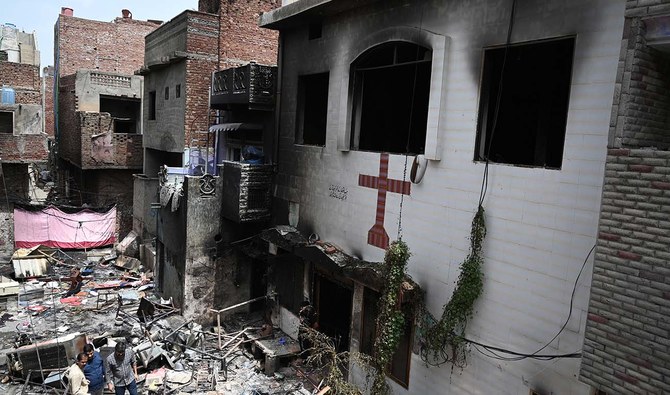
Men stand amid debris outside the torched Saint John Church in Jaranwala on the outskirts of Faisalabad on August 17, 2023, a day after an attack by Muslim men following spread allegations that Christians had desecrated the Koran. (AFP/File)
Short Url
Updated 26 June 2024
Follow

US criticizes both India, Pakistan in annual religious freedom report 

  • US report cites increase in anti-conversion laws, hate speech in India in report
  • Says blasphemy laws in Pakistan “help foster a climate of intolerance and hatred“

WASHINGTON: The United States offered rare criticism of close partner India in a report published Wednesday on religious freedom, while also voicing alarm over rising bigotry worldwide against both Jews and Muslims.

Secretary of State Antony Blinken unveiled the annual report and said that the United States was also facing its own sharp increase of both anti-Semitism and Islamophobia in connection to the Gaza war.

“In India, we see a concerning increase in anti-conversion laws, hate speech, demolitions of homes and places of worship for members of minority faith communities,” Blinken said.

The US ambassador-at-large for international religious freedom, Rashad Hussain, faulted efforts by Indian police.

In India, “Christian communities reported that local police aided mobs that disrupted worship services over accusations of conversion activities, or stood by while mobs attacked them and then arrested the victims on conversion charges,” he said.

The United States for decades has sought warmer ties with India, seeing the fellow democracy as a bulwark against China, with President Joe Biden embracing Prime Minister Narendra Modi, a Hindu nationalist who recently secured a third term.

Despite the public criticism in the report, few expect the State Department to take action on India when it drafts its annual blacklist of countries over religious freedom later this year.

The State Department also raised concerns about countries that are on the list, including India’s historic rival Pakistan, where Blinken condemned blasphemy laws that “help foster a climate of intolerance and hatred that can lead to vigilantism and mob violence.”

Blinken noted that in the United States, hate crimes against both Muslims and Jews “have gone up dramatically.”

He also singled out EU member Hungary, led by nationalist Viktor Orban, saying that “officials continue to use anti-Semitic tropes and anti-Muslim rhetoric and they penalize members of religious groups who criticize the government.”

He said that nine other European nations “effectively ban some forms of religious clothing in public spaces.”

He did not name the countries, although France has been at the forefront on restricting full-face veils worn by some Muslim women.


Three Afghan migrants die crossing into Iran as UN warns of new displacement toward Pakistan

Updated 9 sec ago
Follow

Three Afghan migrants die crossing into Iran as UN warns of new displacement toward Pakistan

  • UNHCR says 1.8 million Afghans were forced to return from Iran this year, straining Afghanistan’s resources
  • Rights groups warn forced refugee returns risk harm as Afghanistan faces food shortages and climate shocks

KABUL: Three Afghans died from exposure in freezing temperatures in the western province of Herat while trying to illegally enter Iran, a local army official said on Saturday.

“Three people who wanted to illegally cross the Iran-Afghanistan border have died because of the cold weather,” the Afghan army official told AFP on condition of anonymity.

He added that a shepherd was also found dead in the mountainous area of Kohsan from the cold.

The migrants were part of a group that attempted to cross into Iran on Wednesday and was stopped by Afghan border forces.

“Searches took place on Wednesday night, but the bodies were only found on Thursday,” the army official said.

More than 1.8 million Afghans were forced to return to Afghanistan by the Iranian authorities between January and the end of November 2025, according to the latest figures from the United Nations refugee agency (UNHCR), which said that the majority were “forced and coerced returns.”

“These mass returns in adverse circumstances have strained Afghanistan’s already overstretched resources and services” which leads to “risks of onward and new displacement, including return movements back into Pakistan and Iran and onward,” UNHCR posted on its site dedicated to Afghanistan’s situation.

This week, Amnesty International called on countries to stop forcibly returning people to Afghanistan, citing a “real risk of serious harm for returnees.”

Hit by two major earthquakes in recent months and highly vulnerable to climate change, Afghanistan faces multiple challenges.

It is subject to international sanctions particularly due to the exclusion of women from many jobs and public places, described by the UN as “gender apartheid.”

More than 17 million people in the country are facing acute food insecurity, the UN World Food Program said Tuesday.