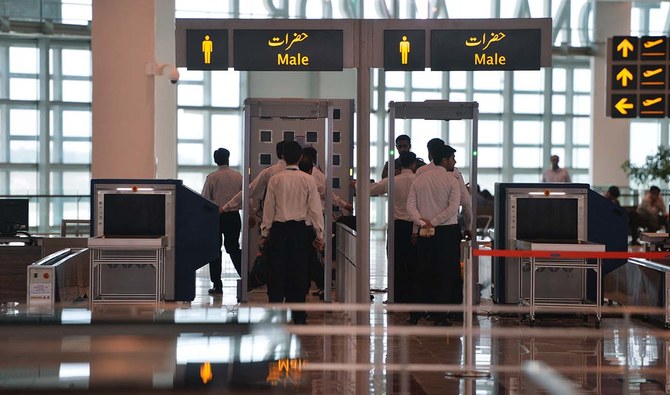
UAE aviation team reviews security measures at Islamabad airport

In this photograph taken on April 26, 2018, Pakistani airport staff walk through security at the new Islamabad International Airport ahead of its official opening on the outskirts of Islamabad. (AFP/File)
Short Url
Updated 26 June 2024
Follow

UAE aviation team reviews security measures at Islamabad airport

  • Emirati team assesses security measures at Islamabad airport for UAE-bound flights
  • UAE civil aviation team to provide Islamabad airport’s assessment on Thursday

ISLAMABAD: A team of the UAE’s General Civil Aviation Authority (GCAA) reviewed security measures for Emirates-bound flights at the Islamabad International Airport on Wednesday, Pakistan’s civil aviation authority said. 

The UAE aviation team arrived in Islamabad on Tuesday for a three-day visit to carry out the assessment. The Pakistan Civil Aviation Authority (PCAA) said the team also reviewed security measures for Etihad Airways flights at the airport and visited the Cargo Complex at the airport. 

The PCAA said Air Commodore (retired) Shahid Qadir, the director of aviation security, briefed the UAE team about the airport’s security measures. 

“The Emirati team is reviewing aviation security measures being provided at the Islamabad airport for UAE-bound flights,” the PCAA said. 

“The Emirati team will provide its assessment regarding the airport tomorrow [Thursday[.”

According to the Pakistani English-language newspaper Dawn, the assessment is a continuation of collaborative efforts between GCAA-UAE and PCAA to enhance aviation security standards in Pakistan. 

The UAE-GCAA team’s visit also includes an aviation security assessment of Karachi’s Jinnah International Airport from July 2-5, the newspaper said. 


Pakistan’s Engro executes $475 million Islamic financing deal to expand telecom infrastructure

Updated 6 sec ago
Follow

Pakistan’s Engro executes $475 million Islamic financing deal to expand telecom infrastructure

  • Islamic banking accounts for over a fifth of Pakistan’s banking assets amid a shift toward Shariah-compliant finance
  • The deal brings more than 10,000 telecom towers under Engro’s control, enabling their shared use by multiple operators

KARACHI: Pakistan’s largest conglomerate Engro Corp. has completed a Rs133 billion ($475 million) Islamic financing deal to acquire telecom tower company Deodar, expanding its telecom infrastructure business as the country seeks to strengthen digital connectivity, the company said on Friday.

The transaction, structured entirely through Shariah-compliant financing, brings more than 10,000 telecom towers under Engro’s control and marks one of the largest Islamic financing deals in Pakistan’s infrastructure sector.

Engro, which has major interests in energy, fertilizers, food and petrochemicals, said the acquisition would allow it to scale shared telecom infrastructure, under which a single tower can host multiple mobile network operators, lowering costs and reducing duplication as Pakistan prepares for next-generation digital services.

“My congratulations to the Dawood family and Engro, the Islamic bankers and conventional banks through their Islamic windows on being able to put together a deal of this size,” State Bank of Pakistan Governor Jameel Ahmed said at a ceremony marking the transaction, referring to the company and its chairman. “This is a great achievement which has been supported by the banks.”

The deal was supported by a group of local banks, including United Bank Limited and Meezan Bank, Engro said, highlighting the increasing role of Islamic financing in funding long-term investment in Pakistan.

Islamic banking, which operates without interest and is based on profit-and-loss sharing structures, accounts for more than a fifth of Pakistan’s banking assets, and authorities have said they aim to transition the financial system toward Shariah compliance over the coming years.

The acquisition of Deodar, which was originally carved out of mobile operator Jazz, also aligns with government efforts to digitize the economy by expanding broadband access and supporting digital payments, e-commerce and online public services, though progress has remained uneven due to infrastructure and regulatory challenges.