YEKATERINBURG, Russia: Wall Street Journal reporter Evan Gershkovich went on trial behind closed doors in Yekaterinburg on Wednesday, 15 months after his arrest in the Ural Mountains city on espionage charges that he, his employer and the US government vehemently deny.
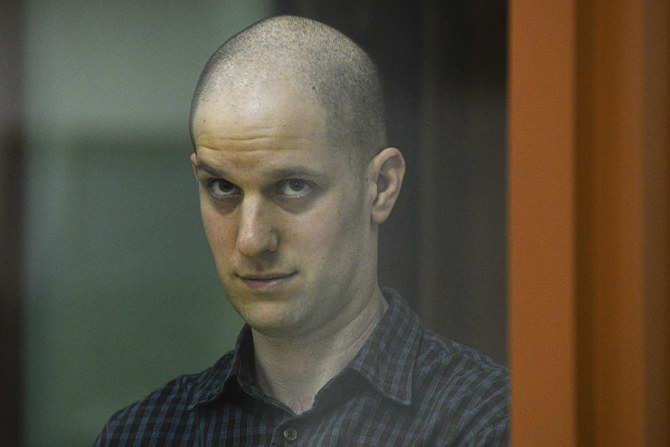
The 32-year-old journalist appeared in the court in a glass defendants’ cage, his head shaved and wearing a black-and-blue plaid shirt. A yellow padlock was attached to the cage.
Journalists were allowed into the courtroom for a few minutes before the proceedings were closed.
The American-born son of immigrants from the USSR, Gershkovich is the first Western journalist arrested on espionage charges in post-Soviet Russia. The Russian authorities arrested Gershkovich when he was on a reporting trip to Yekaterinburg and claimed he was gathering secret information for the US intelligence. The State Department has declared him “wrongfully detained,” thereby committing the government to assertively seek his release.
Jay Conti, executive vice president and general counsel for Dow Jones, in an interview with The Associated Press this week described the trial as a sham.
“He was an accredited journalist doing journalism, and this is a sham trial, bogus charges that are completely trumped up,” Conti said.
The Journal has worked diligently to keep the case in the public eye and it has become an issue in the combative months leading up to the US presidential election.
After his arrest on March 29, 2023, Gershkovich was held in Moscow’s notoriously dismal Lefortovo Prison. He has appeared healthy during court hearings in which his appeals for release have been rejected.
“Evan has displayed remarkable resilience and strength in the face of this grim situation,” US Ambassador Lynne Tracy said on the first anniversary of his arrest.
Gershkovich faces up to 20 years in prison if the court finds him guilty, which is almost certain. Russian courts convict more than 99 percent of the defendants who come before them, and prosecutors can appeal sentences that they regard as too lenient, and they even can appeal acquittals.
In addition, Russia’s interpretation of what constitutes espionage is broad. Igor Sutyagin, an arms control expert at a Russian Academy of Sciences think tank, was behind bars for espionage for 11 years for passing along material that he said was publicly available.
Paul Whelan, an American corporate security executive, was arrested in Moscow for espionage in 2018 and his serving a 16-year sentence.
Gershkovich’s arrest came about a year after President Vladimir Putin pushed through laws that chilled journalists, criminalizing criticism of what the Kremlin calls a “special military operation” in Ukraine and statements seen as discrediting the military. Foreign journalists largely left the country after the laws’ passage; many trickled back in subsequent months, but there were concerns about whether Russian authorities would act against them.
After he was detained, fears rose that Russia was targeting Americans as animosity between Moscow and Washington grew. Last year, Alsu Kurmasheva, a reporter with dual American-Russian citizenship for the US government-funded Radio Liberty/Radio Free Europe was arrested for alleged violation of the law requiring so-called “foreign agents” to register.
Another dual national, Los Angeles resident Ksenia Karelina, is on trial, also in Yekaterinburg, on treason charges for allegedly raising money for a Ukrainian organization that supplied arms and ammunition to Kyiv. Several Western reporters have been forced to leave after Gershkovich’s arrest because Russia refused to renew their visas.
With Gershkovich’s trial being closed, few details of his case may become public. But the Russian Prosecutor General’s office said this month that he is accused of “gathering secret information” on orders from the CIA about Uralvagonzavod, a plant about 150 kilometers (90 miles) north of Yekaterinburg that produces and repairs tanks and other military equipment.
Not only is Uralvagonzavod strategically sensitive, it’s also been a nest of vehement pro-Putin sentiment where an inquisitive American could offend and alarm. In 2011, a plant manager, Igor Kholmanskikh, attracted national attention on Putin’s annual call-in program by denouncing mass protests in Moscow at the time. Putin later appointed him as his regional envoy and as a member of the National Security Council.
“Evan Gershkovich is facing a false and baseless charge. ... The Russian regime’s smearing of Evan is repugnant, disgusting and based on calculated and transparent lies. Journalism is not a crime,” Journal publisher Almar Latour and chief editor Emma Tucker said in a statement after his trial date was announced.
“We had hoped to avoid this moment and now expect the US government to redouble efforts to get Evan released,” they said.
Russia has not ruled out a prisoner exchange involving Gershkovich but says that’s not possible before a verdict in his case. That could be months away, because Russian trials often adjourn for weeks. The post-verdict prospects are mixed.
Although Russia-US relations are highly troubled because of the conflict in Ukraine, the Kremlin and Washington did work out a swap in 2022 that freed WNBA star Brittney Griner, who was serving a 9 1/2-year sentence for cannabis possession.
But that exchange also freed the highest-value Russian prisoner in the United States, arms dealer Viktor Bout, and the US may not hold another card that strong. Putin has alluded to interest in freeing Vadim Krasikov, a Russian imprisoned in Germany for assassinating a Chechen rebel leader in Berlin, but Germany’s willingness to aid in a Russia-US dispute is uncertain.
The Biden administration would also be sensitive to appearing to be giving away too much after coming under substantial criticism in trading Bout, widely called “the Merchant of Death,” for a sports figure.
But Biden may feel an incentive to secure Gershkovich’s release because of boasts by former President Donald Trump, who is his main challenger in this year’s election, that he can easily get the journalist freed. Putin “will do that for me, but not for anyone else,” Trump claimed in May.
The Kremlin, however, says it has not been in touch with Trump, and Putin’s spokesman Dmitry Pekov bristled at the attention given to a possible exchange, saying “these contacts must be carried out in total secrecy.”


![]()

US journalist goes on trial for espionage in Russia, with a conviction all but certain
Short Url
https://arab.news/jdb7b
US journalist goes on trial for espionage in Russia, with a conviction all but certain
- The 32-year-old journalist appeared in the court in a glass defendants’ cage, his head shaved and wearing a black-and-blue plaid shirt
- The American-born son of immigrants from the USSR, Gershkovich is the first Western journalist arrested on espionage charges in post-Soviet Russia


Latest updates


© 2026 SAUDI RESEARCH & PUBLISHING COMPANY, All Rights Reserved And subject to Terms of Use Agreement.