

New report suggests Israeli military views some Gaza journalists as ‘legitimate targets’

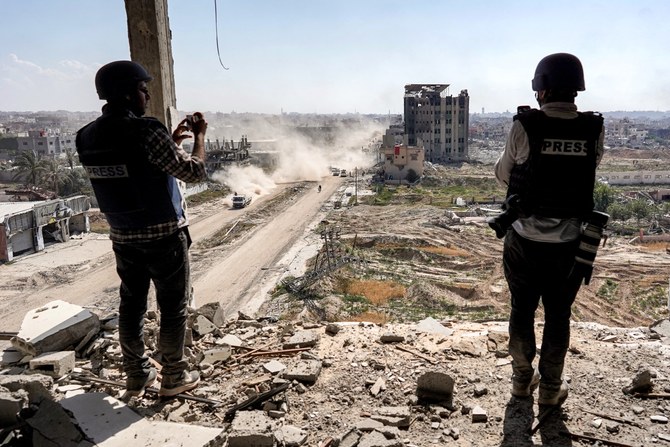
Media watchdogs reported that around 30 percent of the 108 media workers killed since Oct. 7 in Gaza were employed by outlets affiliated with or closely tied to Hamas. (AFP/File)
Short Url
Updated 25 June 2024
Follow

New report suggests Israeli military views some Gaza journalists as ‘legitimate targets’

  • The Guardian and non-profit Forbidden Stories allege that Israeli forces label journalists working for Hamas-controlled media as terrorists
  • Experts argue this approach is part of effort to silence critical reporting

LONDON: A new investigation has suggested that the Israeli military views some Gaza-based journalists as “legitimate targets.”

The Guardian, in collaboration with the Paris-based non-profit Forbidden Stories, revealed that some members of the armed forces consider journalists working for Hamas-controlled or affiliated outlets as legitimate targets not covered by the same international protections as civilians.

Media watchdogs Committee to Protect Journalists and Arab Reporters for Investigative Journalism reported that around 30 percent of the 108 media workers killed since Oct. 7 in Gaza were employed by outlets affiliated with or closely tied to Hamas.

This includes the largest Hamas-run outlet in Gaza, Al-Aqsa media network, which employs hundreds of people across its TV station, radio, and newspaper arms.

The report, authored by Harry Davies, Manisha Ganguly, David Pegg, Hoda Osman, Bethan McKernan, and award-winning Israeli journalist and film director Yuval Abraham, noted that while “Al-Aqsa’s programming is unmistakably pro-Hamas, anti-Israel and, at times, antisemitic … simply working (for the media outlet) does not make someone a legitimate target to be killed.”

Janina Dill, a professor at the University of Oxford and expert in the laws of war, said: “Reporting the news is not direct participation in hostilities.

“Even if they reported the news in a biased way, even if they did propaganda for Hamas, even if Israel fundamentally disagrees with how they report the news. That is not enough.”

Since 2019, Israel has designated Al-Aqsa network as a terrorist organization, calling it “a propaganda arm of Hamas and a central platform for the distribution of inciting messages by the terror organization.”

The media group has also been sanctioned by the US since 2010.

Its offices, evacuated after Hamas attacks on Oct. 7 to avoid Israeli retaliation, have been previously bombed by Israel over accusations of being used for military purposes.

The report detailed how Israeli soldiers were given a “permissive approach” to targeting, with Hamas-affiliated media being told they existed in a “grey zone” and that some in the Israeli military hold the view that “anyone getting paid by Hamas” could be considered a legitimate target.

“Hamas invests a lot of resources in its propaganda teams. They often won’t do an activity if they don’t have a photographer. They must document everything,” an unnamed military intelligence officer said. “So some will tell you: ‘Look, a Hamasnik is Hamasnik.’”

An Israeli military spokesperson denied the report’s accusations, stating that while it “does not target civilian objects,” the outlet “employs terrorists and affords them the facade of journalists.”

The spokesperson claimed that the Israeli military killed six Al-Aqsa workers who were alleged members of Hamas’s armed wing but did not provide evidence to support the claim.

Experts warned that this approach puts Israel in a “troubling position” as it is often difficult to distinguish between combatants and civilians.

Many press freedom organizations expressed concerns about the military’s efforts to silence critical reporting.

Irene Khan, the UN’s special rapporteur on the promotion and protection of the right to freedom of opinion and expression, stated that Israel had “spread disinformation about journalists being linked to militants” and failed to meet the “burden of proof” to make such claims.


Iceland joins Eurovision boycott over Israel’s participation

Updated 10 December 2025
Follow

Iceland joins Eurovision boycott over Israel’s participation

  • Decision follows similar moves by Spain, the Netherlands, Ireland and Slovenia over the Gaza war
  • Iceland’s national broadcaster says it pulled out 'given the public debate' in the country

LONDON: Iceland’s national broadcaster said Wednesday it will boycott next year’s Eurovision Song Contest because of discord over Israel’s participation, joining four other countries in a walkout of the pan-continental music competition.
Broadcasters in Spain, the Netherlands, Ireland and Slovenia told contest organizer the European Broadcasting Union last week that they will not take part in the contest in Vienna in May after organizers declined to expel Israel over its conduct of the war against Hamas in Gaza.
The board of Iceland’s RÚV met Wednesday to make a decision.
At its conclusion the broadcaster said in a statement that “given the public debate in this country ... it is clear that neither joy nor peace will prevail regarding the participation of RÚV in Eurovision. It is therefore the conclusion of RÚV to notify the EBU today that RÚV will not take part in Eurovision next year.”
“The Song Contest and Eurovision have always had the aim of uniting the Icelandic nation but it is now clear that this aim cannot be achieved and it is on these program-related grounds that this decision is taken,” the broadcaster said.
Last week the general assembly of the EBU — a group of public broadcasters from 56 countries that runs Eurovision — met to discuss concerns about Israel’s participation. Members voted to adopt tougher contest voting rules in response to allegations that Israel manipulated the vote in favor of its competitor, but took no action to exclude any broadcaster from the competition.
The pullouts include some big names in the Eurovision world. Spain is one of the “Big Five” large-market countries that contribute the most to the contest. Ireland has won seven times, a record it shares with Sweden.
Iceland, a volcanic North Atlantic island nation with a population of 360,000, has never won but has the highest per capita viewing audience of any country.
The walkouts cast a cloud over the future of what’s meant to be a feel-good cultural party marked by friendly rivalry and disco beats, dealing a blow to fans, broadcasters and the contest’s finances.
The contest, which turns 70 in 2026, strives to put pop before politics, but has repeatedly been embroiled in world events. Russia was expelled in 2022 after its full-scale invasion of Ukraine.
It has been roiled by the war in Gaza for the past two years, stirring protests outside the venues and forcing organizers to clamp down on political flag-waving.
Opponents of Israel’s participation cite the war in Gaza, where more than 70,000 Palestinians have been killed, according to the territory’s Health Ministry, which operates under the Hamas-run government and whose detailed records are viewed as generally reliable by the international community.
Israel’s government has repeatedly defended its campaign as a response to the attack by Hamas-led militants on Oct. 7, 2023. The militants killed around 1,200 people — mostly civilians — in the attack and took 251 hostage.
A number of experts, including those commissioned by a UN body, have said that Israel’s offensive in Gaza amounts to genocide, a claim Israel has vigorously denied.
Wednesday marked the final day for national broadcasters to announce whether they planned to participate. More than two dozen countries have confirmed they will attend the contest in Vienna, and the EBU says a final list of competing nations will be published before Christmas.