

Azm-e-Istehkam not a ‘large-scale military operation,’ clarifies PM Sharif amid growing criticism

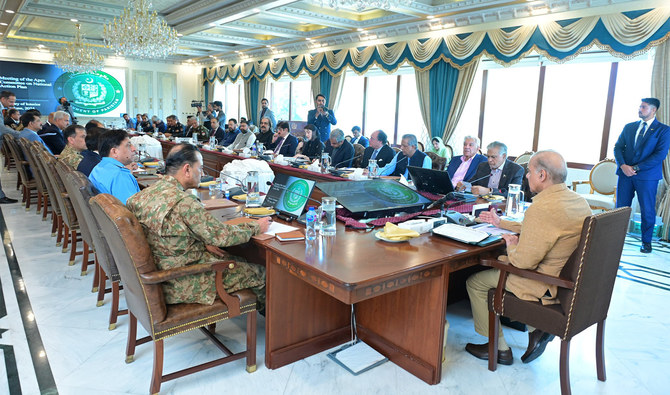
Prime Minister Muhammad Shehbaz Sharif (right) chairs a meeting of Central Apex Committee of National Action Plan in Islamabad, Pakistan on June 22, 2024. (Government of Pakistan)
Short Url
Updated 25 June 2024
Follow

Azm-e-Istehkam not a ‘large-scale military operation,’ clarifies PM Sharif amid growing criticism

  • PM Sharif says new military operation to instill new spirit and drive in implementation of National Action Plan
  • Calls on stakeholders to appreciate “positive step,” demands end to “unnecessary debate” over the issue 

ISLAMABAD: Prime Minister Shehbaz Sharif this week clarified that the government’s new anti-terrorism operation will not be a large-scale military operation that would cause people to be displaced, amid growing opposition by Pakistani political parties who accuse authorities of not taking them into confidence on the matter. 

Pakistan’s top national security forum on Saturday announced the Operation Azm-e-Istehkam, or Resolve for Stability, campaign after a meeting of the Central Apex Committee on the National Action Plan (NAP) that was attended by senior military leaders and top government officials from all provinces, including the PTI-backed Khyber Pakhtunkhwa Chief Minister Ali Amin Gandapur.

However, the PTI and Jamiat Ulama-e-Islam-Fazl (JUI-F), two key political parties in the militancy-hit Khyber Pakhtunkhwa (KP) province, have rejected the military operation. Leaders of both parties have called on the government to take lawmakers into confidence about the new operation. 

In a statement released by his office on Monday night, Sharif said Operation Azm-e-Istehkam is being “misunderstood” and compared to previous military operations such as Operation Zarb-e-Azb and Operation Rah-e-Nijat. He said militants in these operations were killed for creating “no-go areas” in the country and for challenging the writ of the state, adding that they caused massive displacement of the population. 

“There are currently no such no-go areas in the country as the ability of terrorist organizations to carry out large-scale organized operations inside Pakistan has been decisively defeated by past armed operations,” Sharif was quoted as saying. 

“Therefore, no large-scale military operation which would require population displacement is being contemplated,” he added. 

The statement clarified that Operation Azm-e-Istekam is a multi-domain, multi-agency and national vision to bring about sustainable peace and stability in the country. 

“Its objective is to instill a new spirit and drive in the ongoing implementation of the revised National Action Plan, which was launched after a national consensus in the political arena,” the statement added. 

The PMO said the operation would mobilize military operations that have already been launched against militants and aim to eliminate them out of the country for good. It said this would ensure a secure environment for the country’s economic progress and prosperity. 

Sharif said everyone should welcome this “positive step” by the government, saying it had been taken with collective wisdom and after forming a political consensus among various stakeholders. He called for putting an end to “unnecessary debate” on the issue. 

Speaking to a private news channel on Sunday, Defense Minister Khawaja Asif said a consensus was reached on the new military operation between all stakeholders during the apex committee’s meeting last week. He said the decision to launch Operation Azm-e-Istehkam had not been “finalized.”

“It will go through the process,” Asif said. “It will go to the cabinet [for approval] then it will be presented in the house and the house will be briefed on it.”

Pakistan has witnessed a surge in militant attacks in recent months, many of them claimed by the Tehreek-e-Taliban Pakistan (TTP), which pledges allegiance to, and gets its name from, the Afghan Taliban, but is not directly a part of the group that now rules Afghanistan. Its stated aim is to impose Islamic religious law in Pakistan, as the Taliban have done in Afghanistan.

Islamabad blames the recent uptick in attacks on Afghanistan, saying TTP leaders have taken refuge there and run camps to train militants to launch attacks inside Pakistan. Kabul says rising violence in Pakistan is a domestic issue for Islamabad and it does not allow militants to operate on its territory.


Pakistan transporters call off five-day strike after successful talks with Punjab government

Updated 5 sec ago
Follow

Pakistan transporters call off five-day strike after successful talks with Punjab government

  • Transporters went on strike against heavy fines, penalties imposed by Punjab over traffic violations
  • Punjab government sets up committee to resolve transporters issues, confirms provincial minister

ISLAMABAD: Pakistani goods transporters called off their five-day-long nationwide strike on Friday after successful talks with the Punjab government, officials and transporters confirmed, as the business community warned of an impending economic crisis if the dispute stayed unresolved. 

Transporters went on a nationwide strike on Dec. 8 against stringent traffic rules and heavy fines imposed by the Punjab government over traffic violations. These penalties were included in the Motor Vehicle Ordinance 2025 last month. 

The ordinance details hefty fines ranging from Rs2000 [$7] to Rs50,000 [$178] and mentions prison sentences going up to six months for various offenses committed by drivers, such as driving on the wrong side of the road or driving in vehicles with tinted windows. 

“Yes, the strike has been called off after our meeting with Senior Minister of Punjab Marriyum Aurangzeb,” Nabeel Tariq, president of the All Pakistan Goods Transport Association (APGTA), told Arab News. 

Tariq said fines ranging from Rs1000 ($3.6) to Rs1500 ($5.4) for traffic violations have been increased to around Rs20,000 ($71.3) as per the new rules. 

He said the APGTA has agreed to accept a 100 percent or even 200 percent hike in fines. However, he said an increase of 2000 percent was not “logical.”

“Our urgent demands have been accepted and a committee has been formed to review the ordinance and come up with recommendations,” Tariq said. 

Speaking to Arab News, Aurangzeb confirmed the strike had been called off after talks with the Punjab government and that a committee has been formed to resolve the transporters’ issues. 

The committee will be headed by Aurangzeb and will include representatives of goods transporters, a statement issued by her office said. 

“The government wants to protect human lives and make things better for all citizens,” the statement said. “We will resolve the issues (with transporters) amicably.” 

‘UNPRECEDENTED CRISIS’

Pakistan’s business and industrial community, meanwhile, warned of an impending crisis if the disputed was not resolved. 

The All Pakistan Textile Mills Association (APTMA) and the Karachi Chamber of Commerce and Industry (KCCI) have both appealed for immediate government intervention.

Imdad Hussain Naqvi, president of the Grand Transport Alliance Pakistan (GTAP), told Arab News that over 400,000 goods carriers had been stranded across Pakistan due to the strike, affecting supplies to millions of consumers.

Earlier, in a letter to Punjab Chief Minister Maryam Nawaz, APTMA Chairman Kamran Arshad said the strike has “critically impacted import and export operations which are backbone of the country’s economy.”

He said hundreds of cargo vehicles remain stranded across Punjab, creating “abnormal delays” in goods movement and triggering heavy demurrage, detention charges, missed vessels and production shutdowns due to the non-availability of raw materials.

Arshad warned the disruption poses “a serious risk of order cancelation of export orders by international buyers, which would have far-reaching consequences for Pakistan’s foreign exchange earnings.”

Meanwhile in Pakistan’s commercial hub Karachi, KCCI President Rehan Hanif issued an even stronger warning, saying the nationwide strike threatens to paralyze Pakistan’s economic lifeline. 

“The complete suspension of cargo movement is pushing Pakistan toward an unprecedented trade and industrial crisis,” Hanif said in a statement. 

He added that import and export consignments are now stranded at the city’s ports, highways and industrial zones.