EU sanctions 19 Chinese firms over links to Russian war effort

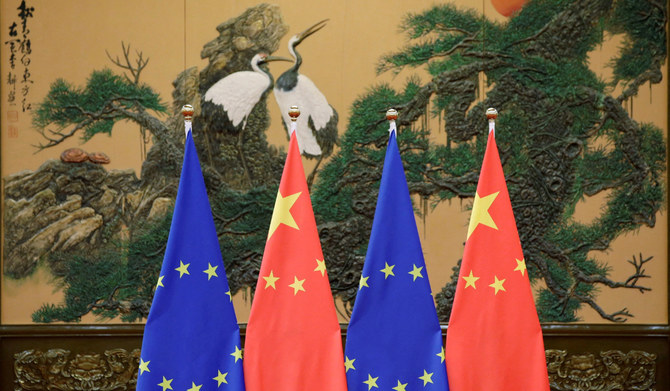
Flags of European Union and China are pictured during the China-EU summit at the Great Hall of the People in Beijing, China, July 12, 2016. (REUTERS)
Short Url
Updated 25 June 2024
Follow

EU sanctions 19 Chinese firms over links to Russian war effort

  • These companies are now subject to drastic restrictions over sales of “dual-use goods and technology” that could be used for the “enhancement of Russia’s defense and security sector”

BRUSSELS, Belgium: The European Union Monday imposed sanctions on 19 Chinese companies aimed at punishing what the West believes is Beijing’s support for Russia’s war in Ukraine.
A list published in the EU’s Official Journal includes several companies located in Hong Kong as well as two global satellite giants.
The 14th package of sanctions against Russia added 61 new companies to the list of entities accused of directly “supporting Russia’s military-industrial complex” in the war in Ukraine, bringing the total to 675 firms.
These companies are now subject to drastic restrictions over sales of “dual-use goods and technology” that could be used for the “enhancement of Russia’s defense and security sector.”
China denies Western accusations that it is supporting Russia’s military campaign.
Among the newly added companies are two major players in the Chinese satellite industry involved in the sale of satellites and satellite imagery to Russia’s Wagner mercenary group.
In October, an AFP investigation revealed that Wagner in 2022 signed a contract worth more than $30 million with Chinese firm Beijing Yunze Technology Co. Ltd. to acquire two satellites and use their images.
The contract was signed in November 2022, over half a year into Moscow’s invasion of Ukraine in which the Wagner group under its founder Yevgeny Prigozhin was playing a key role on the battlefield.
The two high-resolution satellites belonged to Chang Guang Satellite Technology, a leading global satellite company which was the unit to be added to the EU’s sanctions list.
Another company named Monday was Head Aerospace Technology, which sells satellite images and was placed on a US sanctions list in 2023 for supplying the Wagner Group.
Even if China does not deliver weapons directly to Russia, the United States and Europe accuse it of selling components and equipment to Moscow’s military industry.
Chinese foreign ministry spokesman Lin Jian has dismissed the claims as “false information.”
Russian-based companies make up about half of the 61 entities added to the EU’s list Monday.
In addition to the 19 Chinese companies, it also added nine from Turkiye, two in Kyrgyzstan, one in India, one in Kazakhstan, and one in the United Arab Emirates.


No sign Iran’s nuclear sites were hit, IAEA says, but Iran alleges one was

Updated 11 sec ago
Follow

No sign Iran’s nuclear sites were hit, IAEA says, but Iran alleges one was

VIENNA: The UN nuclear watchdog has no indication Israeli and US attacks on Iran have ​hit any nuclear facilities, its chief Rafael Grossi told the agency’s Board of Governors on Monday, moments before Iran’s envoy said one was targeted a day earlier.
Iran’s nuclear program has been among the reasons Israel and the US have given for the attacks, alleging Iran was getting too close to being ‌able to ‌eventually make an atom bomb.
At ​the ‌same ⁠time, ​what remains ⁠of Iran’s atomic facilities after the two militaries attacked them in June appears to have been largely spared in this campaign so far.
“We have no indication that any of the nuclear installations ... have been damaged or hit,” International Atomic Energy Agency chief Rafael Grossi ⁠said in a statement to a ‌meeting of his agency’s 35-nation ‌Board of Governors.
What that assessment ​was based on is ‌unclear, since he also said his agency had not ‌been able to reach its counterparts in Iran. Tehran has not let the IAEA return to its bombed facilities since they were attacked in June.
“Efforts to contact the Iranian ‌nuclear regulatory authorities ... continue, with no response so far. We hope this indispensable channel ⁠of communication ⁠can be re-established as soon as possible,” he said.
Moments later, Iran’s ambassador to the IAEA, Reza Najafi, told reporters outside the closed-door meeting that the sprawling nuclear complex at Natanz had been attacked.
Natanz housed two uranium-enrichment plants that were attacked in June — an above-ground one that the IAEA says was destroyed and an underground one that was at least badly damaged, among other facilities.
“Again they attacked Iran’s peaceful, safeguarded ​nuclear facilities yesterday,” Najafi ​said. Asked by Reuters which facilities were hit, he replied: “Natanz” and left.