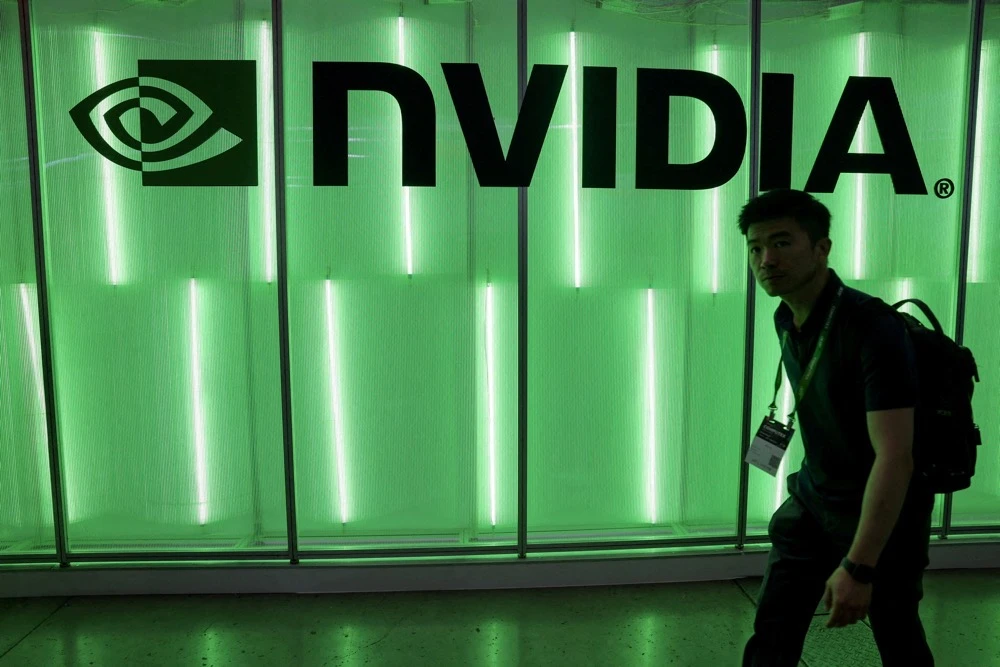
TORONTO, Canada: For a few days, AI chip juggernaut Nvidia sat on the throne as the world’s biggest company, but behind the its staggering success are questions on whether new entrants can stake a claim to the artificial intelligence bonanza.
Nvidia, which makes the processors that are the only option to train generative AI’s large language models, is now Big Tech’s newest member and its stock market takeoff has lifted the whole sector.
Even tech’s second rung on Wall Street has ridden on Nvidia’s coattails with Oracle, Broadcom, HP and a spate of others seeing their stock valuations surge, despite sometimes shaky earnings.
Amid the champagne popping, startups seeking the attention of Silicon Valley venture capitalists are being asked to innovate — but without a clear indication of where the next chapter of AI will be written.
When it comes to generative AI, doubts persist on what exactly will be left for companies that are not existing model makers, a field dominated by Microsoft-backed OpenAI, Google and Anthropic.
Most agree that competing with them head-on could be a fool’s errand.
“I don’t think that there’s a great opportunity to start a foundational AI company at this point in time,” said Mike Myer, founder and CEO of tech firm Quiq, at the Collision technology conference in Toronto.
Some have tried to build applications that use or mimic the powers of the existing big models, but this is being slapped down by Silicon Valley’s biggest players.
“What I find disturbing is that people are not differentiating between those applications which are roadkill for the models as they progress in their capabilities, and those that are really adding value and will be here 10 years from now,” said venture capital veteran Vinod Khosla.
The tough-talking Khosla is one of OpenAI’s earliest investors.
“Grammarly won’t keep up,” Khosla predicted of the spelling and grammar checking app, and others similar to it.
He said these companies, which put only a “thin wrapper” around what the AI models can offer, are doomed.
One of the fields ripe for the taking is chip design, Khosla said, with AI demanding ever more specialized processors that provide highly specific powers.
“If you look across the chip history, we really have for the most part focused on more general chips,” Rebecca Parsons, CTO at tech consultancy Thoughtworks, told AFP.
Providing more specialized processing for the many demands of AI is an opportunity seized by Groq, a hot startup that has built chips for the deployment of AI as opposed to its training, or inference — the specialty of Nvidia’s world-dominating GPUs.
Groq CEO Jonathan Ross told AFP that Nvidia won’t be the best at everything, even if they are uncontested for generative AI training.
“Nvidia and (its CEO) Jensen Huang are like Michael Jordan... the greatest of all time in basketball. But inference is baseball, and we try and forget the time where Michael Jordan tried to play baseball and wasn’t very good at it,” he said.
Another opportunity will come from highly specialized AI that will provide expertise and know-how based on proprietary data which won’t be co-opted by voracious big tech.
“Open AI and Google aren’t going to build a structural engineer. They’re not going to build products like a primary care doctor or a mental health therapist,” said Khosla.
Profiting from highly specialized data is the basis of Cohere, another of Silicon Valley’s hottest startups that pitches specifically-made models to businesses that are skittish about AI veering out of their control.
“Enterprises are skeptical of technology, and they’re risk-averse, and so we need to win their trust and to prove to them that there’s a way to adopt this technology that’s reliable, trustworthy and secure,” Cohere CEO Aidan Gomez told AFP.
When he was just 20 and working at Google, Gomez co-authored the seminal paper “Attention Is All You Need,” which introduced Transformer, the architecture behind popular large language models like OpenAI’s GPT-4.
The company has received funding from Nvidia and Salesforce Ventures and is valued in the billions of dollars.
Beyond Nvidia: the search for AI’s next breakthrough
https://arab.news/23vff
Beyond Nvidia: the search for AI’s next breakthrough

Egypt reveals restored colossal statues of pharaoh in Luxor
- Amenhotep III, one of the most prominent pharaohs, ruled during the 500 years of the New Kingdom, which was the most prosperous time for ancient Egypt
LUXOR: Egypt on Sunday revealed the revamp of two colossal statues of a prominent pharaoh in the southern city of Luxor, the latest in the government’s archeological events that aim at drawing more tourists to the country.
The giant alabaster statues, known as the Colossi of Memnon, were reassembled in a renovation project that lasted about two decades. They represent Amenhotep III, who ruled ancient Egypt about 3,400 years ago.
“Today we are celebrating, actually, the finishing and the erecting of these two colossal statues,” Mohamed Ismail, secretary-general of the Supreme Council of Antiquities, said ahead of the ceremony.
Ismail said the colossi are of great significance to Luxor, a city known for its ancient temples and other antiquities. They’re also an attempt to “revive how this funerary temple of King Amenhotep III looked like a long time ago,” Ismail said.
Amenhotep III, one of the most prominent pharaohs, ruled during the 500 years of the New Kingdom, which was the most prosperous time for ancient Egypt. The pharaoh, whose mummy is showcased at a Cairo museum, ruled between 1390–1353 BC, a peaceful period known for its prosperity and great construction, including his mortuary temple, where the Colossi of Memnon are located, and another temple, Soleb,
in Nubia.
The colossi were toppled by a strong earthquake in about 1200 BC that also destroyed Amenhotep III’s funerary temple, said Ismail.
They were fragmented and partly quarried away, with their pedestals dispersed. Some of their blocks were reused in the Karnak temple, but archeologists brought them back to rebuild the colossi, according to the Antiquities Ministry.
In late 1990s, an Egyptian German mission, chaired by German Egyptologist Hourig Sourouzian, began working in the temple area, including the assembly and renovation of
the colossi.
“This project has in mind … to save the last remains of a once-prestigious temple,” she said.
The statues show Amenhotep III seated with hands resting on his thighs, with their faces looking eastward toward the Nile and the rising sun. They wear the nemes headdress surmounted by the double crowns and the pleated royal kilt, which symbolizes the pharaoh’s rule.
Two other small statues on the pharaoh’s feet depict his
wife, Tiye.
The colossi — 14.5 meters and 13.6 meters respectively — preside over the entrance of the king’s temple on the western bank of the Nile. The 35-hectare complex is believed to be the largest and richest temple in Egypt and is usually compared to the temple of Karnak, also
in Luxor.
The colossi were hewn in Egyptian alabaster from the quarries of Hatnub, in Middle Egypt. They were fixed on large pedestals with inscriptions showing the name of the temple, as well as the quarry.
Unlike other monumental sculptures of ancient Egypt, the colossi were partly compiled with pieces sculpted separately, which were fixed into each statue’s main monolithic alabaster core, the ministry said.
Sunday’s unveiling in Luxor came just six weeks after the inauguration of the long-delayed Grand Egyptian Museum, the centerpiece of the government’s bid to boost the country’s tourism industry. The mega project is located near the famed Giza Pyramids and the Sphinx.
In recent years, the sector has started to recover after the coronavirus pandemic and amid Russia’s war on Ukraine — both countries are major sources of tourists visiting Egypt.
“This site is going to be a point of interest for years to come,” said Tourism and Antiquities Minister Sherif Fathy, who attended the unveiling ceremony. “There are always new things happening in Luxor.”
A record number of about 15.7 million tourists visited Egypt in 2024, contributing about 8 percent of the country’s GDP, according to official figures.
Fathy, the minister, has said about 18 million tourists are expected to visit the country this year, with authorities hoping for 30 million visitors annually by 2032.