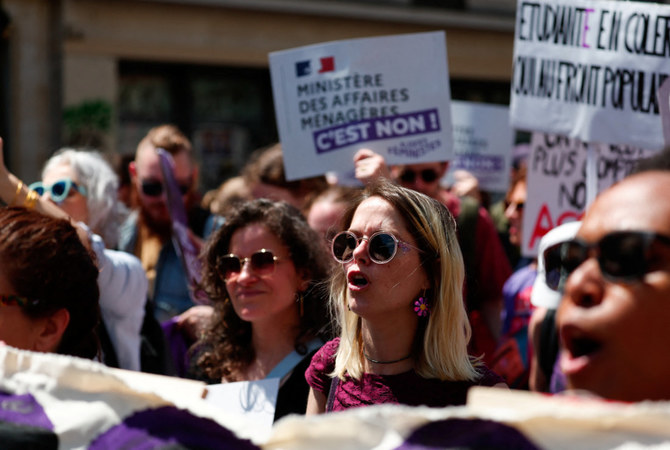
PARIS: Thousands of people turned out in France on Sunday for feminist demonstrations against the far right, which is expected to come out on top in June 30 snap elections, as parties sought to shore up support with days to go.
With the far-right National Rally (RN) polling at around 35 percent, “we have to remind people that they’re the ones who talked about ‘comfort abortions’, who are always attacking family planning services,” said Morgane Legras, a nuclear engineer and feminist activist taking part in the Paris march.
There were between 13,000 (police estimate) and 75,000 (organizers’ estimate) people at Sunday’s demonstration.
Protesters, many wearing violet, marched from the Place de la Republique square in central Paris to Place de la Nation in the east, bearing signs with messages such as “Push back the far right, not our rights.”
Police sources said 53 rallies took place across the country, and said 33,800 people had taken part.
France’s two-round election system makes it difficult to predict which party could ultimately claim a majority in the lower house of parliament, handing them the prime minister’s post which is second in power only to President Emmanuel Macron.
Since Macron dissolved parliament after a European Parliament election battering, his centrists are badly lagging the RN as well as a reforged left-wing alliance called the New Popular Front (NFP) in surveys of voting intentions.
The RN has garnered unprecedented levels of support after a decades-long “de-demonization” push to distance its image from its roots, including a co-founder who was a member of the Nazi Waffen-SS paramilitary.
But the core of its message remains hostility to immigration, Islam and the European Union.
Senior RN lawmaker Sebastien Chenu gestured toward Muslim and Jewish voters Sunday by vowing not to ban the ritual slaughter of livestock to produce halal or kosher meat.
“Everyone will be able to keep eating kosher meat if they want,” Chenu told Jewish broadcaster Radio J.
He added that a historic far-right policy of barring the kippa in public spaces — in the footsteps of an existing law forbidding the full-body burka worn by some Muslim women — was not top of the RN’s agenda, saying its priority was to fight “the Islamist threat.”
In Macron’s camp, Prime Minister Gabriel Attal acknowledged that the European Parliament result — where they scored just 14 percent — was “a message to us that we have to do better with our methods, with our governance” of the country.
If his party defies the odds to come top in the legislative polls, he vowed “change,” including a turn to “seeking out coalitions with the French public, with civil society” in an interview with broadcaster RTL.
Macron’s alliance would open up to “all who want to come, from the conservative right to the social-democratic left,” Macron’s former prime minister Edouard Philippe told broadcaster France 3.
Attal also hammered the centrists’ mantra about the threats from “extremes” on the left and right, saying both promised a “tax bludgeoning... a shredder for the middle classes.”
The RN especially is “not ready to govern... it’s a party of opposition, not a party of government,” Attal said.
In a sign of the disquiet abroad over Macron’s snap poll gamble, German Chancellor Olaf Scholz told public broadcaster ARD on Sunday he was “concerned about the elections in France,” though “it’s up to the French people to decide.”
The left-wing NFP alliance continued to show strains Sunday, after parties hastily re-knitted ties sundered over differing responses to Hamas’s October 7 attack on Israel and the ongoing retaliation by Israeli forces in Gaza.
Divisions are particularly stark over whether their candidate for prime minister should be Jean-Luc Melenchon, head of France Unbowed (LFI) — the largest party in the grouping, some of whose members have been accused of anti-Semitism.
Melenchon should “shut up,” former Socialist president Francois Hollande said Sunday, as “people reject him more strongly” than the RN’s leaders Marine Le Pen and Jordan Bardella.
“Do we want the left to win, or do we want to be stoking conflict?” he said.
Melenchon said on Saturday that he aimed “to govern the country.”


![]()

French feminists march against far right with days before vote
Short Url
https://arab.news/cz6a5
French feminists march against far right with days before vote
- Macron’s alliance would open up to “all who want to come, from the conservative right to the social-democratic left,” Macron’s former prime minister Edouard Philippe told broadcaster France 3


Latest updates





© 2026 SAUDI RESEARCH & PUBLISHING COMPANY, All Rights Reserved And subject to Terms of Use Agreement.