Gunmen kill 15 police officers, priest and multiple civilians in Russia’s southern Dagestan region

1 / 4
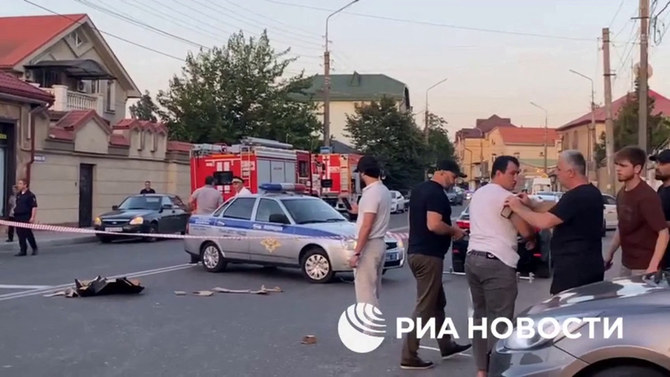
This screengrab picture taken from video released on June 23, 2024 by Russian state news agency RIA Novosti shows an area sealed off by police following deadly attacks on churches and a synagogue in Russia's North Caucasus region of Dagestan. (RIA Novosti via AFP)
2 / 4
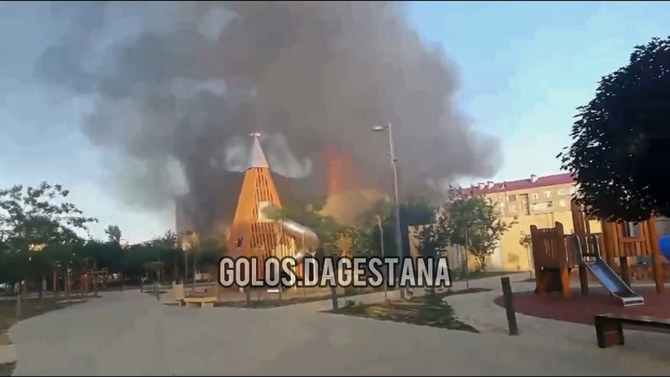
This photo taken from video released by Golos Dagestana shows smoke rises following an attack in Makhachkala, republic of Dagestan, Russia, on June 23, 2024. (Golos Dagestana via AP)
3 / 4
This screengrab picture taken from video released on June 23, 2024 by Russian state news agency RIA Novosti shows an area sealed off by police following deadly attacks on churches and a synagogue in Russia's North Caucasus region of Dagestan. (RIA Novosti via AFP)
4 / 4
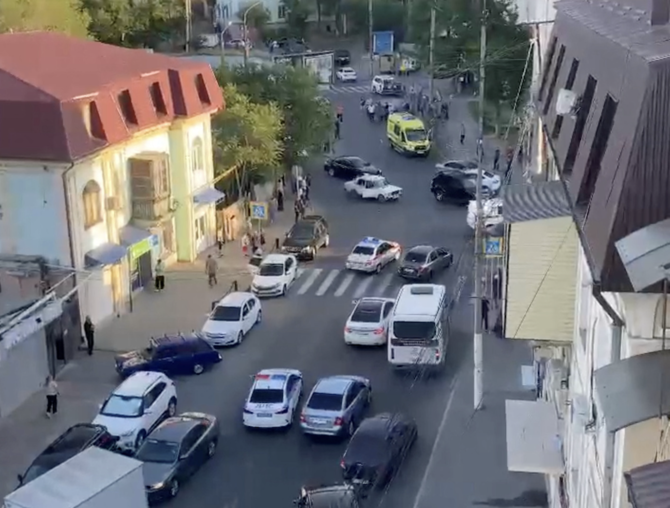
A view shows emergency service vehicles on the street of Makhachkala in southern Russia, June 23, 2024, in this still image obtained from a video. (Reuters) 
Short Url
Updated 24 June 2024
Follow

Gunmen kill 15 police officers, priest and multiple civilians in Russia’s southern Dagestan region

  • Gunmen targetted two Orthodox churches, a synagogue and a police post in two cities
  • Six of the gunmen were shot and killed as the incidents unfolded, says governor

MOSCOW: Gunmen opened fire at a synagogue, an Orthodox church and a police post in attacks across two cities in Russia’s North Caucasus region of Dagestan on Sunday, killing an Orthodox priest and multiple police officers, the region’s head said.
“This is a day of tragedy for Dagestan and the whole country,” Sergei Melikov, governor of the Dagestan region, said in a video published early on Monday on the Telegram messaging app.
Melikov said that more than 15 police officers “fell victim” to what he said was a “terrorist attack,“” but he did not specify how many of the police were killed and how many were injured. Russia’s Interfax agency reported that at least 15 police officers were killed.
The simultaneous attacks across the cities of Makhachkala and Derbent came three months after 145 people were killed in an attack claimed by the Daesh (Islamic State) on a concert hall near Moscow, Russia’s worst terrorist attack in years.
There was no immediate claim of responsibility for the attacks in the volatile North Caucasus region.
“We understand who is behind the organization of the terrorist attacks and what goal they pursued,” Melikov said, without disclosing further details.

Six of the gunmen were shot and killed as the incidents unfolded, Melikov said. Russian state news agencies cited the National Anti-Terrorist Committee as saying that five of the gunmen had been killed.

Russia’s state media cited law enforcement as saying that among the attackers had been two sons of the head of central Dagestan’s Sergokala district, who had been detained by investigators.
Melikov said that among the dead, in addition to the police officers, were several civilians, including an Orthodox priest who worked in Derbent for more than 40 years. A spokesman for the Russian Orthodox Church said on Telegram that the priest, Nikolai Kotelnikov, was “brutally murdered.”
Dagestan’s RGVK broadcaster said Kotelnikov had served more than 40 years in Derbent.
“The synagogue in Derbent is on fire,” the chairman of the public council of Russia’s Federation of Jewish Communities, Boruch Gorin wrote on Telegram.
“It has not been possible to extinguish the fire. Two are killed: a policeman and a security guard.”
He added: “The synagogue in Makhachkala has also been set on fire and burnt down.”

Days of mourning
June 24-26 have been declared days of mourning in Dagestan, Melikov said, with flags lowered to half-staff and all entertainment events canceled.
The restive region was in the 2000s hit by an Islamist insurgency spilling over from neighboring Chechnya, with Russian security forces moving aggressively to combat extremists in the region.
In recent years, attacks had become rarer, with Russia’s Federal Security Service (FSB) saying in 2017 that it had defeated the insurgency in the region.
The agencies reported exchanges of gunfire in the center of Makhachkala. They cited the interior ministry as saying that exits from the Caspian Sea port of around 600,000 had been closed, and that conspirators who were still at large may yet attempt to flee the city.
About 125 km (75 miles) south of Makhachkala, gunmen attacked a synagogue and a church in Derbent, home to an ancient Jewish community and a UNESCO World Heritage site. Authorities were quoted as saying that both the synagogue and church were ablaze, and that two attackers had been killed.
Russian media cited the head of the country’s federation of Jewish communities as calling for people to avoid reacting to “provocations.”
In Israel, the Foreign Ministry said the synagogue in Derbent had been burned to the ground and shots had been fired at a second synagogue in Makhachkala. The statement said it was believed there were no worshippers in the synagogue at the time.
Russian authorities have pointed to militant Muslim elements in previous incidents in the region.
In October, after the war in Gaza broke out, rioters waving Palestinian flags broke down glass doors and rampaged through Makhachkala airport to look for Jewish passengers on a flight arriving from Tel Aviv.
Russian President Vladimir Putin accused the West and Ukraine of stirring up unrest inside Russia in connection with the incident.

Russia’s FSB security service in April said it had arrested four people in Dagestan on suspicion of plotting a deadly attack on Moscow’s Crocus City Hall concert venue in March, which was claimed by Daesh.
Militants from Dagestan are known to have traveled to join the Daesh group in Syria.
In 2015, the group declared it had established a “franchise” in the North Caucasus.
Dagestan lies east of Chechnya where Russian authorities battled separatists in two brutal wars, first in 1994-1996 and then in 1999-2000.
After the defeat of Chechen insurgents, Russian authorities have been locked in a simmering conflict with militants from across the North Caucasus that has killed scores of civilians and police.


Guinea’s tough new migration route for desperate young west Africans

Updated 1 sec ago
Follow

Guinea’s tough new migration route for desperate young west Africans

CONAKRY: With a determined look on her weathered face, Safiatou Bah has made up her mind: she will leave her young children behind and migrate to Europe on a new and perilous ocean route from Guinea.
Thousands of young Guineans have attempted to migrate via the Atlantic in recent years, a flow so severe that authorities in the junta-led country have dubbed it a “haemorrhage.”
Lacking both economic opportunity and any hope of change, the migrants are leaving from their own shores after neighboring Senegal and Mauritania and Morocco further north, beefed up controls.
However the longer voyage which begins farther south only increases the number of dangers they will face.
Most west Africans traveling the Atlantic route embark in pirogue canoes toward Spain’s Canary Islands off northwest Africa, the jumping off point for their continued journey to the European continent.
At least eight boats have left Guinea since the spring, each carrying more than a hundred people, according to migration NGOs.
Bah, 33, initially left her village for the capital Conakry where she tried to do NGO work that didn’t pan out. In the end, she started a fruit stand to make money to migrate.
Her husband, whom she was married off to at age 18, is now 75 and can no longer provide for the family.
“I’m the one raising my children alone,” Bah told AFP.
Her decision to leave her three children, age 11 to six months, with her mother is firm: “I’m suffering here. You struggle and there’s no one to support you,” she said.

- New route -

Due to increasingly restrictive visa policies in Europe, migrants say their only option is illegal migration.
The Spanish NGO Caminando Fronteras, which monitors migration, confirmed the existence of the new Guinean route to AFP as well as the significant number of people taking it.
Guineans are now the leading African nationality — and the third largest group after Afghans and Ukrainians — to apply for asylum in France, the country’s former colonial ruler.
In 2024 a total of 11,336 asylum applications were made, according to France’s refugee agency OFPRA.
Mamadou Saitiou Barry, managing director of the Directorate General for Guineans Living Abroad, confirmed that “several thousand” Guineans embark on the journey each year.
“We are aware of this, because it is us who lose our sons and these young people,” he said.
Meanwhile Guinea has increased policing measures in an attempt to staunch the outward flow.
Elhadj Mohamed Diallo, director of the Guinean Organization for the Fight Against Irregular Migration (OGLMI), deals with these young people on a daily basis.
“When you tell them that the route is dangerous, most reply: ‘Where we are, we are actually already dead,’” he said, adding that they believe it is better to try.
Even among those with an education, finding a job can be an impossible task.

- Scarring journey -

Abdourahim Diallo, a young father of two, cannot find work and has lost all hope in his country, much like Bah.
AFP met him at a gathering of dozens of young people in Conakry’s Yattaya T6 suburb, in an unelectrified shack being used as a cafe.
“Here we have more than 150 young people and none of them has a job,” Ibrahima Balde, head of a neighborhood young people’s association, told AFP.
Diallo, who said he has “a lot of family who are counting on me,” is preparing to migrate for the fourth time.
His shocking prior attempts, which left him with physical — and no doubt psychological — scars, span 2011 to 2024, leading him through Mali, Algeria and Morocco.
He spent five years surviving in Morocco’s Gourougou forest, which overlooks the Spanish enclave of Melilla.
Thousands of migrants from sub-Saharan Africa seeking to enter the enclave eke out a living in the surrounding woods.
To reach the area and escape authorities, one must jump from a moving train, according to Diallo, who said “some break their feet while others die.”
In December 2011 he injured his head after attempting, along with hundreds of others, to scale the Melilla fence.
Another time he nearly died when his pirogue capsized off Morocco.
Overall, he said, he has lost count of the arrests in Morocco, extortion by various police, and robberies along the way.
Next door to the cafe, 30-year-old Mamadou Yero Diallo is bent under the hood of a car in his garage.
“We manage, we earn a little for food, nothing more,” he said, insisting he too will attempt the Atlantic route later this year.
As for Bah, she became less confident in her upcoming journey when speaking about conversations she has had with those who returned.
“There are so many risks,” she said, adding that she has heard of migrant women being raped.
“But I’m still going,” she said. “I ask God to protect me.”