

Mauritanian president calls on West African states to rally against extremism

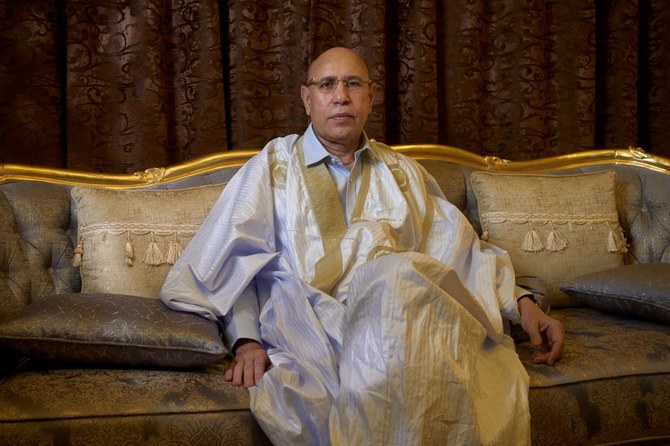
Mauritanian President Mohamed Ould Cheikh El Ghazouani said West African countries ‘must generate a common political will to be able to fight against insecurity.’ (AFP)
Short Url
Updated 23 June 2024
Follow

Mauritanian president calls on West African states to rally against extremism

  • I am not one of those who think today that countries can face a threat like terrorism individually

ATAR, Mauritania: Mauritanian President Mohammed Ould Cheikh El-Ghazouani called on West African countries to come together in the face of extremism in an interview ahead of the country’s presidential vote.
“The region must generate a common political will to be able to fight against insecurity,” El-Ghazouani said on the campaign trail ahead of an election on June 29.
“I am not one of those who think today that countries can face a threat like terrorism individually.”
The 67-year-old former army chief and defense minister is tipped for a second term as head of the country of 4.5 million that lies strategically between north and sub-Saharan Africa.
He said the “security situation in the sub-region is not good” and has become “worse.”
The military has seized power by force in Mali, Burkina Faso and Niger in recent years, heightening uncertainty in the region.
El-Ghazouani’s huge desert nation has a more than 2,000 km frontier with Mali.
While extremism has spread in the Sahel, particularly in Mali, Mauritania has not seen an attack since 2011.
“We need to form a coalition,” El-Ghazouani said, urging the region’s countries to “come together.”
He spoke to AFP in Atar, some 450 km northeast of the capital Nouakchott, where he launched his reelection campaign last week.
El-Ghazouani called for a possible replacement to the G5 Sahel alliance, which was created in 2014 by Mauritania, Burkina Faso, Mali, Niger and Chad, with the support of Western countries, to confront terrorism.
The military leaders in Mali, Burkina, and Niger have all withdrawn from the G5 alliance in recent years.
“If the G5 Sahel is not the right one, we must find another G-something,” he said.
The three countries, which have broken militarily and politically with the former French colonial power, have pivoted closer to Russia under their new military rulers.
They have also pulled out of the Economic Community of West African States or, ECOWAS, and created their alliance of Sahel states.
El-Ghazouani said Mauritania did not seek any role in the internal affairs of the other Sahel countries.
“We respect their sovereignty in their decisions. We want these countries to move as fast as possible toward elections,” he said.
Mauritania, rich in natural resources but still has a low gross domestic product, was hit by a series of coups from 1978 to 2008 before the 2019 election marked the first transition between two elected presidents.
The president said that stability had been maintained by being aware of the militant threat and “enormous efforts” made in education and health provision.
El-Ghazouani has pledged to “step up” his social welfare policy for the poor if reelected, claiming more than 1.5 million people had benefited already from housing and financial help during his first term.


Venezuela aims to boost oil output but sanctions stand in the way, VP says

Updated 4 sec ago
Follow

Venezuela aims to boost oil output but sanctions stand in the way, VP says

  • Sanchez called the recent capture of Nicolas Maduro a “dark day” for the country

DUBAI: Venezuela’s Vice President for Economy Calixto Ortega Sanchez said on Wednesday that his country needed vast foreign investment and sanctions relief to tap its huge oil reserves and restart its ailing economy.

“We know that the reference for Venezuela is that (it is) the country with the biggest oil reserves, and we want to stop being known for this, and we want to be known as one of the countries with the highest production levels,” Sanchez said.

Responding to questions by American journalist Tucker Carlson, Sanchez called the recent capture of Nicolas Maduro a “dark day” for the country but said Venezuela was working to reestablish a relationship with the US, which he described as a “natural partner” for the country.

“The Venezuelan people and authorities have shown that they are ready to peacefully move forward and to build opportunities,” he said during a session at the World Government Summit.

Sanchez, who headed Venezuela’s central bank, said the most pertinent issue facing his country is continued US sanctions.

Despite failing to result in regime change, the sanctions had effectively stifled the economy from growing, he added.

He said the Venezuelan government was now working to reform its laws to allow foreign investment and hoped the US would ease sanctions to aid their work.

“The first decisions that interim President Rodriguez took was to go to the National Assembly and ask for reform to the hydrocarbon law … this law will allow international investors to go to Venezuela with favorable conditions, with legal assurance of their investments,” he added.

“The economy is ready for investment. The economy is ready for the private sector; it is ready to build up a better future for the Venezuelan people.”

Sanchez played down inferences by Carlson that his government had been taken over, insisting that the regime still held authority in the country. He said the country had set up two funds to receive money from oil production that would fund better welfare and social conditions for Venezuelans.

“Allow us to have access to our own assets … we don’t have access to our own money,” he added.

“If you allow us to function like a regular country, Venezuela will show extraordinary improvement and growth.”