TEMPE, Arizona: Over the course of two weeks, President Joe Biden has imposed significant restrictions on immigrants seeking asylum in the US while also offering potential citizenship to hundreds of thousands of people without legal status already living in the country.
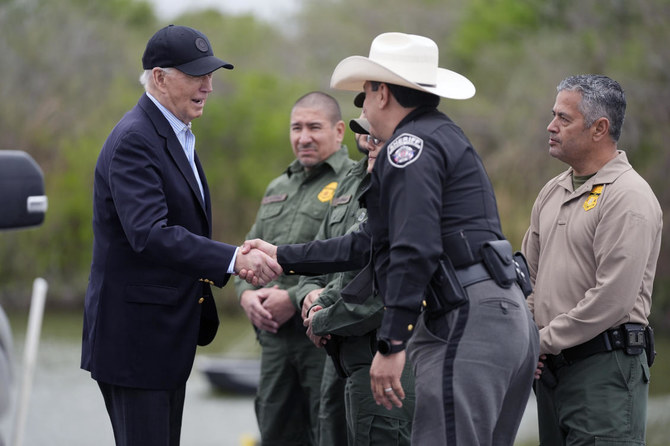
The tandem actions — the first to help immigrants illegally in the US, the second to prevent others from entering at the border — give the president a chance to address one of the biggest vulnerabilities for his reelection campaign.
Americans give Biden poor marks for his handling of immigration and favor the approach of presumptive Republican nominee Donald Trump, whose administration imposed hard-line policies such as separating immigrant families and who now has proposed the largest deportation operation in US history if elected again.
While the White House said its most recent actions aren’t meant to counterbalance each other, the election-year policy changes offer something both for voters who think border enforcement is too lenient and for those who support helping immigrants who live in the US illegally. They echo the White House’s overall approach since Biden took office, using a mix of policies to restrict illegal immigration and offer help to people already in the country.
Trump and top Republicans have ripped Biden for record-high numbers of encounters at the border, with some suggesting without evidence that Biden is abetting a so-called “invasion” to affect the election. Tightening asylum rules as Biden did could reduce border crossings.
Helping people long established in the country obtain citizenship, meanwhile, might defuse criticism of immigration advocates and liberal parts of Biden’s Democratic coalition who opposed the new border restrictions unveiled earlier this month.
An Associated Press-NORC Center for Public Affairs Research poll conducted in March found that only about 3 in 10 Americans approved of Biden’s handling of immigration. A similar share approved of his handling of border security. In the same poll, about half of US adults said that Biden is extremely or very responsible for the current situation at the US-Mexico border, compared to about one-third who said Trump was extremely or very responsible.
Biden’s latest action was endorsed by Rep. Tom Suozzi of New York, a moderate Democrat who won a special election in February to replace expelled former Republican Rep. George Santos. Suozzi’s race centered heavily on immigration and New York City’s struggles to accommodate thousands of immigrants bused there from the US-Mexico border.
Suozzi described first being elected mayor of Glen Cove, New York, in 1994 and helping organize centers to assist groups of immigrants waiting on street corners for day-laborer jobs, which he said still informs how he sees the issue.
“The reality is, those same guys that were on the street corners in 1994, today own their own businesses, own their own homes and their kids went to school with my kids,” Suozzi said on a call with reporters. “We’ve got to take action. People are sick of this.”
Van Callaway, a hairstylist from Mesa, Arizona, who uses they/them pronouns, voted for Biden four years ago but was disappointed to hear the president was making it harder to claim asylum. But they were also skeptical whether the president’s plan to help legalize spouses who are married to US citizens would actually come to fruition.
“I wish that it was an easier process so people who need to be here could be here,” said Callaway, 29. “And I wish that there was more love and acceptance about it. And more empathy. I feel like if there was a lot empathy on immigration as a whole, the world would be a lot better.”
The Department of Homeland Security estimates that around 500,000 spouses of US citizens will be protected under Biden’s latest action, as will 50,000 children of a noncitizen parent. The White House said those benefiting have been in the US for an average of 23 years.
That won’t be the case for most of the new arrivals to the US-Mexico border who find themselves unable to apply because of Biden’s other executive action. The White House notes, however, that it has taken several other actions to make it easier for new immigrants to enter the country.
With congressional Republicans “refusing to address our broken immigration system,” the administration “has taken action to secure our border and to keep American families together in the United States,” said Angelo Fernández Hernández, a White House spokesman.
That includes creating a program last year allowing people from Cuba, Haiti, Nicaragua and Venezuela to come to the US if they have a financial sponsor, pass a background check and fly into a US airport — which nearly 435,000 people had used by the end of April. The administration also expanded H-2 temporary work visa programs, and established processing centers away from the US border, in countries including Guatemala and Columbia.
Republican House Speaker Mike Johnson nonetheless accused Biden of “trying to play both sides.”
And Trump dismissed Biden’s action on asylum as “all for show,” suggesting the president is “giving mass amnesty and citizenship to hundreds of thousands of illegals who he knows will ultimately vote for him.”
Callaway said deciding whom to vote for this year will be excruciating, “a real hard conundrum.” They’re worried about Trump’s second-term agenda but also furious about Biden’s approach to Israel’s war in Gaza, and not excited to support a third-party candidate who probably can’t win. More harsh border policies would be another knock against Biden, they said.
“They’ll tell you what you want to hear, but they’re not often going to follow through on it,” Callaway said. “It feels like the things they follow through on are fueled by prejudice and this weird sense of victimhood.”


![]()

Biden’s 2 steps on immigration could reframe how US voters see a major political problem for him
Short Url
https://arab.news/gmku6
Biden’s 2 steps on immigration could reframe how US voters see a major political problem for him
- Trump and top Republicans have ripped Biden for record-high numbers of encounters at the border


Latest updates


© 2026 SAUDI RESEARCH & PUBLISHING COMPANY, All Rights Reserved And subject to Terms of Use Agreement.