ISLAMABAD: The government’s key coalition allies criticized its tax-heavy federal budget during a parliamentary session on Friday, urging authorities to adopt “people-friendly” policies as Islamabad’s hopes the document will prove instrumental in securing another International Monetary Fund (IMF) bailout package.
Pakistan’s parliament kicked off the debate into the federal budget on Thursday, with opposition party Sunni Ittehad Council (SIC) labelling the government’s move to present the budget as “economic terrorism” against the people. Islamabad has set an ambitious tax revenue generation target of about Rs13 trillion ($46.55 billion) in the budget, which was presented on June 12 by Finance Minister Muhammad Aurangzeb.
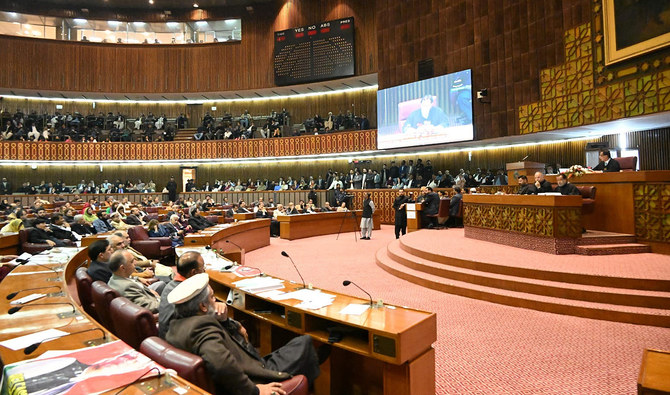
When the budget debate resumed in the National Assembly on Friday, the government’s key coalition allies distanced themselves from the taxes imposed in the finance bill, calling on authorities to levy them on landlords and the affluent class rather than the salaried group.
“If sanity fails to prevail and a public-friendly budget is not prepared, then this traditional budget is going to be the biggest threat to the country’s security,” Dr. Farooq Sattar, a senior lawmaker of the government’s coalition partner, Muttahida Quami Movement-Pakistan, (MQM-P) said during the parliamentary session.
He said the budget signaled that the status quo continued to wield power in Pakistan.
Meanwhile, Pakistan Peoples Party (PPP) lawmaker Shazia Marri confirmed that no breakthrough had been reached in talks held between the ruling Pakistan Muslim League-Nawaz (PML-N) party and the PPP’s senior leadership on their differences regarding the budget.
PPP Chairman Bilawal Bhutto-Zardari led a high-level delegation of his party to meet Prime Minister Shehbaz Sharif and the government’s senior leadership on Thursday. The two sides attempted to iron out their differences over the federal budget.
The PPP has accused the government of ignoring its recommendations in the budget. While not a member of the federal cabinet, the PPP voted for Sharif in the prime minister’s election and forms the government in Pakistan’s southern Sindh province. The PML-N-led government requires the PPP’s votes for the budget to pass.
After the meeting between the two sides ended on Thursday, a handout issued by the Prime Minister’s Office (PMO) said both sides had agreed to form committees to work out their differences over the budget.
Speaking during the National Assembly session on Friday, Marri pointed out that the government’s ministers had not attended the session.
“Relevant ministers must be present in the house during budget session,” Marri said, adding that her party was reluctant to participate in such sessions till it resolved its differences with the government on the budget.
Another PPP leader Sharmila Faruqi said both parties’ relevant committees would hold meetings to reach a consensus on the budget before voting on the finance bill takes place next week.
“Not much of a breakthrough, subsequent meetings to follow,” Faruqi told Arab News about the meeting between the two sides. “PML-N must honor its commitments to PPP.”
Meanwhile, SIC lawmaker Sajid Khan criticized the government for imposing heavy taxes in the budget on medicines and food items.
“The government should reopen border with Afghanistan from Angoor Ada [town in northwestern Pakistan] to resume trade and business activities,” he recommended.
Khan said the government should review tax measures and allocate a special budget for the development of the erstwhile tribal regions bordering Afghanistan.
“The government should allocate the promised 3 percent of the National Finance Award for the development of the tribal regions,” he said.


![]()

Pakistani government’s coalition allies distance themselves from ‘tax-heavy’ budget in parliamentary debate
Short Url
https://arab.news/m5aya
Pakistani government’s coalition allies distance themselves from ‘tax-heavy’ budget in parliamentary debate
- Dr. Farooq Sattar, a lawmaker of government ally MQM-P, demands a more “people-friendly” budget
- PPP lawmakers confirm no breakthrough reached with ruling party PML-N on budget differences
Latest updates


Recommended


© 2026 SAUDI RESEARCH & PUBLISHING COMPANY, All Rights Reserved And subject to Terms of Use Agreement.