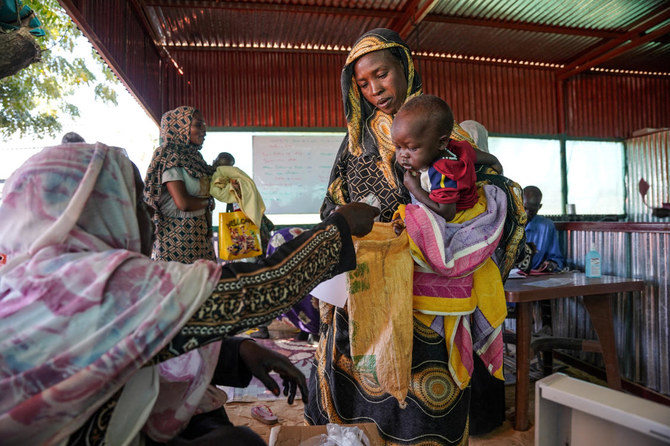
CAIRO: Families in Sudan’s embattled western Darfur region have finally received an emergency increase in food aid that is much needed to help avert looming famine, the UN food agency said Thursday.
The World Food Program said in an update that five convoys carrying 5,000 tons of food aid have crossed from neighboring Chad into Darfur since the beginning of 2024.
Some aid trucks entered the region on June 10 and completed deliveries in southern Darfur on Thursday, Leni Kinzli, the head of communications at WFP’s Sudan office, told The Associated Press. Distribution was continuing in central and western Darfur.
“The food distribution is an emergency scale-up to avert famine and to get to those people in the highest level of food insecurity to prevent widespread starvation,” Kinzli said. “But, we need to continue to do more and expand access and we’re working on possibly opening new corridors from South Sudan and Egypt and also expanding crossline access from Port Sudan into the Darfur region.”
Famine looms in parts of Sudan, which has been engulfed by violence since April of last year. That’s when tensions between leaders of the Sudanese military and the paramilitary Rapid Support Forces erupted into intense fighting and spread across the country, including to Darfur.
The latest WFP distribution was part of two aid convoys that made their way to Sudan over the past weeks, carrying enough assistance for more than 245,000 people. The first convoy crossed on May 23 and delivered aid for 117,000 people in South and Central Darfur states.
“We aren’t just delivering for immediate needs but ensuring people have enough to get through the coming months,” said Kinzli. “Especially in those areas that we anticipate will become harder to reach when the road conditions further deteriorate in the rains in the coming weeks.”
In May, the WFP said in a report that at least 1.7 million people are already experiencing emergency levels of hunger in Darfur, including in Al Fasher, the capital of North Darfur state that is besieged by RSF.
Some of the challenges in reaching communities in Darfur include securing access through negotiations, which Kinzli described as “complicated” because many of the checkpoints are controlled by different armed groups. She added that getting aid into places with intense fighting such as Al Fasher is extremely dangerous.
Some WFP aid trucks encountered mechanical issues in the most recent food aid delivery because of deteriorating road conditions. Still, three more WFP convoys carrying food and nutritious commodities are planned to enter Darfur in the coming weeks from Chad through the Tine crossing to help 675,000 people.
Carlos Perea-Milla, with the logistics team for Sudan at the international humanitarian organization Action Against Hunger, told the AP that Tine, which leads to North Darfur state, is the only authorized crossing point for UN agencies. The Adre crossing point, occasionally used by humanitarian organizations, provides access to RSF-controlled areas. The UN’s humanitarian agency is pushing for Adre to be used as the other official crossing point to Sudan.


![]()

Darfur sees an increase in much needed food aid, but it’s still not enough to avert famine, UN says
Short Url
https://arab.news/468se
Darfur sees an increase in much needed food aid, but it’s still not enough to avert famine, UN says
- WFP said in an update that five convoys carrying 5,000 tons of food aid have crossed from neighboring Chad into Darfur since the beginning of 2024
- Famine looms in parts of Sudan, which has been engulfed by violence since April of last year


Latest updates





© 2026 SAUDI RESEARCH & PUBLISHING COMPANY, All Rights Reserved And subject to Terms of Use Agreement.