

Pakistan affirms full political support for CPEC during Chinese Communist Party official’s Islamabad visit

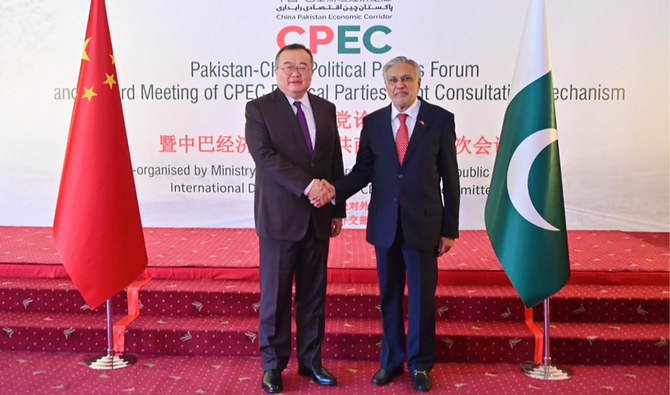
Pakistan's Deputy Prime Minister Ishaq Dar (right) meets a senior Chinese Communist Party leader Liu Jianchao in Islamabad, Pakistan on June 21, 2024. (@ForeignOfficePk/X)
Short Url
Updated 21 June 2024
Follow

Pakistan affirms full political support for CPEC during Chinese Communist Party official’s Islamabad visit

  • Liu Jianchao is visiting Islamabad to co-chair the meeting of the Pakistan-China Joint Consultative Mechanism on CPEC
  • Ishaq Dar says the Pakistan-China relations and CPEC have opened new vistas of progress, prosperity and development

ISLAMABAD: Deputy Prime Minister Ishaq Dar announced on Friday the China-Pakistan Economic Corridor (CPEC) enjoyed the complete support of political parties in his country while welcoming a senior Chinese Communist Party leader Liu Jianchao at the foreign office in Islamabad.

The Chinese official arrived in the country on Thursday night to co-chair the 3rd Meeting of the Pakistan-China Joint Consultative Mechanism (JCM), focusing on the progress of CPEC projects.

Established in 2019, the JCM for political parties on CPEC serves as a regular consultation platform between the Communist Party of China and Pakistani political parties.

Its inaugural meeting took place in Beijing in March 2019, and the second meeting, held virtually in August 2020.

Welcoming Liu, the deputy PM said Pakistan and China had always been strategic partners and trusted neighbors who had consistently supported each other’s core concerns on the world stage.

“Pakistan-China relations and CPEC [enjoy] full support and confidence of all political parties in Pakistan as [they have] opened up new vistas of progress, prosperity and development,” the foreign office quoted him as saying in a social media post.

The Chinese official also described the bilateral ties between the two states as unique, with “no parallel in modern inter-state relations.”

He also underscored China’s commitment to work with Pakistan to add further substance and scope to relationship and upgrade CPEC as envisaged by the leadership of both countries.

The two officials agreed to maintain the momentum of high-level engagements and to further enhance communication on important regional and global issues.

Liu is expected to meet Prime Minister Shehbaz Sharif during his stay in the country.

He will also interact with leaders of various political parties and Pakistan’s top military officials.

Pakistan and China have agreed to advance CPEC into its second phase, expanding beyond infrastructure and energy to broader economic and social development, including rural revitalization, agricultural modernization, industrialization, and green development.

This phase also emphasizes establishing Special Economic Zones to promote industrial growth and job creation.


Pakistan’s Mahnoor Omer named among TIME’s ‘Women of the Year’ for 2026

Updated 8 sec ago
Follow

Pakistan’s Mahnoor Omer named among TIME’s ‘Women of the Year’ for 2026

  • Omer moved a Pakistani court against the so-called ‘period tax’ in Sept. 2025 which has since sparked a national debate
  • Taxes on sanitary pads in Pakistan can add up to 40 percent to retail price, UNICEF says only around 12 percent women use such products

ISLAMABAD: Pakistani women’s rights activist Mahnoor Omer, who fought against taxes on menstrual products, has been named among the TIME magazine’s ‘Women of the Year’ for 2026.

Omer’s efforts have been recognized alongside 16 activists, artists, athletes and businesswomen in the TIME’s Women of the Year 2026 list, including Olympic gold medalist Sydney McLaughlin-Levrone and Oscar-nominated filmmaker Chloe Zhao.

Dissatisfied with the efforts to educate Pakistani girls about sexual violence, Omer founded the Noor Foundation at the age of 14 and held her own workshops with village girls about everything from climate change to menstruation, according to the TIME magazine.

Two years later, a conversation with a domestic worker about the price of pads made her realize that not everyone could afford these essentials. She moved a court against the so-called “period tax” in Sept. 2025 and the case has sparked a national debate on the subject, considered a taboo by many in Pakistan, since its first hearing late last year.

“A decade and one law degree after her interest in activism was sparked, Omer, now 25, is putting her passion and expertise to work in the name of gender equity,” TIME wrote about Omer on its website.

Taxes imposed on sanitary products in Pakistan can add up to 40 percent to the retail price. UNICEF estimates just 12 percent of women in the country use commercially produced pads or tampons. The alternative, using cloth, risks health impacts including rashes and infections, and can make it impossible for girls to attend school while menstruating.

Omer’s suit, which awaits the government response, has sparked a national discussion. She says she spoke about menstruation to her father and male cousins, who thanked her for standing up for their daughters.
The 25-year-old, who is currently enrolled in a master’s degree in gender, peace, and security at the London School of Economics, sees this case as just the first of many.

“I’m not free until every woman is free,” she was quoted as saying by TIME. “I want to leave no stones unturned in terms of what I can do with the next few decades, as a lawyer for the women in my country and gender minorities in general.”