Pakistan’s president advocates ‘political dialogue’ for Balochistan’s stability during Gwadar visit

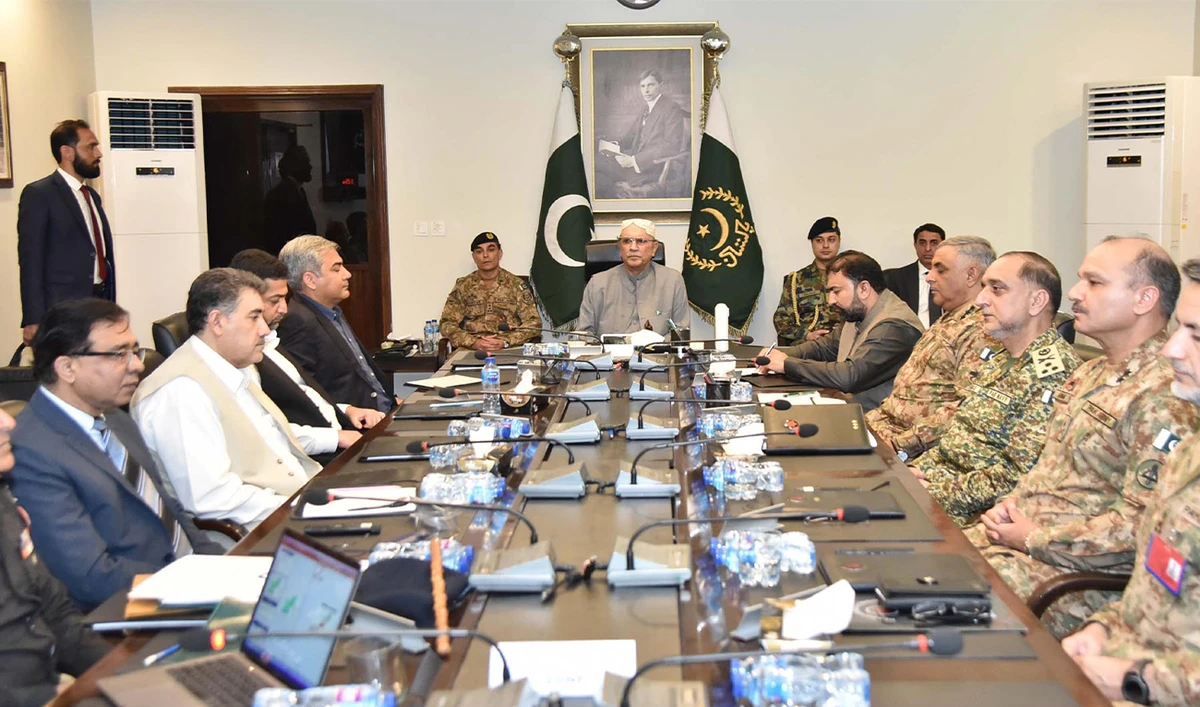
Pakistan President Asif Ali Zardari (center) chairs a meeting on the law and order situation in Balochistan in Gwadar, Pakistan on June 20, 2024. (PID)
Short Url
Updated 21 June 2024
Follow

Pakistan’s president advocates ‘political dialogue’ for Balochistan’s stability during Gwadar visit

  • Balochistan is viewed as strategically vital for Pakistan but has witnessed separatist and militant violence for decades
  • President Asif Ali Zardari calls for improved law enforcement capacity, better prosecution system to counter violence

ISLAMABAD: President Asif Ali Zardari on Thursday emphasized political dialogue for peace, development and prosperity in Pakistan’s southwestern Balochistan region, which has been recognized as vital for the country’s strategic interests but has also witnessed prolonged militant and separatist violence.

Pakistan’s largest province by area, Balochistan holds a strategic position that borders Iran and Afghanistan, making it pivotal for regional connectivity and central to the multibillion-dollar China-Pakistan Economic Corridor (CPEC), which aims to strengthen the ties between Pakistan, the Middle East and Central Asia. The government has also taken initiatives to tap the province’s vast mineral and natural resources that largely remain underexploited, hoping to utilize them for the country’s economic growth.

However, Balochistan has witnessed a low-level insurgency carried out by Baloch nationalist groups who have long accused Pakistani governments of profiting from the province’s natural resources while leaving the region underdeveloped for its own residents.

Zardari, who went to the region’s strategic Gwadar port city on a daylong visit, chaired a meeting on the security situation in Balochistan on Thursday.

“Political dialogue is the way forward to bring prosperity, development and peace to Balochistan,” he was quoted as saying by his office after the meeting.

However, the president also spoke about enhancing the capacity of law enforcement agencies (LEAs) in the area, emphasized the deployment of “competent officers” in the province and called for a better prosecution mechanism to counter violence in Balochistan.

“Compensation for the families of martyrs of LEAs in Balochistan should be enhanced, bringing it at par with the rest of the provinces,” he said.

He also instructed the authorities to take necessary measures for the safety of religious tourists from other province who travel to the Middle East from Balochistan.

The president also maintained it was necessary to focus on skill development of people, adding that trained human resources should be equipped with foreign language skills to help them find jobs in other countries.

“There is a need for providing financing and equipment to local fishermen, apart from promoting sustainable fishing practices and checking the production of illegal fishing nets,” he added while speaking about one of the leading livelihood sources for people in Gwadar.

The meeting was also attended by Pakistan’s interior minister Mohsin Naqvi, Balochistan’s chief minister Sarfaraz Bugti and senior military officials.

Pakistan rejects Amnesty claims of Israeli spyware use, calls reports ‘disinformation’

Updated 10 sec ago
Follow

Pakistan rejects Amnesty claims of Israeli spyware use, calls reports ‘disinformation’

  • FO denies any link with Israel, says Pakistan has “absolutely no cooperation” on surveillance tools
  • Islamabad accuses India of delaying clearance for relief aircraft bound for flood-hit Sri Lanka

ISLAMABAD: Pakistan on Friday rejected an Amnesty International report alleging the use of Israeli-made invasive spyware in the country, calling the findings speculative and misleading.

Amnesty’s investigation, published Thursday under the title Intellexa Leaks, cited the case of a Pakistan-based human rights lawyer who reported receiving a suspicious WhatsApp link in 2025. According to Amnesty International’s Security Lab, the link bore signatures consistent with Predator, a spyware product developed by Israeli manufacturer c

Foreign Office spokesperson Tahir Andrabi dismissed the suggestion that Islamabad had deployed the tool or maintained any technological cooperation with Israel.

“These are all media speculations. These are all rumor-mongering and disinformation. There is absolutely no cooperation between Pakistan and Israel on anything, let alone a spyware or these kinds of tools. So, I would reject it quite emphatically,” he said at a weekly briefing.

Andrabi also accused India of obstructing humanitarian operations, saying New Delhi delayed flight clearance for a Pakistani relief aircraft carrying aid to flood-affected Sri Lanka.

“The special aircraft carrying Pakistan’s relief goods had to wait for 48 hours, in fact more than 48 hours, around 60 hours, while the flight clearance from India was delayed,” he said.

He added that the eventual conditional flight window was too narrow to be workable.

“The partial flight clearance which eventually was given after 48 hours was operationally impractical, time-bound just for a few hours and hence not operable, severely hindering the urgent need for the relief mission for the brotherly people of Sri Lanka,” Andrabi stated.

“Humanitarian assistance is like justice, if it is delayed, it is denied.”

Responding to India’s claim that clearance was granted within four hours, he said Pakistan has documentary proof contradicting New Delhi’s version.

On a separate question about reported delays in the arrival of a Turkish delegation aimed at mediating between Islamabad and Kabul, Andrabi said Pakistan welcomed Ankara’s initiative but was unaware of the cause of postponement.

“We stand ready to receive the Turkish delegation. That delegation has not arrived as yet. And I’m not aware of any schedule. Pakistan is ready to hold negotiations, discussions,” he said, adding that the delay may be linked to coordination with the Afghan side.