

In Tijuana, shelter for Muslim migrants on US doorstep

1 / 2
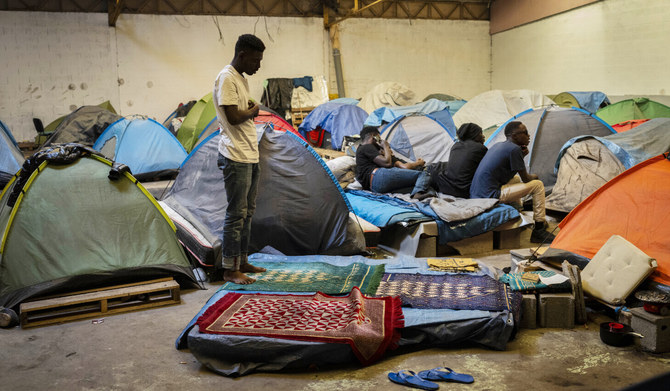
A migrant prays at an abandoned warehouse turned migrant camp in Calais, northern France, on Wednesday, May 15, 2024. (AP)
2 / 2
A migrant talks on her phone after being dropped off by bus at a transit station near the border following processing by U.S. Customs and Immigration in San Diego, California,U.S., June 17, 2024. (REUTERS)
Short Url
Updated 20 June 2024
Follow

In Tijuana, shelter for Muslim migrants on US doorstep

  • Increasingly, migrants from the Middle East and North Africa also undertake the perilous route via South and Central America

TIJUANA, Mexico: From Algeria, Syria, Yemen and Afghanistan, citizens of distant, Muslim countries wait for US asylum at a shelter in the Mexican border city of Tijuana -- more used to seeing migrants from Latin America than the Middle East.
At the Assabil Inn, Mexico's first shelter catering for US-bound Muslim migrants, the backstories of the guests are as varied as the assortment of languages they speak.
"Almost everybody follows the same faith. So it feels like you're among your brothers and sisters," Maitham Alojaili, a 26-year-old who fled civil war-wrecked Sudan, told AFP before joining Friday prayers at the facility's mosque.
"People get kidnapped. Anything could happen. Sometimes, when you leave home, there's a very high chance that you don't come back," Alojaili said of the circumstances that compelled him to leave everything behind in search of a better life far away.
Data released this week by Mexico's National Migration Institute said some 1.39 million people from 177 countries have traveled through the country so far this year, trying to reach the United States without entry papers.
The figure represents almost the whole world -- the United Nations has 193 member states.
The majority came from Venezuela, Guatemala, Honduras, Ecuador and Haiti.

Increasingly, migrants from the Middle East and North Africa also undertake the perilous route via South and Central America.
For many, it includes a journey on foot through the dangerous Darien Gap, a dense jungle on the Colombia-Panama border replete with dangerous animals, criminals and human traffickers.
Yusseph Rahnali, a 31-year-old Algerian, told AFP he opted for the United States "because they accept everybody."
Europe is not an option, he said, because of visa requirements. Instead, he flew visa-free to Ecuador before crossing seven other countries to Mexico where he awaits news on the US asylum process.
Migration is at the heart of the campaign for the US presidential election in November.
Seeking re-election, incumbent Joe Biden signed a decree this month shutting down the border to asylum seekers after certain daily limits are reached.
On Tuesday, in an attempt to balance the crackdown criticized by the left and human rights groups, he announced a new potential citizenship path for immigrants married to US nationals -- which was in turn slammed by conservatives.

In Tijuana, 29-year-old Afghan journalist Fanah Ahmadi told AFP he traveled to Brazil on a humanitarian visa, then through "nine or ten other countries" to get to Mexico.
"There are many difficulties on the way but I am still grateful that... today, I am here," said Ahmadi of the Assabil Inn, where migrants receive food and shelter, "and we are near the border as well."
The Inn, opened in 2022, can house up to 200 people and allows Muslims to pray and eat halal. A stay can last from one week to seven months.
"Muslims have their home here in Tijuana," said founder Sonia Garcia, a Mexican who converted to Islam through marriage.
In 2023, a record 2.4 million people crossed the US-Mexico border without travel documents, according to US figures.
The flow hit a high of 10,000 people per day in December, which has since been reduced as both countries have cracked down.
For purposes of statistics, migrants from Muslim countries are grouped by US officials into a category labeled "other," due to their small number compared to those from Latin America, India or Russia.
Trump, as US president, banned migrants from Muslim countries in a measure that has since been overturned.
On the campaign trail he has ramped up his anti-immigration rhetoric, saying migrants were "poisoning the blood" of the United States.


India’s Parliament approves bill to open civil nuclear power sector to private firms

Updated 8 sec ago
Follow

India’s Parliament approves bill to open civil nuclear power sector to private firms

  • The government termed it a major policy shift to speed up clean energy expansion
  • The move carries global significance as India seeks to position itself as a major player in the next wave of nuclear energy

NEW DELHI: India’s Parliament approved new legislation Thursday that enables opening the tightly controlled civil nuclear power sector to private companies.
The government termed it a major policy shift to speed up clean energy expansion while the opposition political parties argued that it dilutes safety and liability safeguards.
The lower house of parliament passed the legislation Wednesday and the upper house on Thursday. It now needs the assent from the Indian president, which is a formality, to come into force.
The move carries global significance as India seeks to position itself as a major player in the next wave of nuclear energy, including with small modular reactors at a time many nations are reassessing nuclear power to meet climate targets and reduce dependence on fossil fuels.
Supporters argue the legislation marks a decisive break from decades of state dominance in nuclear energy while critics say it opens the door to risks, mainly health hazards, that could have long term consequences.
“It marks a momentous milestone for India and signals capable private sector players that the country is open for business in the nuclear energy space,” said Karthik Ganesan, director of strategic partnerships at the Council on Energy, Environment and Water, a think tank.
Junior Minister Jitendra Singh, who oversees the department of atomic energy, told lawmakers that the bill — which has been dubbed Sustainable Harnessing and Advancement of Nuclear Energy for Transforming India — seeks to modernize India’s nuclear framework in line with technological, economic and energy realities. It also retains and strengthens core safety, security and regulatory safeguards.
“India’s role in geopolitics is increasing. And if we have to be a global player effectively, we have to live up to global benchmarks, follow global parameters and adopt global strategies,” Singh said in the lower house, adding that the legislation was necessary to address the country’s growing energy needs.
India wants more nuclear power and has pledged over $2 billion in recent months toward research and allied activities. Nuclear power is a way to make electricity that doesn’t emit planet-warming gases, although it does create radioactive waste.
India is one of the world’s biggest emitters of planet-heating gases and over 75 percent of its power is still generated by burning fossil fuels, mostly coal. India wants to install 100 gigawatts of nuclear power by 2047 — enough to power nearly 60 million Indian homes a year.
Energy experts say that for the world to move away from carbon-polluting fuels like coal, oil and gas, sources like nuclear that don’t rely on the sun and the wind — which aren’t always available — are needed. But some are skeptical about India’s ambitions as the country’s nuclear sector is still very small, and negative public perceptions about the industry remain.
Opposition parties flagged concerns related to several provisions of the bill and urged the government to refer it to a parliamentary panel for examination. The government didn’t adhere to the request.
“The bill doesn’t have sufficient safeguards when it comes to mitigating the bad health of those impacted by living in areas closer to nuclear plants,” Ashok Mittal, a lawmaker from the opposition Aam Admi Party, told The Associated Press.
G. Sundarrajan, an anti-nuclear energy activist, called the bill a “disastrous law,” saying it takes away essential safeguards that are needed to make sure companies invest in safety and reduce the chances of a major disaster that can impact millions from occurring.
“It also provides little recourse for any Indian citizen to claim damages from nuclear companies even if they are affected by radiation leaks or suffer from any other health impact as a result of a nuclear plant in their region,” he said.