DEIR AL-BALAH, Gaza: The disfiguring facial burns of 10-year-old Hanan Akel show how Israel’s military campaign in Gaza is not only causing thousands of deaths but terrible injuries afflicting both old and young.
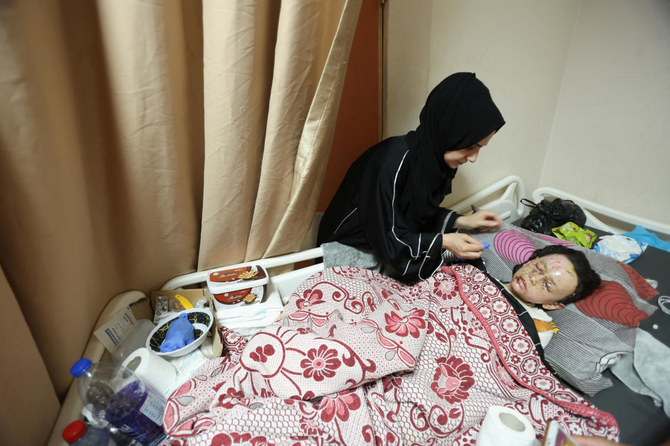
Hanan lay in a hospital cot in Deir Al-Balah in central Gaza Strip, struggling to move her mouth as she spoke and with her eyes partly shut, patches of her forehead still raw and stitched scars across her nose and lips.
When her mother Walaa Akel tried to clean her, she wailed.
Israel has been at war in Gaza for more than eight months saying it wants to destroy Hamas, the Palestinian group that attacked Israeli communities on Oct. 7, killing more than 1,200 people and grabbing 253 hostages according to Israeli tallies.
The ground and air assault on Gaza has killed more than 37,396 people and injured 85,523 according to Palestinian health authorities, while driving nearly all the tiny territory’s people from their homes with massive bombardments.
Hanan was out walking in Al-Bureij refugee camp where the family had taken shelter after leaving their home when she was caught in Israeli shellfire, her mother Walaa said.
Instead of spending the Eid Al-Adha festival playing with friends, she has spent it in the Al-Aqsa Martyrs Hospital being treated for second and third degree burns on her face and limbs.
“I used to go with my friends. Play, buy things, eat and celebrate Eid. We were happy. We used to play on the swings and we used to wear our Eid clothes. We used to wear nice new shoes,” she said.
Now she hopes for treatment and for her face to heal.
“I want to go back to what I was like before,” she said.
Since Israel expanded its offensive last month to include the southern city of Rafah, where the border post to Egypt is located, the frontier has been closed and Gaza residents have been unable to go abroad for medical help.
Doctor Mahmoud Mahani, the plastic surgeon treating Hanan at the hospital, said she needs urgent treatment somewhere with more advanced equipment.
Walaa Akel said her daughter used to be “as beautiful as the moon.” Now, Hanan often wants to look at videos and pictures of what her face was like before.
“She says to me ‘mama, I wish I could walk. Mama, I wish I could stand. I wish I could play with my siblings’,” said Walaa.

Palestinian girl with burns from Israeli shelling hopes for treatment
https://arab.news/4ekum
Palestinian girl with burns from Israeli shelling hopes for treatment
- Hanan was out walking in Al-Bureij refugee camp where the family had taken shelter after leaving their home when she was caught in Israeli shellfire
- Instead of spending the Eid Al-Adha festival playing with friends, she has spent it in the Al-Aqsa Martyrs Hospital being treated
UN delegation wraps up Lebanon visit with call for international backing for country at 'pivotal’ juncture
- Security Council President Samuel Zbogar urges intensified support for Lebanese Armed Forces; welcomes government commitment to ensuring a state monopoly on arms
- Council highlights ‘strong commitment’ to Lebanon’s stability, territorial independence
NEW YORK: A UN Security Council delegation wrapped up its visit to Lebanon on Friday, saying the trip underscored international backing for the country at what it described as a pivotal moment for maintaining calm along its southern border and advancing implementation of long-standing UN resolutions.
Samuel Zbogar, Slovenia’s ambassador to the UN and president of the Security Council for December, said the delegation had received “warm hospitality” from Lebanese officials, and highlighted the council’s “strong commitment” to Lebanon’s stability and that of the wider region.
“The council regularly deliberates on the situation in Lebanon and along the Blue Line,” Zbogar told reporters in Beirut.
He said the visit is a further demonstration of the council’s commitment, coming at a pivotal time for implementing relevant resolutions and the ceasefire agreement between Israel and Hezbollah brokered in November 2024.
During the trip, the delegation held meetings with Lebanon’s president, parliament speaker, prime minister and foreign minister.
Members were also briefed by the commander of the Lebanese Armed Forces, the head of the UN peacekeeping mission, UN officials in Lebanon, and a US general involved in the ceasefire mechanism.
The delegation also toured the Blue Line area and UNIFIL headquarters.
Zbogar said discussions focused on Lebanon’s political, economic, and security situation, with particular attention to UNIFIL’s work and the Lebanese Armed Force’s role in maintaining stability.
“This mission is a demonstration of the international community’s support for Lebanon and its people,” he said, reaffirming the council’s backing for the country’s territorial integrity, sovereignty, and political independence.
He urged all parties to uphold last year’s ceasefire agreement and noted “progress achieved by Lebanon this year.” He also praised UNIFIL and the UN Special Coordinator’s office for their role in de-escalation efforts, adding that the safety of peacekeepers “must be respected and they must never be targeted.”
Zbogar called for intensified international support to the Lebanese Armed Forces, including for their continued deployment south of the Litani River, and welcomed the government’s commitment to ensuring a state monopoly on arms.
He said the council also used the visit to examine options for implementing Resolution 1701 once UNIFIL leaves Lebanon, saying that the issue will require “thorough conversation during 2026” and that members were awaiting recommendations from the UN secretary-general.
The delegation also reiterated support for Lebanon’s economic and institutional reforms, which international donors have made a condition for unlocking major recovery and reconstruction assistance.


