KARACHI: While Eid Al-Adha generates billions of rupees through the sale and purchase of sacrificial animals, allied businesses like animal fodder sellers and knife makers also thrive in Pakistan, traders said, underscoring the religious festival’s impact on livelihoods and local commerce.
Last year Pakistanis sacrificed over six million animals worth around Rs531 billion ($1.9 billion) over Eid, according to the Pakistan Tanners Association (PTA).
“Eid offers employment opportunities to thousands of people across the city,” said Syed Amjad Ali, an animal feed seller who had set up his stall in the Burns Road area of Karachi, Pakistan’s largest city and commercial hub.
Indeed, a variety of animal feeds go up on sale at stalls around the city, ranging from bales of hay to more nutrient-rich feeds, while the prices of animal fodder typically increase in the run-up to Eid due to high demand. Sellers capitalize on the opportunity to earn additional income while it is also convenient for members of the public to find things like feed, knives and wooden blocks at makeshift stalls set up in their neighborhoods rather than traveling far to purchase them.
“It is easier for people living in the neighborhood, even a child can come and buy the feed,” said Ali, who set up his stall two weeks before Eid. ” In this area there will be about 8-10 stalls and 6-8 people are working at each stall.”
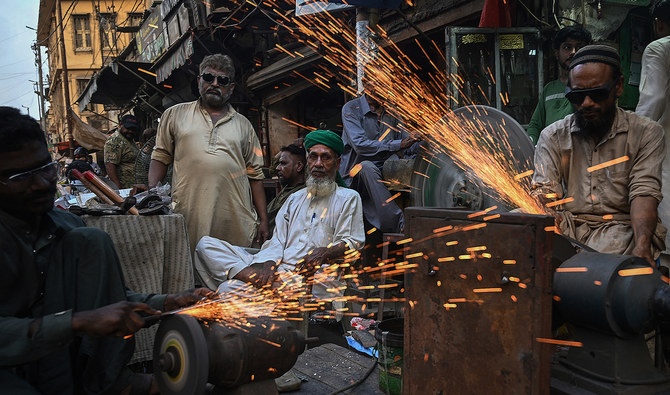
Another business that thrives ahead of Eid is that of butchering tools, most importantly knives and cleavers. Retailers report a “significant boost” in sales before the holiday, when markets and shops across Pakistan stock up on knife varieties.
“We have been doing this for 50 years, since my grandfather’s time. Every year, when the moon of Bakra Eid (Dhul-Hijjah) is sighted, we set up this stall to facilitate consumers,” said seller Muhammad Sarfraz, whose customers include families as well as amateur and professional butchers.
Sarfraz also sells related materials like skewers, grills, stands and various types of pans.
Sales of wooden blocks on which butchers cut up meat after slaughtering the animals also see a boom ahead of Eid.
“People come to buy wooden meat cutting blocks from our saw machine,” vendor Paras Khan said, adding that his business picked up pace two months before Eid.
Meanwhile, the boom in Eid side businesses also creates seasonal employment opportunities.
“This is the system of Allah,” Muhammad Siddique, a resident of Karachi’s Saddar area, said as he bought feed for his two cows, “where livelihood is created for many people including transporters, feed sellers, and decorative material sellers for animals.”
“I have bought two goats and have come to buy ropes for them,” said Yousaf Gul Ahmed, a young child standing at a stall. “I have bought two good goats.”


![]()

Small businesses boom ahead of Eid Al-Adha, invigorating local commerce
Short Url
https://arab.news/cz993
Small businesses boom ahead of Eid Al-Adha, invigorating local commerce
- Allied businesses like animal fodder, knives and wooden blocks thrive in weeks before Eid
- Boom in Eid side businesses also creates seasonal employment opportunities in Pakistan
Latest updates


© 2026 SAUDI RESEARCH & PUBLISHING COMPANY, All Rights Reserved And subject to Terms of Use Agreement.