Gaza war death toll rises to 37,347/node/2532456/middle-east
Gaza war death toll rises to 37,347
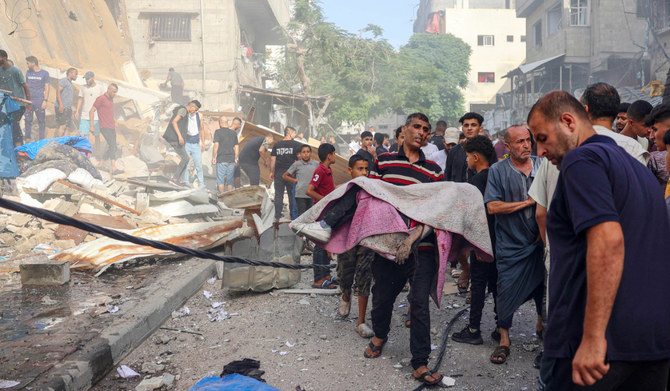
People search for survivors in the rubble of a building following Israeli bombardment at al-Bureij refugee camp in the central Gaza Strip on June 16, 2024, amid the ongoing conflict between Israel and the Palestinian militant group Hamas. (AFP)
This war has proven even deadlier than the displacement from Israel in 1948, said Rashid Khalidi, a Palestinian-American historian at Columbia University, when 20,000 were killed in what is known as the Nakbah
Israel’s air and ground campaign in Gaza has killed hundreds of family members from the same bloodline, an unprecedented toll on the small community mostly made up of refugees and their descendants
Updated 17 June 2024
AFP AP
GAZA STRIP: The Health Ministry in Gaza said on Monday that at least 37,347 people have been killed in the territory during more than eight months of war between Israel and Palestinian militants.
The toll includes at least 10 deaths in the past 24 hours, a ministry statement said, adding that a total of 85,372 people had been wounded in the Gaza Strip since the war began when Hamas attacked Israel on Oct. 7.
Dire shortages of food and other essentials in the Gaza Strip have been exacerbated by overland access restrictions and the closure of the key Rafah crossing with Egypt since Israeli forces seized its Palestinian side in early May.
Israel’s air and ground campaign in Gaza has killed hundreds of family members from the same bloodline, an unprecedented toll on the small community mostly made up of refugees and their descendants.
An Associated Press investigation analyzed 10 strikes across the Gaza Strip between October and December that killed over 500 people.
Nearly every Palestinian family has suffered grievous, multiple losses.
But many have been decimated, particularly in the first months of the war.
AP geolocated and analyzed the strikes; consulted with weapons investigators; open data-analysts and legal experts; and drew on data by Airwars, a London-based conflict monitor.
They hit residential buildings and shelters with families inside. In no case was there an obvious military target or direct warning to those inside. In one case the family said they had raised a white flag on their building in a combat zone.
This war has proven even deadlier than the displacement from Israel in 1948, said Rashid Khalidi, a Palestinian-American historian at Columbia University, when 20,000 were killed in what is known as the Nakbah
“I don’t think anything like this has happened in modern Palestinian history,” said Khalidi.
In Gaza City, medics at Al-Ahli Hospital said on Saturday at least five people were killed in two separate airstrikes, and witnesses reported tank shelling in the southern neighbourhood of Zeitun.
At least one strike hit Bureij refugee camp in the central Gaza Strip, residents said.
Palestinian officials in the far-southern city of Rafah reported tank shelling early on Monday.
Jens Laerke, spokesman for the UN humanitarian agency OCHA, called for “further concrete measures by Israel to address longstanding issues” on humanitarian needs.
Gazans “urgently need food, water, sanitation, shelter, and healthcare, with many living near piles of solid waste, heightening health risks,” Laerke said.
Iranians fleeing cities under attack seek refuge in the countryside
Tens of thousands of Iranians are fleeing Tehran and other cities as Israeli and US bombardment spreads fear
he UN refugee agency says that about 100,000 people left the Iran’s capital Tehran in the war’s first two days and that the level of displacement is surely much higher by now
Updated 5 sec ago
AP
BEIRUT: Terrified by explosions shaking their homes in Tehran and other cities, tens of thousands of Iranians have packed up and left, finding refuge in small, remote towns to wait out massive bombardment by Israel and the United States. Pouya Akhgari, 22, is holed up in a family house with aunts and cousins in a village 200 kilometers (120 miles) from his home in the capital, Tehran. As snow falls in the mountainous countryside of Zanjan province, he mostly spends his days watching movies and TV shows and sometimes ventures out to the nearest main town. The village has been spared strikes, but Akhgari’s friends in Tehran tell him about the blasts all around them. “It just feels so chaotic. I thought it’d be very short but it’s dragging on,” he told The Associated Press by a messaging app. ”If it goes on like this, we’ll run out of money.” The UN refugee agency said that in the first two days of the war, about 100,000 people fled Tehran, a city of around 9.7 million. It said that the scale of displacement is likely much higher, though it didn’t have figures for the days since, or on the flight from other cities. A strawberry farm’s relative safety A 39-year-old lawyer endured a day of explosions that shook her home in the city of Ahvaz, 800 kilometers (500 miles) southeast of Tehran. The next day, on March 2, she packed up her things and hit the road with her brother, sister and their families — and their dogs Coco and Maggie. They went to their family’s strawberry farm in a small town several hours away. She and others reached by the AP spoke on condition of anonymity to prevent reprisals, and she asked that the town not be identified. The town doesn’t have any military bases, so it feels relatively safe. Still, southern Iran has been the target of some of the most intense bombardment. She said that the next town over — which is even smaller — saw an explosion when a strike hit an ammunition site belonging to the Revolutionary Guard, the nation’s most powerful armed force. She worries that strikes could target a gym used by Guard members a few hundred meters down the road from their farm. Airstrikes have hit a number of sports facilities around Iran, apparently because the Guard often uses such sites as gathering places. The gym is probably far enough away that it won’t affect them if it’s hit, she said, “but all the same, the danger exists.” No one is going to work, and the kids are far from school. To pass the time and keep their minds off things, they walk the dogs, play board games and pick strawberries. The peacefulness of the nature around them helps make the war feel distant — the clouds rolling across the green hills, the bleating of their neighbor’s goats at sunset. The brightest spot, the lawyer said, was when one of the two farm dogs, Maya, gave birth to a litter of puppies. Still, uncertainty hangs over everything. “From morning to night, we talk about what is happening, our worries, how everything gets more expensive every day, about how far our money will stretch,” she said. “If this situation continues, we will have problems meeting basic needs.” Between bombardment and the Revolutionary Guard The US-Israeli campaign has struck heavy blows to Iran’s leadership, killing Supreme Leader Ayatollah Ali Khamenei and top military figures. It has also particularly targeted the Revolutionary Guard and paramilitary Basij, the forces that are tasked with protecting the cleric-led Islamic Republic and that have led the crushing of waves of anti-government protests, including ones in January, The leadership has kept its hold. Khamenei’s son, Ayatollah Mojtaba Khamenei, was named the new supreme leader this week. The Guard and Basij have shown that their local networks are still in place so far. The lawyer said that on the rare times she left the farm to go into town, she saw that members of the Basij were now more heavily armed in the streets. “They are waiting for the slightest movement” showing dissent, she said. She once campaigned against the mandatory hijab — in fact, she was briefly detained in the past — and stopped wearing it years ago. But since the war, she wears one when she leaves home for fear of provoking the Basij. The town is traditionally considered pro-government, she said, and many residents have taken state positions or joined the Guard. Religious and patronage loyalties run deep in rural areas in particular, since the Islamic Republic brought basic services to Iran’s countryside and small towns. Still, she has seen signs of growing discontent even here. Large crowds turned out in the town for January’s anti-government protests, she said, and observance of the state’s official mourning week for Khamenei has been muted, with few people wearing black as urged by authorities. The ‘remarkable kindness’ of strangers One man described how, before fleeing home in Tehran, explosions made his 6½-year-old son tremble in fear. “You place him between you and your wife in bed, hoping he might feel safer,” he said, but he still screamed in his sleep. They decided it was time to leave. As they drove through the capital, they saw cars on the roadside, their windows shattered from blasts. Leaving the city at the foothills of the Alborz Mountains north of Tehran, they saw columns of smoke rising from different parts of the city into the overcast sky. “The scene made the city look frightening,” he said. On the highway west out of Tehran, heavy with traffic, explosions shook their car, terrifying his son, he said. Finally they reached a family home in a small village on the other side of the mountains, northwest of the capital, overlooking the Caspian Sea. There they spend their days in the house, surrounded by rice paddies, with snow-capped mountains in the distance. Each day, he and his wife take their son out for walks. “Boys have so much energy, and in a village, there is not much fun for him,” he said. In the evenings, his wife’s mother and father, who also fled Tehran, visit. Amid all the chaos, local residents show “remarkable kindness,” he said. He said he went to the neighborhood bakery to buy bread and found a long line. When the baker realized he wasn’t from the area, he called him to the front of the line, then tried to refuse payment for the bread. “The others in line were very friendly, asking whether I had a place to stay and whether I needed anything,” he said. Leaving home isn’t an option for everyone. One 53-year-old man in Tehran said that he can’t move his elderly parents and so is staying home. The strain is immense, he said. “At night, I go down to the parking garage, sit inside my car and scream out loud,” he said. “I pray for calm and for quieter days.”