

Paramedics in Makkah saving lives amid scorching heat

1 / 2
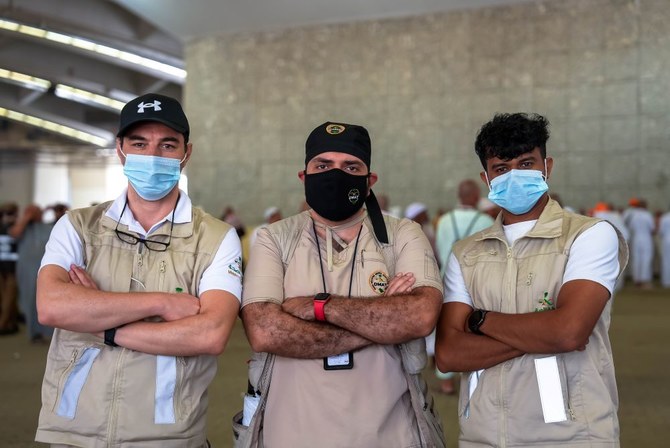
The team of doctors, who arrived from hospitals around Saudi Arabia, are putting their skills to use for Hajj. (AN Photo/Huda Bashatah)
2 / 2
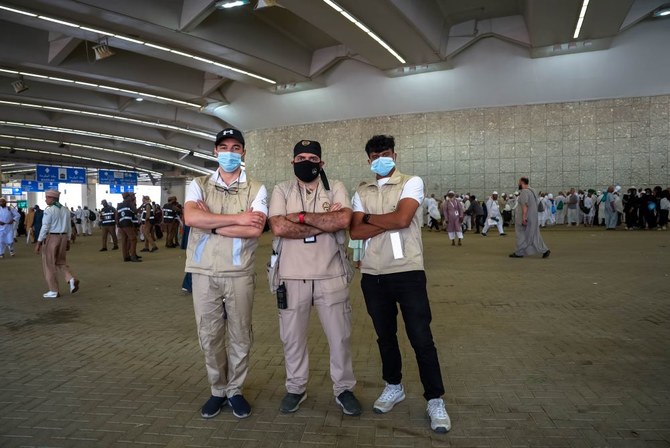
The team of doctors, who arrived from hospitals around Saudi Arabia, are putting their skills to use for Hajj. (AN Photo/Huda Bashatah)
Short Url
Updated 18 June 2024
Follow

Paramedics in Makkah saving lives amid scorching heat

  • Doctor Nawaf Karshami: It’s an amazing feeling to be able to help the pilgrims that need the help, and especially the elderly persons who are unable to walk
  • Doctor Loui Al-Sulimani said that pilgrims can avoid heat exhaustion through proper hydration, self-cooling and avoiding the outdoors during peak heat hours

MAKKAH: Doctors and paramedics are saving the lives of pilgrims in Makkah amid scorching summer temperatures.

Arab News interviewed a Disaster Medical Assistant Team from the Ministry of Health. The team of doctors, who arrived from hospitals around Saudi Arabia, are putting their skills to use for Hajj.

Nawaf Karshami, a doctor and emergency medicine specialist, told Arab News that most of the pilgrim patients treated by the team are suffering from exhaustion due to high temperatures.

“We have very high degrees, especially here in Makkah. So, most of the pilgrims came in need of hydration and needed to be covered from the sun with ice bags.

“Thankfully, we did our best to help the pilgrims, to smooth the way of the pilgrims to do their Hajj and perform their Hajj. It’s an amazing feeling to be able to help the pilgrims that need the help, and especially the elderly persons who are unable to walk.”

Doctor Loui Al-Sulimani, a consultant in emergency and disaster medicine, said pilgrims can avoid heat exhaustion through proper hydration, self-cooling and avoiding the outdoors during peak heat hours.

He also advised pilgrims to “wear protective, cool clothes, and also use an umbrella and any coverage for your head.”

The unit has received many cases of foot injuries, Al-Sulimani said, adding: “Because of the hot weather, most of the cases related to the suboptimal shoes.

“We are glad that we are participating this year and the previous year, and high season, with all responding agencies here to provide the best care for our pilgrims.”

Doctor Abdulqader Salman, a doctor and emergency specialist, described the “incredible experience” of helping pilgrims.

“We did not face any difficult challenges, thank God. As the Disaster Medical Assistant Team, we really worked together to help out the pilgrims.”

Health services provided to worshipers include medical and specialized clinics, pharmacies, dialysis centers, intensive care units and isolation units, the Health Ministry said in a report quoted by the Saudi Press Agency.

The ministry also has 250 employees and health practitioners on hand to aid pilgrims, including 50 doctors specialized in intensive care, cardiology, emergency, internal medicine, surgery, obstetrics and gynecology, orthopedics, family and community medicine, and fighting infections.

The Saudi health system seeks to provide the highest levels of care for pilgrims with health facilities across Makkah, Madinah and the holy sites.

Before the beginning of the Hajj season, the ministry urged people in Saudi Arabia to receive vaccinations and to register them via the Sehhaty app, the Saudi Press Agency reported.

Mandatory vaccinations include a dose of the COVID-19 vaccine and one of the influenza vaccines taken this year, along with a dose of the meningitis vaccine taken within the past five years.

Rare sighting of critically endangered leatherback turtle in Red Sea

Updated 05 February 2026
Follow

Rare sighting of critically endangered leatherback turtle in Red Sea

  • Turtles travel thousands of kilometers to Red Sea
  • Nesting 6,500km away in India’s Andaman Islands

RIYADH: Saudi Arabia’s National Center for Wildlife has documented a rare sighting of a leatherback sea turtle in the Red Sea, marking a significant biological record for one of the planet’s most critically endangered marine species.

The sighting occurred approximately 30 km off the coast of Al-Qunfudhah within the Blue Holes Protected Area, a newly established marine reserve, according to a recent report from the Saudi Press Agency.

The NCW said the presence of a leatherback in these waters was an exceptional event.

Recognized as the largest turtle species on Earth, the leatherback can weigh up to 900 kilograms. It has a unique leathery, black carapace — distinguished by five longitudinal ridges rather than a hard bony shell — and able to dive to depths exceeding 1,000 meters.

Shutterstock image

Noting the species’ migratory nature, the center explained that leatherbacks travel thousands of kilometers foraging for jellyfish. The specimen likely navigated through the Bab Al-Mandeb Strait in search of food.

This is considered a remarkable journey, the NCW said, noting that the nearest known populations reside in the Indian Ocean, spanning waters from South Africa to Sri Lanka (roughly 7,000 to 8,000 km away).

The closest known nesting grounds are located in India’s Andaman Islands, approximately 6,500 kilometers away. No nesting activity has been recorded in the Red Sea.

According to the Red List of the International Union for Conservation of Nature, the leatherback is Critically Endangered in the Indian Ocean.

While data for the Red Sea and Arabian Gulf is scarce, recent isolated sightings include a juvenile recorded in Jordan in December 2025 and another off Djibouti in 2019.

The NCW emphasized that these rare appearances highlight the ecological importance of the Kingdom's marine conservation efforts in the Red Sea.

The center pointed to the Farasan Islands Marine Protected Area, along with the new Blue Holes and Ras Hatiba reserves, as critical sanctuaries that could support the expansion in range of such endangered species.