

Pakistan creating special police unit to protect foreigners in Islamabad — interior minister

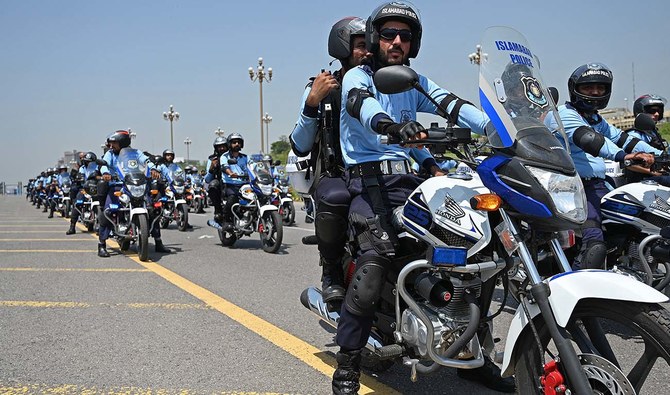
Police personnel from the 'Eagle Squad Unit' start patrolling the streets during a ceremony in Islamabad on June 18, 2021. (AFP/File)
Short Url
Updated 16 June 2024
Follow

Pakistan creating special police unit to protect foreigners in Islamabad — interior minister

  • Pakistan’s interior minister meets China’s Ambassador to Pakistan Jiang Zaidong in Islamabad 
  • Separatist and religiously motivated militants have targeted Chinese nationals in Pakistan recently

ISLAMABAD: The Pakistani government is creating a special police unit for the protection of foreign nationals in Islamabad, Interior Minister Mohsin Naqvi said on Sunday, as Pakistan looks to bolster security for Chinese citizens in the country. 

Naqvi’s comments came during a meeting with China’s Ambassador to Pakistan Jiang Zaidong at the Chinese embassy in Islamabad on Sunday, state broadcaster Radio Pakistan said. 

China is a major ally and investor in Pakistan but both separatist and religiously motivated militants have attacked Chinese projects in recent years, killing Chinese personnel. 

The most recent attack targeting Chinese nationals took place in March when five Chinese workers were killed in a suicide bombing. The Chinese nationals were on their way to a hydropower project funded by Beijing being built in Dasu in the country’s northwest when their vehicle was targeted. 

“Mohsin Naqvi said a separate force SPU [Special Protection Unit] is being created in Islamabad for the protection of foreign nationals,” Radio Pakistan said in a report. 

The March blast was the third major attack in a little over a week on China’s interests in the South Asian nation, where Beijing has invested more than $65 billion in infrastructure, energy and other projects as part of the China-Pakistan Economic Corridor (CPEC).

China has repeatedly called on Pakistan to ensure its nationals in the South Asian country are kept safe from militant attacks. Islamabad has since then taken measures to enhance the security of Chinese nationals in the country. 

Naqvi briefed the Chinese envoy regarding the security plan for Chinese engineers and staff working on CPEC and other projects, the state media said. 

“The minister said no one can create a rift in the eternal friendship between Pakistan and China and any such conspiracy will never be allowed to succeed,” Radio Pakistan said. 

The minister said the security of Chinese nationals working for Pakistan’s construction and development was Islamabad’s first priority. 

“The Chinese ambassador expressed satisfaction over the security arrangements,” Radio Pakistan said. 

An SPU of the police has already been formed in Pakistan’s southern port city of Karachi for the security of Chinese nationals in the metropolis. 

Sindh’s top cop earlier this week reviewed security measures for Chinese nationals in the southern Pakistani province. 


Pakistan urges concessional finance for developing nations to boost clean energy security

Updated 6 sec ago
Follow

Pakistan urges concessional finance for developing nations to boost clean energy security

  • Pakistan has emerged as one of world’s fastest growing solar markets, with 12GWs of off-grid and 6GWs of net-metered capacity in 2025
  • PM’s aide says Islamabad remains committed to Paris Agreement, looks for continued support in building a resilient and low-carbon future

ISLAMABAD: Pakistan has urged international partners to scale up concessional financing for developing countries, the country’s Press Information Department (PID) said on Sunday, citing an aide to Prime Minister Shehbaz Sharif.

The call was made by Sharif’s coordinator on climate change, Romina Khurshid Alam, while delivering Pakistan’s national statement at the 16th International Renewable Energy Agency (IRENA) Assembly in Abu Dhabi.

Pakistan has emerged as one of the world’s fastest growing solar markets, with 12 gigawatts (GWs) of off-grid and over 6GWs of net-metered solar capacity by the end of 2025. Last fiscal year, renewables accounted for a historic 53 percent of total electricity generation, according to Alam.

The prime minister’s aide stressed that affordable funding for developing nations is critical to accelerating their transition to clean energy and strengthening energy security amid rising climate and economic challenges.

“Alam reaffirmed Pakistan’s target of achieving 60 percent renewables in the power mix by 2030,” the PID said in a statement.

“In her call to action, she urged IRENA and Member States to increase concessional finance for developing nations, treat technologies such as energy storage and green hydrogen as global public goods, and strengthen regional cooperation for shared energy security.”

IRENA is a global intergovernmental agency for energy transformation that serves as the principal platform for international cooperation, supports countries in their energy transition, and provides state of the art data and analyzes on technology, innovation, policy, finance and investment. Its membership comprises 170 countries and the European Union (EU).

The 16th session of the IRENA Assembly is taking place on Jan. 10-12 in Abu Dhabi and focuses on the theme of “Powering Humanity: Renewable Energy for Shared Prosperity.” The session has gathered global leaders and energy decision-makers to discuss strategies and underline necessary actions for the acceleration of renewable energy across countries, regions, and the world, driving economic inclusion, equity, and human well-being.

Alam shared that Pakistan is taking action against energy poverty through initiatives like the Punjab Solar Panel Scheme 2026, which provides free or subsidized systems to low-income households.

She highlighted how distributed solar kits have restored power and livelihoods in flood-affected communities and offer a replicable model for climate-resilient recovery.

“Pakistan remains fully committed to the Paris Agreement and looks to IRENA for continued technical and financial support in building a resilient, inclusive, and low-carbon future,” Alam said.

Adopted in 2015 to combat climate change, the Paris Agreement binds nations to hold “the increase in the global average temperature to well below 2°C above pre-industrial levels” and pursue efforts “to limit the temperature increase to 1.5°C above pre-industrial levels.”