
BEIRUT: Hezbollah intensified its attacks on Friday after a Lebanese village was shaken by Thursday night’s Israeli strike that killed two civilian women in a house in Jannata, in Tyre.
Over 10 people, most of whom were children and women, were injured in the Jannata assault.
A security source in Lebanon described Hezbollah’s escalation in the past 48 hours as “a message to Israel stating that any assassination will be faced with a fiery salvo with no geographic limits.”
Hezbollah announced on Friday morning that “in response to the attack on Jannata in southern Lebanon, which killed and injured civilians, it bombed the Kiryat Shmona and Kfar Szold settlements with dozens of Katyusha and Falaq missiles.”
Hezbollah said it “targeted buildings used by soldiers in Metula with appropriate weapons, causing direct hits.”
In a series of statements, Hezbollah announced “targeting Al-Ramtha and Al-Semmaqah in the occupied Kfarshouba hills with missile weapons, as well as the Metula site with appropriate weapons.”
It also targeted in the afternoon “the spy systems in Misgav Am with appropriate weapons, which led to their destruction.”
Hezbollah’s attacks also reached and destroyed “the spy equipment in the Jal Al-Deir site.”
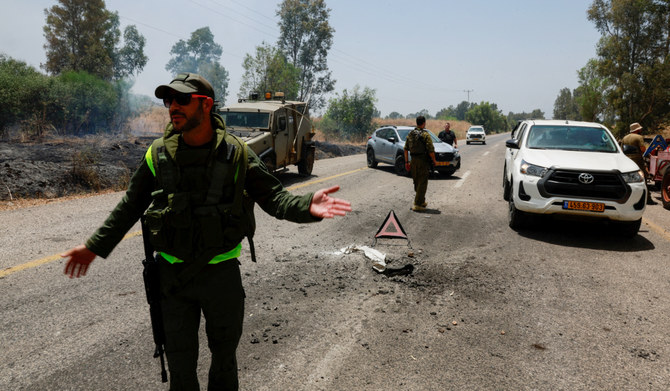
Israeli army spokesperson Avichay Adraee said that two soldiers were slightly injured after an anti-armor missile landed in an area in northern Israel.
They were transported to the hospital for medical treatment.
Meanwhile, Khiam, on the outskirts of Deir Mimas, Kfarkila, and Odaisseh, was subject to artillery shelling.
An Israeli shell landed in the square of the Taybeh village.
Israeli artillery shelling containing internationally prohibited white phosphorus caused a fire in a neighborhood in Mays Al-Jabal.
The Tallouseh village was also shelled using phosphorus bombs.
Two cases of suffocation were reported in Kfarkila due to the eruption of fire.
The outskirts of Aita Al-Shaab in Bint Jbeil were also subject to sporadic artillery shelling, while the outskirts of Houla over the Al-Slouqi valley were subject to phosphorus shelling.
The targeted area is the closest to the Litani Line and is included in the UN Resolution 1701, which called for Israeli forces to withdraw behind the line in the context of the 2006 Lebanon War.
Israeli reconnaissance planes were seen flying over the villages and towns of Tyre.
Israeli Army Radio reported severe damage to property and infrastructure as a result of seven rockets falling in Kiryat Shmona.
Diplomatic efforts are underway to contain the accelerating developments on the Lebanese southern front.
Israeli media said Israel had shown interest in a French-American initiative to reduce tension on the northern front with Lebanon.
Israeli Defense Minister Yoav Gallant, however, ruled out joining an initiative promoted by French President Emmanuel Macron.
France, the US, and Israel were set to form a contact group to work on defusing tensions on the border with Lebanon under the Macron initiative.
During the G7 summit, Macron said: “France, the US, and Israel will work within a trilateral framework on a French roadmap aimed at containing tension on the border between Israel and Lebanon.”
Gallant, however, accused France of “adopting anti-Israeli policies.”
He said: “Israel will not be a party in the trilateral framework suggested by France.”
Israeli Chief of Staff Herzi Halevi stressed: “The army is preparing to deal with Hezbollah.”
Former Israeli Chief of Staff Benny Gantz — a member who resigned from the war cabinet — said that “the best solution to end the war with Hezbollah on the northern front is a political solution.”
Gantz added: “If we can prevent a war with Lebanon through political pressure, we will do it, and if not, we will move forward.”
In his Friday sermon in Baalbak, Sheikh Mohammed Yazbek, the head of Hezbollah’s Shariah Council, said: “The resistance is bogging down the Israelis in Gaza’s mud, troubling it in the West Bank, and hitting it at its core by support fronts that have vowed to continue the path until the war on Gaza is stopped.”