Pakistan raises defense budget by 17.5% to $6.15 billion amid surge in militancy

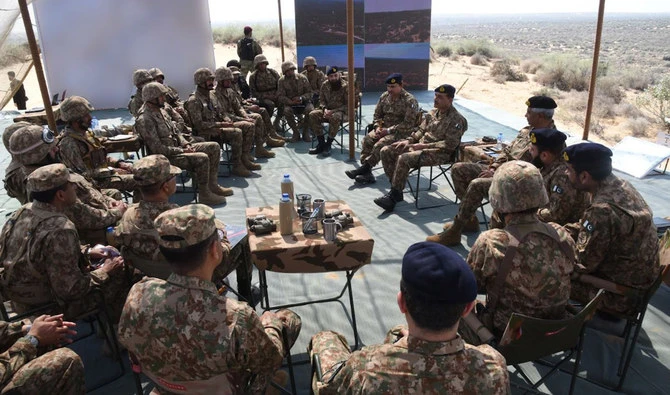
In this file photo, taken and released by Pakistan’s Inter-Service Public Relations (ISPR) on March 9, 2024, Pakistan’s Army Chief General Asim Munir meets military personnel during an exercise in Rahim Yar Khan. (Photo courtesy: ISPR)
Short Url
Updated 13 June 2024
Follow

Pakistan raises defense budget by 17.5% to $6.15 billion amid surge in militancy

  • Defense spending in Pakistan draws media focus as debates over security needs and public services persist
  • Media coverage also reflects concerns about transparency, with few details available on the overall spending

ISLAMABAD: Pakistan’s finance minister Muhammad Aurangzeb announced a 17.5 percent increase in the country’s defense budget on Wednesday, saying the government had decided to allocate Rs2.12 trillion ($6.15 billion) for the country’s security needs in view of its geopolitical situation.
Pakistan’s defense budget consistently attracts media attention due to the military’s substantial role in both the political and economic arenas of the country.
The allocation of significant funds to defense sparks debates over the balance between security needs and other critical public services, such as education and health care.
Media coverage and public discussions also reflect concerns about transparency, with governments only mentioning the overall figure without sharing further details.
“Rs2.122 trillion will be provided for defense needs,” the finance minister said during his address to the National Assembly. “And Rs849 billion are being allocated for civil administration expenses.”
Last year, the defense allocation stood at Rs1.80 trillion ($5.23 billion).
According to Pakistan’s Dawn newspaper, the allocated amount “presents an incomplete picture of the country’s actual military expenditure.”
“A significant sum of Rs662 billion [$1.92 billion], designated for retired military personnel, which equals to about 31pc of allocation for the armed forces, will not be drawn from the defense budget, rather government’s current expenditure,” it reported.
Pakistan has witnessed a surge in militant violence in recent years, prompting its armed forces to carry out targeted operations in areas adjoining its border with Afghanistan.
Pakistan’s army and other law enforcement agencies are also responsible for the providing security to Chinese nationals working on the China-Pakistan Economic Corridor, which is widely viewed as pivotal to the country’s economic security.
Militant groups have periodically targeted these Chinese workers, killing five of them earlier this year in a suicide bombing in Pakistan’s northwest while they were going to the site of a hydropower project.


Pakistan Airports Authority reports ‘historic’ twin-engine aircraft landing in Lahore

Updated 8 sec ago
Follow

Pakistan Airports Authority reports ‘historic’ twin-engine aircraft landing in Lahore

  • Twin-engine aircraft are usually larger, heavier and require better airport infrastructure, navigation systems to land
  • Pakistan Airports Authority says landing reflects its commitment to enhance aviation sector, strengthen infrastructure

ISLAMABAD: The Pakistan Airports Authority (PAA) announced on Saturday that the New General Aviation Aerodrome achieved a significant milestone when it handled the landing of a twin-engine aircraft. 

A twin-engine aircraft has two engines that provide it redundancy and increased performance compared to single-engine counterparts. These aircraft range from small twin-engine propeller planes to large commercial jetliners. The presence of multiple engines enhances safety by allowing the aircraft to continue flying in the event of an engine failure.

However, twin-engine aircraft are usually larger, heavier and more complex than single-engine planes. They require advanced airport infrastructure such as better runways, navigation systems and air traffic coordination. 

“The New General Aviation Aerodrome, Lahore achieved another significant operational milestone today with the successful landing of a twin-engine aircraft, following the recent arrival of a single-engine aircraft,” the PAA said in a statement. 

It said the flight was also boarded by Air Vice Marshal Zeeshan Saeed, the director general of the PAA. The move reflected “strong institutional confidence” in the aerodrome’s safety standards, operational capability, and overall readiness, it added. 

“The landing was conducted with exceptional precision and professionalism, demonstrating the aerodrome’s robust operational framework, technical preparedness, and effective airside coordination in accordance with contemporary aviation requirements,” the PAA said. 

It said the landing represented a “major advancement” in Pakistan’s general aviation sector and underscores the PAA’s commitment to enhancing regional aviation capacity, strengthening infrastructure and promoting excellence in aviation development.