Aston Villa owner Nassef Sawiris considering legal action over Premier League spending rules

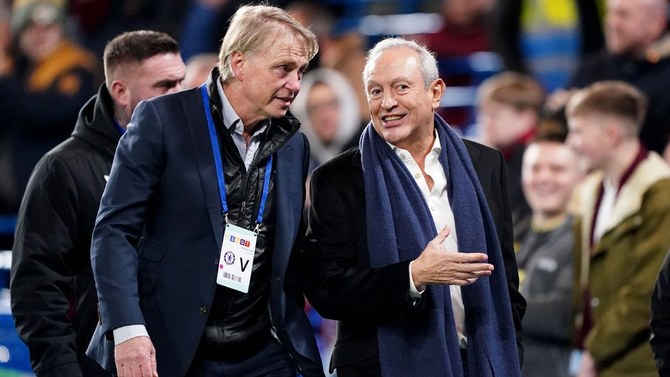
Nassef Sawiris (R) with co-owner Wesley Edens. credit: x platform
Short Url
Updated 12 June 2024
Follow

Aston Villa owner Nassef Sawiris considering legal action over Premier League spending rules

  • Villa had a proposal to raise the maximum permitted losses from 105 million to 135 million rejected at the Premier Leagues' annual general meeting last week
  • Premier League clubs have, however, agreed to trial a new financial system next season, including a cap on spending to replace PSR from the 2025-26 season

Aston Villa owner Nassef Sawiris says he is considering taking legal action against the Premier League's profit and sustainability rules (PSR).
In an interview with the Financial Times, Sawiris — Egypt's richest man — said the regulations, which place a limit on the amount clubs are able to lose across a three-year period, do not make sense and are not good for football.
Villa had a proposal to raise the maximum permitted losses from 105 million to 135 million rejected at the Premier Leagues' annual general meeting last week.
Sawiris, who called PSR anti-competitive, said he was seeking advice over the prospect of taking legal action against them.
Some of the rules have actually resulted in cementing the status quo more than creating upward mobility and fluidity in the sport, he told the Financial Times in an interview. The rules do not make sense and are not good for football.
He added: "Managing a sports team has become more like being a treasurer or a bean counter rather than looking at what your team needs."
It's more about creating paper profits, not real profits. It becomes a financial game, not a sporting game.
Premier League clubs have, however, agreed to trial a new financial system next season, including a cap on spending to replace PSR from the 2025-26 season.
The Premier League said in a statement: "Clubs agreed to trial an alternative league-wide financial system next season on a non-binding basis. The existing PSR will remain in place, but clubs will trial squad cost rules (SCR) and top-to-bottom anchoring rules (TBA) in shadow."

This will enable the league and clubs to fully evaluate the system, including the operation of Uefas equivalent new financial regulations, and to complete its consultation with all relevant stakeholders.
Everton and Nottingham Forest were given points deductions last season for breaching the 105m limit. In March, Villa reported a loss of 119.6m ($152m) after tax in the year ending May 31, 2023.
The Athletic reported last week that champions Manchester City had begun a separate legal case against the Premier League associated party transaction (APT) rules.
GO DEEPER
Premier League fails with attempt to close Financial Fair Play loophole
For the past 18 months, there has been the inescapable feeling internally that Aston Villa would need to move on a first-team player for substantial profit if they intend to continue spending in line with performance on the pitch and to stay on the right side of PSR.
In the recent set of financial accounts, Villa reported a loss of 119.6m ($152m) after tax in the year, compared to the marginal profit of 300,000 from 12 months prior.
It is a delicate financial act, with Villa juggling on-pitch aspirations and financial compliance off it. Strategy centers on managing concerns around PSR with NSWE, Villas ownership group, appointing Bjorn Schuurmans as a secretary. Schuurmans has worked in tax and structuring at other companies and will be relied upon in managing this summer's finances.
Villas' wages-to-turnover ratio — the percentage of money spent on employees' salaries — stood at 89 percent in 2022 and 2023, the fourth highest in the Premier League.
Concerningly, the three clubs above them were Leicester City, Nottingham Forest, and Everton, all of whom have breached PSR rules and are in varying processes of being sanctioned.
Villa feels PSR sanctions are restrictive and impede upwardly mobile clubs from regularly competing among the elite and why they proposed the idea to increase PSR losses, only for one other Premier League club to vote in favor.


Pakistan-born Australian Khawaja, set to retire from cricket, criticizes racial stereotypes

Updated 43 min 28 sec ago
Follow

Pakistan-born Australian Khawaja, set to retire from cricket, criticizes racial stereotypes

  • Usman Khawaja said he felt he was treated ‘a little bit different, even to now,’ because of his Pakistan and Muslim background
  • Khawaja was criticized in the days leading up to the Perth match for golfing twice, not taking part in an optional training session

Veteran Australia batter Usman Khawaja has announced he will retire from international cricket after the fifth Ashes test beginning Sunday at the Sydney Cricket Ground.

He didn’t go quietly.

The Pakistan-born Khawaja, who was the first Muslim to play for Australia, used his retirement announcement Friday to criticize the “racial” stereotyping he experienced during his career.

It will be the 39-year-old Khawaja’s 88th and final test — played at the ground where he began his first-class career. Khawaja scored his first Ashes century at the SCG with 171 against England in 2018.

It was also at that the SCG where he revived his career at age 35, scoring two centuries against England. That prompted one of the great late-career revivals, as Khawaja hit seven centuries in his next two years back in the side.

But Khawaja’s position had come under scrutiny and criticism this season after being unable to open in the first Ashes test in Perth due to back spasms and then missing the Brisbane test with the injury.

He was then initially left out in Adelaide until Steve Smith’s vertigo allowed Khawaja to return, before an 82 in the first innings there ensured he would stay in the side for the fourth test in Melbourne. Australia, with a 3-1 lead going into the fifth test, has retained the Ashes.

Khawaja said he felt he was treated “a little bit different, even to now,” because of his Pakistan and Muslim background.

“Different in the way I’ve been treated, different in how things have happened,” he said at a media conference in Sydney. “I had back spasms, it was something I couldn’t control. The way the media and the past players came out and attacked me . . . I copped it for about five days straight. Everyone was piling in.

“Once the racial stereotypes came in, of me being lazy, it was things I’ve dealt with my whole life. Pakistani, West Indian, colored players...we’re selfish, we only care about ourselves, we don’t care about the team, we don’t train hard enough.”

Khawaja was criticized in the days leading up to the Perth match for golfing twice and not taking part in an optional training session. Some commentators suggested the golf might have been responsible for his back issues.

“I can give you countless number of guys who have played golf the day before a match and have been injured, but you guys haven’t said a thing,” Khawaja told the assembled media.

“I can give you even more examples of guys who have had 15 schooners (large glasses of beer) the night before a game and have then been injured, but no one said a word because they were just being ‘Aussie larrikins,’ they were just being lads. But when I get injured, everyone went at my credibility and who I am as a person.”

Khawaja said he knew the end of his career was imminent.

“I guess moving into this series, I had an inkling this would be the last series,” he said. “I’m glad I can go out on my own terms.”

Khawaja has scored 6,206 runs at an average of 43.49 in his 87 tests with 16 centuries and 28 half-centuries.

“Usman has made a huge contribution to Australian cricket both through his outstanding achievements as one of our most stylish and resilient batters . . . and off field, particularly through the Usman Khawaja Foundation,” Cricket Australia chief executive Todd Greenberg said in a statement.

“Usman has been one of Australia’s most reliable opening batters and testament to his success was him being named ICC test cricketer of the year the same season that Australia won the World Test Championship (in 2023).”

Khawaja said his No. 1 emotion on announcing his retirement was “contentment.”

“I’m very lucky to have played so many games for Australia the way I have,” Khawaja said. “I hope I have inspired people along the way.”