

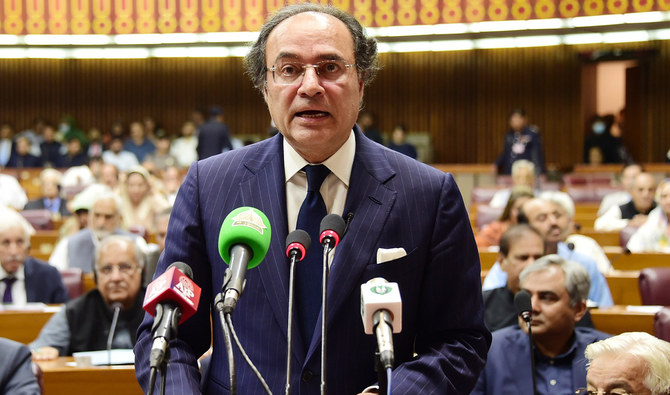

KARACHI: Finance Minister Muhammad Aurangzeb on Wednesday unveiled the much-awaited Rs18.877 trillion ($67.76 billion) federal budget for the fiscal year 2024-25, which is expected to play a pivotal role in Pakistan’s negotiations with the International Monetary Fund (IMF) to unlock yet another loan from the international lender.
Last year, Pakistan received $3 billion from the IMF under a Stand-By Arrangement (SBA) to stabilize its economy in the short term, including addressing immediate financial needs like debt repayments and supporting economic reforms.
However, given ongoing economic challenges like low foreign reserves and substantial fiscal deficits, Pakistan continues to need external financial support to meet its long-term goals and sustain structural reforms.
Speaking on the floor of the National Assembly while presenting the federal budget, Aurangzeb said Pakistan’s economy is expected to grow by 3.6% during the next fiscal year. He credited Prime Minister Shehbaz Sharif for fulfilling the conditions of Pakistan’s SBA agreement with the IMF, noting that the country’s economic indicators were showing a positive trend.
“Mr. Speaker, I think despite political and economic challenges, our progress on the economic front in the past year has been impressive,” Aurangzeb told lawmakers amid loud slogans from the opposition benches.
He said Pakistan’s improved economic conditions indicated that a “successful future” awaited the country.
“Mr. Speaker, we need to increase the speed of our progress and achieve the destination of economic independence,” the minister said.
“But this is not something that can be done overnight. For this, we need to work hard and work with all institutions and the people on a homegrown economic reform plan.”
The minister said the government has estimated total expenditures for the new fiscal year at Rs18.877 trillion ($67.76 billion), adding that the budget deficit is projected to be 6.9% of the GDP while the primary surplus is expected to be at 1.0 percent of GDP.
“The estimated revenue for FBR is Rs12.97 trillion ($46.55 billion) which is 38 percent more than the current fiscal year,” Aurangzeb said.
He added that the share of the provinces in revenue will be Rs7.438 trillion($26.7 billion), while the government’s target for the federal non-tax revenue has been kept at Rs3.587 trillion ($12.87 billion).
The minister said the net income of the federal government is expected to be Rs9.119 trillion ($32.72 billion).
Aurangzeb said the Public Sector Development Program (PSDP) plays a vital role in a country’s development, prosperity and social welfare.
“The government has devised the history’s biggest PSDP for the fiscal year 2024-25, which is worth Rs1,500 billion ($5.3 billion) and its volume is 101% larger than the previous year’s revised volume,” the finance minister noted.
SALARIES, TAX SLABS
He announced the government would raise the salaries of employees below grade 17 by 25 percent and 20 percent for employees in the 17-22 grade range. The minister also announced a 15 percent increment in the pension of retired government employees and said that the minimum wage was being increased from Rs32,000 ($115) to Rs37,000 ($133).
Aurangzeb said tax slabs for Pakistan’s salaried group will change while for the non-salaried individuals, the income tax rate can go as high as 45 percent. However, he clarified that the minimum tax slab will remain the same at Rs600,000 ($2,153) per year.
He said the gain on capital tax (CGT) on securities for non-filers would be kept as high as 45%, while it would remain at 15 percent for filers. However, he proposed that the tax on CGT on real estate for both filers and non-filers be kept at the rate of 15 percent.
The minister stressed the need for Pakistan to move toward a market-driven economy from a government-driven economy.
“We must transition from a government-controlled economy to a market-driven one, aligning our economic system with global standards, boosting exports, and prioritizing a savings-and-investment-based economy over a consumption-based model,” he said.
‘HIGH TAX COLLECTION TARGET’
Pakistani analysts said the budget will help in fiscal consolidation, saying it is broadly in line with the IMF’s guidelines.
“Though the tax collection target is high, we believe that considering new taxation measures Pakistan may be able to reach closer to the primary and fiscal deficit estimates,” Muhammed Sohail, chief executive officer of Topline Securities, told Arab News.
“Though no major reforms were seen on the exports, energy and other sectors, many tax exemptions have been removed,” he observed.
Sohail said that by increasing the tax on petroleum products to Rs80 per liter, will help the government collect around Rs350 billion ($1.26 billion).


