

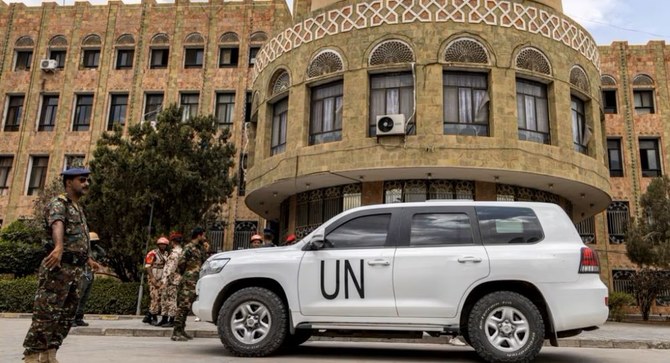

AL-MUKALLA: The UN secretary-general has called on the Iran-backed Houthis to free dozens of Yemenis who were seized by the militia during a recent crackdown.
Last week, the Houthis detained around 50 Yemenis working for UN agencies and other foreign organizations, as well as former US Embassy personnel in Sanaa and other provinces under their control.
In a statement on Tuesday, Antonio Guterres said: “This is an alarming development that raises serious concerns about the Houthis’ commitment to a negotiated solution to the conflict. The United Nations condemns all arbitrary detention of civilians. I demand the immediate and unconditional release of all detained UN personnel.”
On Monday, the Houthis claimed to have arrested an “American-Israeli spy network” of Yemeni nationals using international organizations as a cover for their operations.
In addition to four UN staff detained since 2021, Guterres said the Houthis held 13 workers from different agencies during their last campaign, including the Office of the UN High Commissioner for Human Rights, the office of the UN Yemen envoy, the Development Programme, UNICEF, the World Food Programme and UNESCO, as well as 11 workers from other civil society organizations.
He accused the Houthis of keeping the abducted workers incommunicado and preventing them from contacting their families or organizations.
To put pressure on them to release the workers, UN Yemen envoy Hans Grundberg met Houthi negotiator Mohammed Abdul Sallam and senior Omani officials in Muscat on Monday.
“We are working diligently to secure the immediate and unconditional release of our detained personnel through all available channels,” the envoy said, adding that the latest crackdown on civil society groups undermined UN-brokered attempts to reach peace in Yemen.
The Houthis have lately increased the number of arrests of private company owners, Yemeni workers with international organizations, dissidents, and Yemeni employees in Western embassies.
Yemen’s information minister said managers and staff from two big pharmaceutical businesses in Yemen were seized during the latest in a series of raids on private enterprises.
Moammar Al-Eryani alleged that the Houthis stormed the two enterprises because they refused to share earnings.
The management of Modern Pharma Company and Global Pharma Company in Sanaa were abducted, as well as managers and staff of the two enterprises’ branches in other Yemeni regions under Houthi control.
According to Yemeni news outlet Al-Masdar Online, a Houthi “judicial guard” named Saleh Dubaish, who oversees the seizing of assets from the militia’s opponents, stormed the two companies and seized employees.
At the same time, Yemeni and international rights groups and activists slammed the Houthis for accusing imprisoned Yemenis of working as spies for US and Israeli intelligence agencies.
On Monday, the Houthis released a videotape of 10 Yemenis from the alleged spy network in which they admitted to collaborating with US and Israeli agents and providing them with sensitive military information, as well as undermining the country’s health, agricultural and educational sectors and recruiting other Yemeni spies.
In a post on X, Fatehi bin Lazerq, editor of Aden Al-Ghad newspaper, described the Houthi claim as “shocking and very painful.” He said: “It confirms that this barbaric group is taking the people in areas under its control to prehistoric times.”
Experts argue that by accusing Yemenis of working as spies for Israel and the US, the Houthis aim to deprive those people of public support, incite hostility towards the West, and thus justify repressive rules in areas under their control.
Ibrahim Jalal, a nonresident scholar at Carnegie Middle East Centre, told Arab News the recent Houthi campaign would discourage Yemenis from joining international organizations or Western missions in Houthi-controlled parts of Yemen.
“The Houthi espionage accusations against Yemenis working for Western diplomatic missions and international humanitarian and development organizations mark yet another dangerous decline in personal freedoms, humanitarian access, and civilian safety and security, including (that of) women and children,” Jalal said.
He added that the Houthis would use the accused spies and other personnel as a negotiating chip to gain concessions from the international community.
“Externally, Houthi espionage fabrication, akin to Iran, uses citizens as ‘hostages’ to negotiate what they want, without regard for their lives and stability of their families,” Jalal said.


