

India always stood for peace, Modi says in response to Nawaz Sharif’s congratulatory post

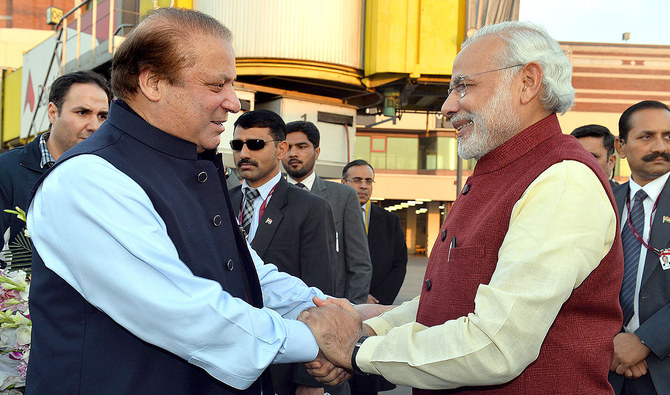
In this file photograph released by the Press Information Bureau (PIB) on December 25, 2015, Indian Prime Minister, Narendra Modi (R) shakes hands with Pakistan’s the-then Prime Minister, Nawaz Sharif in Lahore. (AFP/File)
Short Url
Updated 11 June 2024
Follow

India always stood for peace, Modi says in response to Nawaz Sharif’s congratulatory post

  • Elder Sharif, a three-time PM, took to X to congratulate Modi on winning third term as PM
  • Pakistan’s Sharif family has always been a proponent of peace with neighboring India

ISLAMABAD: Indian Prime Minister Narendra Modi has said the people of India had always stood for “peace and progressive ideas,” in response to an X message this week by former three-time Pakistani prime minister Nawaz Sharif to congratulate the Indian leader on becoming premier for a third time.
Pakistan’s Prime Minister Shehbaz Sharif and his elder brother and former three-time prime minister Nawaz greeted Modi in posts on the social media platform within hours of each other, in what was Pakistan’s first response to the election results from across the border.
“Your party’s success in recent elections reflects the confidence of the people in your leadership. Let us replace hate with hope and seize the opportunity to shape the destiny of the two billion people of South Asia,” Nawaz said in one post.

Modi responded:
“The people of India have always stood for peace, security and progressive ideas. Advancing the well-being and security of our people shall always remain our priority.”

New Delhi invited leaders of seven regional countries to Sunday’s grand inauguration at the Rashtrapati Bhavan, or president’s palace, in New Delhi but Sharif wasn’t included.
A few hours after Shehbaz Sharif had wished him well, Modi responded on X: “Thank you @cmshehbaz for your good wishes.”

The elder Sharif has always been a proponent of peace with India, which is widely believed to be one of the main reasons he fell out with his country’s powerful military in his last tenure from 2013 to 2017. In 2015, Modi made a surprise stopover in Pakistan to meet Nawaz, then prime minister, the first time an Indian premier has visited the rival nation in over a decade.
The visit, requested by Modi just hours earlier before he flew back home from Afghanistan, raised hopes that stop-and-start negotiations between the nuclear-armed neighbors might finally make progress after three wars and more than 65 years of hostility.
Nuclear-armed rivals and neighbors India and Pakistan have fought three wars, including two over control of the disputed Kashmir region in the Himalayas.
Ties between the two have been frozen since India ended the special status of Jammu and Kashmir state in 2019 and split it into two federally administered territories.
They came closer to yet another war when India launched air strikes inside Pakistan to target what it said was a militants’ sanctuary in 2019. Islamabad denies Indian accusations it harbors militants. 
Analysts don’t see any chance of peace talks between the two sides anytime soon, however.
“Modi is not ready as yet,” said author and defense analyst Ayesha Siddiqa. The two sides have some backdoor diplomatic initiatives, however, which may be a “a gentle start.”
With inputs from Reuters


Pakistan offers seaport for global cargo transshipment amid Gulf conflict escalation

Updated 12 sec ago
Follow

Pakistan offers seaport for global cargo transshipment amid Gulf conflict escalation

  • Karachi Port Trust says its services can ensure ‘continuity and stability’ of maritime trade
  • The region is currently witnessing significant disruptions to global trade and oil shipments

KARACHI: Pakistan has offered its Karachi seaport for uninterrupted global cargo transshipments as escalating Middle East tensions threaten maritime trade, the country’s largest port operator said on Friday.

Iran has been rocked by joint US and Israeli strikes since Feb. 28 that killed Supreme Leader Ayatollah Ali Khamenei. Tehran retaliated with missile and drone attacks on US, Israeli and allied targets across the Gulf, plunging the region into conflict and uncertainty.

The escalation disrupted air travel, heightened military activity, and disrupted shipping through the Strait of Hormuz, a key route carrying roughly 20 percent of global oil shipments.

The Karachi Port Trust (KPT) said in a statement it was ready to support international shipping lines by offering transshipment services to regional ports, helping ensure the “continuity and stability” of global maritime trade.

“Karachi Port Trust remains fully prepared to support the international maritime community and to provide reliable, efficient, and secure port services in the interest of sustaining regional trade connectivity,” KPT Chairman Shahid Ahmed said, according to a statement circulated by the port authority.

It added the facility could help stabilize maritime trade by offering transshipment services for cargo destined for ports across the region.

The statement said as a demonstration of its capability, international vessels MV TS TACOMA and MV TS SYDNEY arrived in Karachi and discharged large number of containers as transshipment cargo.

“The containers will subsequently be transshipped from Karachi to Jebel Ali in the Middle East,” it continued.

Pakistan Maritime Affairs Minister Junaid Anwar Chaudhry on Thursday highlighted the importance of the Gwadar port city’s transshipment role as major shipping routes face disruption from the ongoing conflict.

The developments come as the Strait of Hormuz, a strategic waterway between Iran and Oman and one of the world’s most critical oil transit routes, has been blocked by Iran which has threatened to attack ships that attempt to transit through it.

US President Donald Trump has assured shipping companies of naval escorts and insurance support to protect vessels.

The escalating tensions have contributed to a sharp rise in energy prices and significant disruptions to tanker traffic through the strategic waterway.

Pakistan has long viewed its seaports as strategic assets that could boost trade with Central Asia and the Gulf region, while helping the country earn valuable foreign exchange.