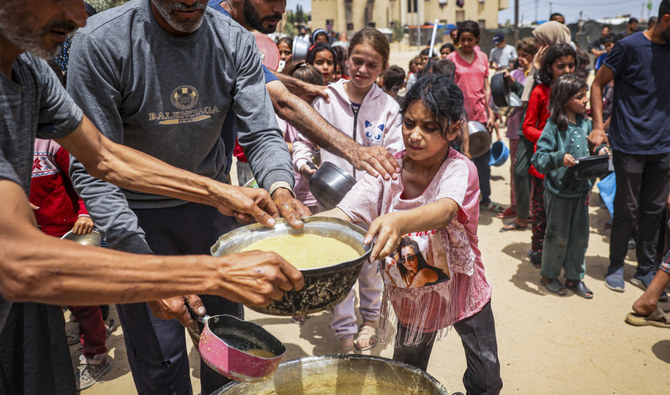

DUBAI: Eight months after the war in Gaza began, the Palestinian population is in the grips of an unprecedented humanitarian catastrophe, deprived of sufficient food, water, shelter, sanitation and health services while under constant Israeli bombardment.
Israel’s military offensive has killed at least 36,654 Palestinians and injured 83,309 since Oct. 7, according to Gaza’s Ministry of Health. The UN’s World Food Programme describes the situation in northern Gaza as a “full-blown famine.”
In response to the deepening crisis, Jordan is hosting an emergency international conference today to assess the humanitarian response. The event, at the King Hussein bin Talal Convention Center near the Dead Sea, is co-hosted by Egypt and the UN.
Jordan’s Royal Court said the aim of the meeting is “to identify ways to bolster the international community’s response to the humanitarian catastrophe in the Gaza Strip” and seek “commitment for a collective coordinated response to address the humanitarian situation in Gaza.”

A man, woman, and children ride in the back of a tricycle loaded with belongings and other items as they flee bound for Khan Yunis, in Rafah in the southern Gaza Strip on May 11, 2024. (AFP)
The crisis has dramatically worsened since the start of the Israeli ground offensive in Gaza’s southernmost city of Rafah on May 6, Guillemette Thomas, the Medecins Sans Frontieres medical coordinator for Palestine, told Arab News.
She described conditions in Gaza as “catastrophic,” as she outlined the immense challenges international aid agencies face in distributing food, water, fuel and medical supplies to the population.
“Since the ground operations started, we’ve seen almost 1 million people leaving the area, and moving from one place to another with very few things, living already in dire conditions,” Thomas said.
The majority of the people who had been sheltering in Rafah, having already been displaced from elsewhere in Gaza, have now been forced to evacuate to Deir Al-Balah and Khan Younis, where there are no facilities in place to support them.

Palestinians flee with their belongings as smoke rises in the background, in the area of Tel Al-Sultan in Rafah in the southern Gaza Strip on May 30, 2024. (AFP)
“Intensified hostilities and military operations in Rafah have so far forced the displacement of approximately 1 million people,” a UN spokesperson told Arab News. “This has deepened the humanitarian crisis and significantly destabilized humanitarian aid.
“Less than 100,000 people are estimated to have remained in Rafah governorate. At present, there are no functioning hospitals and no functioning bakeries inside Rafah. According to UNICEF, nine of every ten children in Gaza are experiencing severe food poverty, surviving on two or fewer food groups per day.
“Deir Al-Balah and Khan Younis, where almost a million people have fled, are very crowded; people face dire shortages of food, clean water, medical supplies and healthcare services. Partners are currently providing hot meals in the area.
“In northern Gaza, aid, primarily food, that has arrived via the northern crossings since May 1 has provided some relief, but lack of access to clean water, nutritious foods, health care and sanitation continue to devastate the area.”

A UN spokesperson said that intensified hostilities and military operations in Rafah have so far forced the displacement of approximately 1 million people. (AFP)
Gazan authorities have said about 3,500 children are at imminent risk of starvation because of severe shortages of milk, food, nutritional supplements and vaccines. Females are considered especially vulnerable.
“When it comes to women and girls, they are living in terrible conditions,” said Thomas. “There is no privacy, no hygiene and no access to basic necessities like showers or toilets.”
She said pregnant women are in an impossible situation, unable to give birth in humane conditions because of limited access to health facilities, which are overwhelmed by the scale of needs and a lack of supplies.
In the past eight months, at least 20,000 women have given birth in Gaza under extremely challenging conditions, said Dr. Hafeez ur Rahman of the nongovernmental organization Alkhidmat Foundation Pakistan.
“These newborn babies are also at high risk of malnutrition because their mothers do not intake enough nutrients in order to be able to feed them,” he told Arab News.
Rahman said most relief operations have been halted, including the provision of hot meals and clean drinking water, because of the ongoing fighting.

According to UNICEF, nine of every ten children in Gaza are experiencing severe food poverty, surviving on two or fewer food groups per day. (AFP)
Thomas said she fears the closure last month of the Rafah border crossing, through which much of the aid provided to Gazans had been arriving via Egypt, and restrictions placed on aid trucks at the Kerem Shalom border crossing, could make matters even worse. Kerem Shalom, which had been closed for several weeks, recently reopened but strict Israeli security checks remain in place.
“The number of trucks that used to enter before the closure was about 150 trucks per day,” said Thomas. “This is the number of trucks entering Kerem Shalom per week, now.”
The World Food Programme said that ongoing attacks have blocked access to its main warehouse in Rafah, and the quantity of aid entering Gaza fell by 67 percent to a daily average of 58 trucks between May 7 and May 28. The UN previously reported that 500 aid trucks entered Gaza each day on average in the months before Oct. 7.
“The incursion into Rafah has further choked off aid entering Gaza,” the spokesperson for the UN told Arab News. “The closure of Rafah has also reduced fuel supplies, affecting trucks, hospitals, sewage systems, desalination operations and bakeries.
“We need meaningful reassurances that our convoys and our facilities are not targeted. This means ensuring that the movement of aid movements within Gaza, including through checkpoints, is predictable and expedited.
“It also means all roads are operational because land routes are the most viable, effective and efficient aid delivery method for the passage of life-saving humanitarian assistance and fuel into Gaza.”

While Israeli officials have insisted there is no limit on the amount of aid that can enter Gaza, the UN has accused authorities of imposing “unlawful restrictions” on relief operations, including blocked land routes, communications blackouts and air strikes.
According to Thomas, the biggest challenges currently facing Medecins Sans Frontieres in Gaza are gaining access to the population and having the means to safely distribute the limited supplies of hygiene kits, medications and food.
“Insecurity in Kerem Shalom and around the border is making our work extremely difficult as it is difficult to get the supplies across the border safely, to reach the warehouse safely, and then to be distributed to the population,” she said.
Because supplies are so limited, food prices have surged. There has also been an increase in reports of looting of the few aid trucks permitted to enter in recent weeks.
“For many people, they are just totally desperate,” Thomas said. “They have no food, hey have nothing, and at some point you just need to survive and get food for your kids.”

The World Food Programme said that the quantity of aid entering Gaza fell by 67 percent to a daily average of 58 trucks between May 7 and May 28. (AFP)
Since the closure of the Rafah crossing, aid agencies have been exploring other access routes. At the Western Erez crossing in Zikim, approximately 50 to 60 trucks are now able to enter the territory each day. While this remains insufficient, it is providing some relief to the population.
“Recently, a new route has been used by these NGOs (nongovernmental organizations) to deliver aid to Gaza, which starts from Jordan and goes through Israel and the West Bank,” said Rahman, whose Alkhidmat Foundation Pakistan has used this route to deliver aid in partnership with the Jordan Hashemite Charity Organization.
However, all of these routes are fully controlled by Israeli forces and every consignment is subject to approval by authorities, aid officials say, adding that as a result, truckloads of humanitarian relief have been left queuing at the border, unable to enter.
“There is a dire need to create pressure on Israel by the neighboring countries and the UN,” said Rahman. “The upcoming conference could prove to be beneficial for convincing the international community and Israel to allow aid into Gaza.”

Humanitarian aid dropped on Khan Yunis falls near tents sheltering Palestinians displaced by conflict in the southern Gaza Strip on June 4, 2024. (AFP)
Meanwhile, the few hospitals still functioning have been completely overwhelmed by the number of wounded and the lack of basic medical supplies they need to treat casualties.
An Israeli hostage-rescue operation on Saturday in the Nuseirat refugee camp and areas around Al-Aqsa Martyrs Hospital in Deir Al-Balah resulted in more than 200 deaths and at least 400 injuries, according to Gaza health officials.
“Within the last few days, we have been receiving many mass-casualty incidents in Al-Aqsa Hospital, where more than 300 wounded patients arrived in 24 hours,” said Thomas. “Seventy of them were dead on arrival due to the bombing and the shelling in crowded areas.”
The majority of the casualties were women and children, many of whom suffered burns covering more than 40 percent of their bodies. Others sustained complex fractures and required traumatic amputations, she added.
“Unfortunately, many of them will die following these kinds of injuries because we are simply unable to provide the necessary care for them,” said Thomas.
“When it comes to supplies, the level of violence is extremely high and the entry of medical supplies has almost stopped, which leaves us in a very critical situation now.”

The few hospitals still functioning have been completely overwhelmed by the number of wounded and the lack of basic medical supplies they need to treat casualties. (AFP)
Thomas said only three hospitals are still functioning in southern Gaza: Nasser Hospital, Gaza European Hospital, and Al-Aqsa Hospital. A few field hospitals have been set up in Al-Mawasi and other areas, managed by NGOs such as UK-MED and International Medical Corps.
“It is very important to understand that we cannot replace a hospital with a field hospital,” said Thomas. “We are doing what we can in these kinds of facilities but it is really not enough.”
The conditions for patients in field hospitals are far from ideal, she explained, adding: “They are under tents, it’s extremely hot and it’s unsafe. Any shrapnel that enters the hospital area leaves everyone unprotected. It’s not safe for the patients or the health workers.”

Palestinians walk on a ravaged road in front of Nasser Hospital in Khan Yunis in the southern Gaza Strip on May 2, 2024. (AFP)
Doctors are also witnessing a rise in diseases that were unseen before the war, including numerous cases of acute diarrhea leading to dehydration, and skin diseases resulting from poor hygiene.
“Many diseases we’re seeing at primary health centers are directly related to living conditions: the lack of access to clean water, proper shelter and basic sanitation systems,” said Thomas.
“We need a ceasefire, we need this war to end. There is no other solution to be able to help this population. We need full access to the population. This is the message we want to send today.”