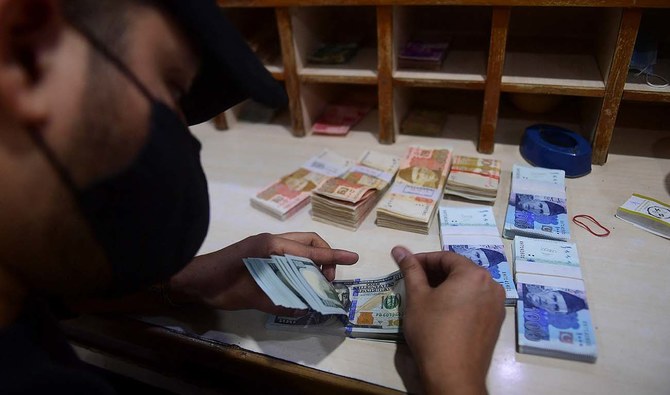
KARACHI: Pakistan’s central bank cut its key interest rate by 150 basis points on Monday in a widely expected move, marking its first rate reduction in nearly four years in its effort to boost growth amid a sharp decline in retail inflation.
The decision to cut the key rate to 20.5 percent comes two days ahead of Pakistan’s annual budget and a week after data showed inflation slowed to a 30-month low of 11.8 percent in May.
It also comes ahead of Pakistan’s negotiations with the International Monetary Fund (IMF).
Pakistan is in talks with the IMF for a loan estimated to be anything between $6 billion to $8 billion to avert a default for an economy that is growing at the slowest pace in the region.
The growth target for the upcoming year is expected to be higher at 3.6 percent than this year’s 2 percent and last year’s economic contraction.
Analysts and the business community have had mixed reactions to the cut, and are looking forward to the upcoming budget for clarity on the central bank’s next moves.
PAKISTAN BUSINESS COUNCIL
“With headline inflation decelerating by 550 bps from April to 11.8 percent in May, and the policy rate significantly positive, businesses generally expected a sharper cut.
“However, as the monetary policy committee points out, upward inflationary risks emanate from the FY 25 budget and future increases in energy tariffs. So the ball is in the government’s court to manage inflation.”
“Businesses should derive comfort from the narrowing current account deficit, a primary surplus on the fiscal account, deceleration in the growth of currency in circulation, declining food inflation, and stable FX reserves... All these factors augur well for further reduction in the policy rate.”
MUSADAQ ZULQARNAIN, DIRECTOR OF THE PAKISTAN TEXTILE COUNCIL
“I expect that, while the policy rate should come down by 300 basis points, out of abundant caution it was reduced by 150-200 basis points.
“It will surely help a bit, though the rates will still be in a higher than workable range. But this will set the direction. We will also have to wait for the budget to see what the overall impact (is).”
M ABDUL ALEEM, CEO AND SECRETARY GENERAL OF PAKISTAN’S OVERSEAS INVESTORS CHAMBER OF COMMERCE AND INDUSTRY
“At present our real policy rate stands at 10 percent. This leaves room for a higher cut, at least by 2 percent. However, the monetary policy committee decided to cut the rate by 150 bps.
“This decline in the policy rate will provide relief of around 600 billion rupees ($2.16 billion) in debt servicing to the government and also to businesses by lowering the cost of borrowing.
“Business confidence has already improved, as reflected in the latest OICCI Business Confidence Index.
“Post the June 12 budget, we expect a revival of economic activities and the creation of employment opportunities. Moreover, as inflation is declining, we expect more cuts in future.”
TAHIR ABBAS, HEAD OF RESEARCH AT ARIF HABIB LIMITED
“The central bank has indicated that inflationary pressures are easing, supported by a significantly positive real interest rate. We believe that this monetary easing cycle will persist, with an additional 3-4 percent decline expected in 2024.
“The stock market is expected to take the news positively. However, there remains fear and uncertainty over hefty taxation measures in the upcoming federal budget.
“For industries, it would be a welcome step as it would reduce borrowing costs. More importantly, it would be positive for the federal government fiscal account as well, as it is the largest borrower in the system.”
ABID SULERI, EXECUTIVE DIRECTOR OF THE SUSTAINABLE DEVELOPMENT POLICY INSTITUTE
“This is a prudent measure by the central bank. The central bank is cautious because of the upcoming budget and some measures that may push inflation up once again.
“Once in an IMF program, we may see some changes in the rupee-dollar parity.
“We need to remember that the monetary policy is not just for inflation, but also to encourage domestic savings to prevent dollarization.
“In the next two meetings, if things remain constant, we will see the key rate ease further.”
ALMAS HYDER, SENIOR MEMBER OF THE LAHORE CHAMBER OF COMMERCE AND INDUSTRY
“A rate cut signifies taming of inflation and creating opportunities for investment. This will start a positive cycle of investment planning for the future.”
MUSTAFA PASHA, CHIEF INVESTMENT OFFICER AT LAKSON INVESTMENTS
“(I) don’t see (the cut) being an issue with the IMF as we are still very far from an accommodative policy stance (12 percent or lower). (I) foresee aggressive rate cuts in the second half of the year (4-5 percent) if we get an IMF program.”


![]()

Expert and industry present mixed reviews on Pakistan central bank rate cut
Short Url
https://arab.news/bw6hc
Expert and industry present mixed reviews on Pakistan central bank rate cut
- Pakistan is in talks with the IMF for a loan estimated to be anything between $6 billion to $8 billion to avert a sovereign default
- The growth target for upcoming year is expected to be higher at 3.6 percent than this year’s 2 percent and last year’s economic contraction
Latest updates



© 2026 SAUDI RESEARCH & PUBLISHING COMPANY, All Rights Reserved And subject to Terms of Use Agreement.