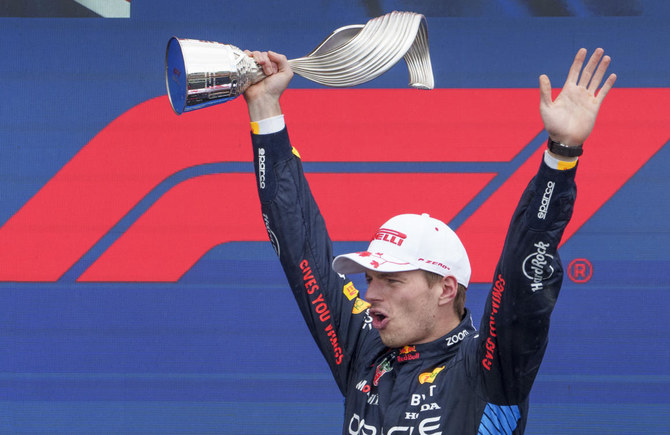
MONTREAL: Max Verstappen returned to form and completed a hat-trick of Canadian Grand Prix wins on Sunday when he triumphed for Red Bull in a thrilling, tactical and incident-filled race at the Circuit Gilles Villeneuve.
“Pretty crazy race,” said the Dutchman at the finish. “A lot happening. We stayed calm.”
The series leader and three-time champion rode his luck through changing wet and dry conditions and two safety car interventions to win by 3.879 seconds ahead of McLaren’s Lando Norris and Mercedes’ George Russell.
Seven-time champion Lewis Hamilton came home fourth, after being passed by Russell in the closing laps. Oscar Piastri was fourth in the second McLaren ahead of two-time champion Fernando Alonso of Aston Martin.
It was a 60th career victory for Verstappen and his 50th from the last 75 races.
Local hope Lance Stroll was seventh in the second Aston Martin ahead of RB’s Daniel Ricciardo and the two Alpines of Pierre Gasly and Esteban Ocon.
“What a race guys,” Verstappen told his team on the radio. “Not easy, but we did it! A great job by everyone. We made all the right calls. I enjoyed that one.”
“A lot of fun,” said Norris, whose result together with Piastri, brought McLaren their first points in Canada since 2014 on the 56th anniversary of the team’s first win, with Bruce McLaren, at the 1968 Belgian Grand Prix.
“An ugly race on my behalf and I am sorry for that,” Russell said, conceding he was disappointed not to convert his pole position into victory.
Five cars, including both Ferraris and both Williams, failed to finish.
On a day of showers, only the two Haas cars chose full wet tires to start as Russell, on intermediates, pulled clear of Verstappen. The entire field slithered through the opening laps. Hamilton passed Ricciardo to sixth.
When the sun returned, a dry line emerged and lap times tumbled, Russell and Verstappen swapping fastest laps at the front, nearly eight seconds clear of Norris.
Russell resisted Verstappen before the champion ran wide at turn two and fell within Norris’s reach, the McLaren man passing on lap 20, using Drag Reduction System (DRS) to sweep by. He then passed Russell on lap 21.
Behind the top four, Alonso in fifth resisted Hamilton before Sargeant crashed his Williams, prompting a safety car intervention. Norris stayed out, but Verstappen, Russell and Piastri pitted for inters, as did Alonso and Hamilton.
As the marshals struggled to remove Sargeant’s car, Norris pitted from the lead and re-joined third behind Verstappen and Russell, a harsh setback for the McLaren man.
“The safety car helped me in Miami but now it held me. It happens that’s racing,” Norris who enjoyed good fortune on the way to his maiden win in May, said after the race.
The race resumed on lap 30 with Leclerc gambling on hard tires, but as rain arrived again he dropped to 19th. Alonso then ran off and Hamilton surged to fifth, just behind Piastri.
As the track dried, Leclerc pitted again, before retiring.
As the other leaders pitted, Norris staying out to pad his lead and build an ‘over-cut’ before pitting on lap 47.
He took mediums, but as he re-joined , Verstappen speared through.
“The ride is bad, like a locked suspension,” grumbled the Dutchman with 20 laps to go in dry conditions. “I can’t touch any kerbs, it almost knocks me out.”
Another crash on lap 54 brought out a second safety car, Albon and a spinning Carlos Sainz tangling after Perez had smashed into the barriers and broken his rear wing.
Mercedes promptly pitted both cars, Russell for mediums and Hamilton for hards. They were fourth and fifth behind Verstappen and the two McLarens when racing resumed and the late drama unfolded.


![]()

Max Verstappen wins ‘crazy’ rain-hit Canadian Grand Prix
Short Url
https://arab.news/2tsm5
Max Verstappen wins ‘crazy’ rain-hit Canadian Grand Prix
- The series leader and three-time champion rode his luck through changing wet and dry conditions


Latest updates


© 2026 SAUDI RESEARCH & PUBLISHING COMPANY, All Rights Reserved And subject to Terms of Use Agreement.