


DUBAI: Hala Rharrit, who resigned as the US State Department’s Arabic-language spokesperson on April 24 over the government’s stance on Gaza, has commended President Joe Biden’s peace proposal, saying “this will hopefully alleviate some of the suffering; we’ll have to wait and see.” However, she expressed concern that he US is violating international law by continuing to sell weapons to Israel.
Appearing on Arab News current affairs program “Frankly Speaking,” Rharrit said she was pleased to hear President Biden calling for a ceasefire in Gaza, but cautioned that the peace plan neither addressed US arms sales to Israel, nor committed to creating a Palestinian state.
Biden outlined on May 31 a three-phase ceasefire proposal, beginning with Israeli troops pulling out of Gaza’s cities, releasing humanitarian aid, and freeing hundreds of Palestinian prisoners in exchange for Hamas returning some of the hostages and captured Israeli soldiers.
Under the plan, the warring sides would then discuss a full hostage release and military withdrawal, followed by multilateral talks to rebuild Gaza without rearming Hamas. One week into the US pressure campaign, the world still is waiting for signs that the ceasefire appeal is working.
“First and foremost, the priority is to stop the fighting and stop the violence by any means necessary,” Rharrit told “Frankly Speaking” host Katie Jensen during an interview that explored the motives and timing for her resignation from the State Department among other topics.
“I think we can see that there’s been intense suffering and every day that this conflict continues, there are more lives that are lost in Gaza. And I was very pleased to see that the president from the podium was advocating for a ceasefire and saying it is now time for this war to end.
“Of course, it is horrific that it’s taking this long. And I’m also very concerned that we have not stopped our US weapons flow to Israel.
“It does not address the fact that we are still in violation of US and international law, for all intents and purposes, and that we continue to supply deadly ammunition, offensive weaponry to the state of Israel. And that also needs to stop.
“And obviously the issue of a two-state solution and the Palestinian right to self-determination needs to be included in that. But, for the immediate term, we need a ceasefire. We need the weapons to stop dropping and we need the Gazans to be able to breathe and to live.”

Appearing on Arab News current affairs program “Frankly Speaking,” Rharrit said she was pleased to hear President Biden calling for a ceasefire in Gaza, but warned it did not prevent US arms sales to Israel nor commit to creating a Palestinian state. (AN Photo)
Rharrit was neither the first nor the last administration official to quit over the issue. Nearly a month earlier, Annelle Sheline of the State Department’s human rights bureau announced her resignation, and State Department official Josh Paul resigned in October.
A senior official in the US Education Department, Tariq Habash, who is Palestinian-American, stepped down in January, and Lily Greenberg-Call became the latest to go in mid-May when she left her position at the Department of the Interior.
Rharrit said she resigned after failing to influence the administration’s position from within and because the government’s stance made it “impossible” to promote US interests abroad. “I did it, really, to follow my conscience, and I did it, really, in service of my country,” said Rharrit.
“I became a diplomat 18 years ago to help the US promote its interests throughout the world, specifically in the Arab world, and to strengthen ties throughout this particular region. And I felt like I could effectively do that for the last 18 years. This policy unfortunately made it impossible.
“I saw that there was mass killing in Gaza that my government unfortunately was enabling through the continuous flow of US weapons. I could go on and on about the atrocities that we all bear witness to these last few months.
“I did everything I could since Oct. 7 to try to dissuade the US position, to try to help the situation. But after a while, it became clear that the policy was not shifting. And so I decided to submit my resignation, also to speak out on behalf of the US, not as a diplomat, but as an American citizen, to try to help the situation from the outside.”
Challenged by Jensen on whether it was the US policy itself that she objected to or the talking points the administration made her deliver as Arabic-language spokesperson, Rharrit said her opposition was not “based on personal reasons.” Rather it was intended to serve US interest in the face of “growing anti-American sentiment” in the Middle East.
Elaborating on the issue, she said: “The talking points I was expected to deliver to this part of the world really failed to acknowledge the plight of the Palestinians. You cannot speak about one people without speaking about the suffering of another people. ... I had intense pushback and I actually refused to do interviews on Gaza.”
She added: “I was opposed to the policy based on my experience and my regional expertise in the Middle East and what I’ve done for my country in this part of the world.”
Rharrit also emphasized that she was actually a political affairs officer (“This is what I have done my entire career”), citing her previous postings as a political and human rights officer in Yemen and deputy political economic chief in Qatar.
“My latest position was as spokesperson and I was the one that was supposed to go out on Arab television and promote this policy. I did not become a diplomat to promote a war and I certainly didn’t become a diplomat to promote a plausible genocide.
“So, from the very beginning there were major concerns that I made very clear about our talking points that they were, indeed, dehumanizing to the Palestinians, that they did not acknowledge the plight of the Palestinians in Gaza, that they tried to gloss over the suffering of Palestinians.
“And why I made that point is that, as spokespeople, our job was not just to be communicators; our job was to be effective communicators. And what I was documenting on a daily basis, and reporting back to Washington, was that what we were saying was creating anti-American sentiment. Generating a backlash. And that, in itself, was not in the interests of the US.”
Israel launched its retaliatory assault in Gaza following the Oct. 7 Hamas-led attack, which saw some 1,200 people killed and 240 taken hostage. Over the course of the eight-month conflict, more than 35,000 Palestinians have been killed, according to Gaza health officials.
Asked by Jensen why it took so long — and the deaths of so many civilians — before she “developed a conscience” and resigned, Rharrit said she had hoped to influence the administration’s stance from within by communicating the sentiments of the Arab street.
“I believed in my government. I continue to believe in my government despite all of it. And I felt it was my duty and my responsibility to stay on and make my voice heard,” she said.
“Part of what I did as spokesperson was generate daily reports back to Washington covering pan-Arab media — not just traditional media but (also) social media. And we all have been witnessing what has been happening on Arab social media, specifically everything that has been coming out of Gaza.
“I needed and I wanted Washington to see this and I sent those images that were going viral, of the toddlers being killed, of the children being burnt. I sent these images to Washington to wake up their conscience as well to show them that Americans were being blamed for this, not just the Israelis, and that is fundamentally not in the US interest.
“I felt it was my duty as an American diplomat to stay on and do it and say that. But, unfortunately, as you said, it became abundantly clear that there were no red lines and it was intensely disheartening, day after day, week after week, month after month, to see that we would continue to send more and more arms.
“And I would stress, that is in violation of US law in addition to international law. And that is why I eventually submitted my resignation after countless conversations internally, which basically made me feel like no matter what I would do, no matter what anybody else would do, the position wasn’t changing.”
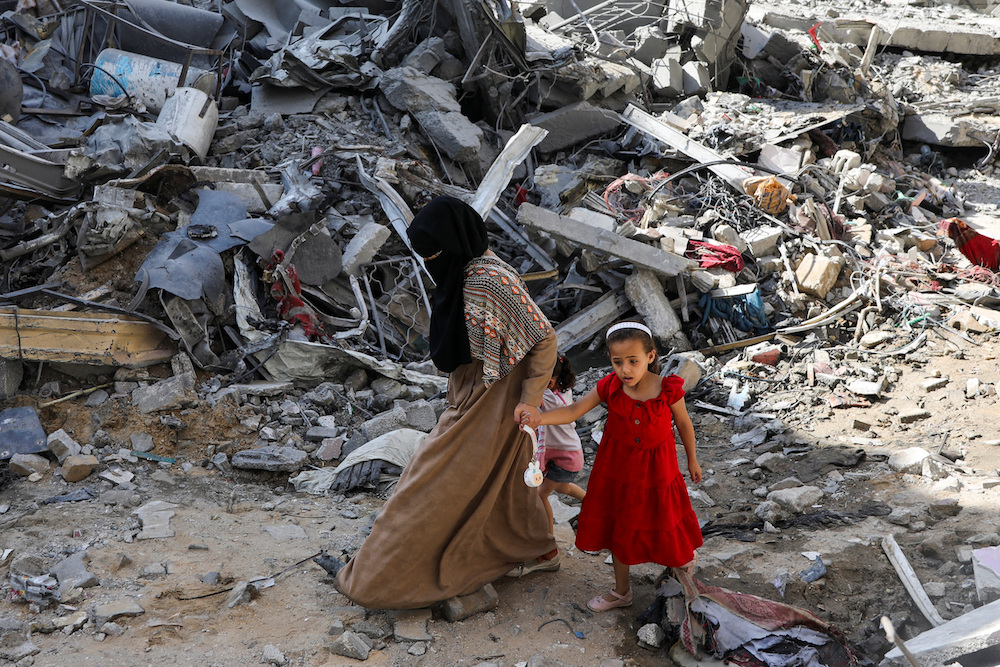
A woman and child walk among debris, aftermath of Israeli strikes at the area, where Israeli hostages were rescued on Saturday, as Palestinian death toll rises to 274, amid the Israel-Hamas conflict, in Nuseirat refugee camp in the central Gaza Strip. (Reuters)
Although they did not resign in “any coordinated manner,” Rharrit said she was in regular contact with other former administration officials who quit over the issue and who hope to continue to change attitudes in Washington.
Rharrit concurred that the stance adopted by the Biden administration could radicalize a generation of Muslim and Arab youth, potentially creating a Hamas 2.0 capable of replicating attacks like the one that befell Israel on Oct. 7.
“This was my argument for months, every single day, that, again if you want to even ignore the plight of the Palestinians, even if you are choosing to not acknowledge their humanity, this is not in the interests of the Israeli people, because all this will do is generate an endless cycle of violence, and this cycle of revenge,” she said.
“And that does not serve Israeli interests and it certainly does not serve the US. It will continue to destabilize the Middle East for generations to come. All the countries in this region will have to deal with that.
“Violence is not the answer. Bombs are not the answer. A political solution which actually recognizes the dignity and the humanity of the Palestinians, establishes a state of self-determination for the Palestinians, that is the only solution to this, and the only thing that really can counter extremism. And we’ve seen that. And that’s what we need to get to, that type of political resolution.”
Of course, Washington’s stance on Gaza could soon change if Biden fails to secure a second term in November’s presidential election and his Republican rival Donald Trump returns to the White House.
Whatever the outcome, Rharrit expects Gaza will weigh heavily on the election.
“I think it will weigh intensely,” she said. “Because I think young Americans have been consuming all of this carnage on their phones and they’ve risen up. It’s awakened their consciousness not just in terms of Gaza, but in terms of so many injustices in this world.
“And they’re seeing through a lot that the government has sort of tried to promote and they’re demanding a change. They’re demanding social change. And it doesn’t matter what walks of life.
“And I want to stress this, that a lot of this movement, it’s not about an us vs. them narrative. Not at all. People that are supporting the Palestinians in Gaza come from all faiths, all backgrounds. And it’s for the sake of humanity and nothing else.”


