

Pakistan fans hold hope as team vow ‘best shot’ in crucial World Cup match against India today

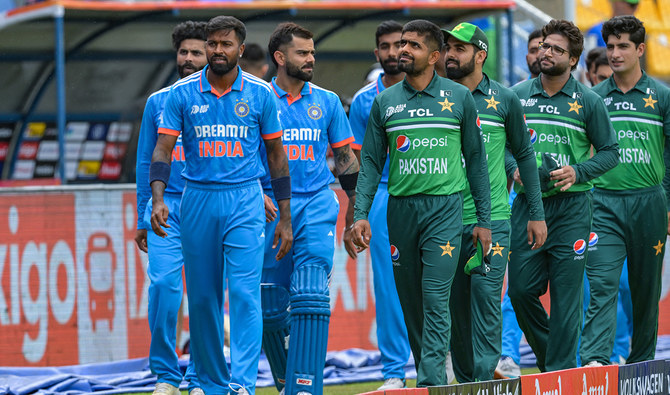
India's (L) and Pakistan's palyers arrive for the Asia Cup 2023 one-day international (ODI) cricket match between India and Pakistan at the Pallekele International Cricket Stadium in Kandy on September 2, 2023. (AFP/File)
Short Url
Updated 09 June 2024
Follow

Pakistan fans hold hope as team vow ‘best shot’ in crucial World Cup match against India today

  • Pakistan coach Gary Kirsten says players are ‘trying their best’ after a shock defeat against USA in the first match
  • Despite criticizing team’s performance, cricket fans ask people to support the Pakistani squad as much as possible

ISLAMABAD: Cricket fans in Pakistan expressed disappointment with the performance of the national squad ahead of a crucial Twenty20 World Cup contest with arch-rival India today, Sunday, but held onto hope for the team’s “best shot.”
Pakistan’s cricket performance has faced challenges since last year’s Asia Cup and the ODI World Cup in India. The team have remained inconsistent, struggling with issues such as a weak middle order and ineffective bowling in the death overs, which have affected their results in significant tournaments.
Pakistan lost their first World Cup match against the USA in Dallas, which was viewed as a major upset in the tournament’s history, generating a lot of criticism against the players and the management.
“Looking at their past performance, it is difficult to pin hopes on them,” Ahmed Mansoor, a corporate professional, told Arab News, criticizing the team. “Still, we are praying [for them].”
Pakistani all-rounder Imad Wasim, who had to sit out the opening game due to rib injury, will play today’s match, giving a much-needed boost to his team.
Gary Kirsten, the new coach from South Africa, said during a news conference in the US a day earlier the players were “trying their best,” adding it was not pleasant for anyone to lose.
He said he did not need to motivate the players for today match was against the team Pakistan had always fought against.
“I think the important thing for us is that we operate genuinely as a team,” he said. “Yes, we need individuals to make good performances, but playing games like this, I think is a real team effort.”
“It’s a big game, so we’re going to treat it as any other game,” he added. “But certainly, give it our best shot.”
Speaking to Arab News, Saba Abbasi, a marketing professional, explained why it was so important for people to see Pakistan win.
“The situation of the country is ... quite worrisome,” she said. “The weather is awful, and so are politics, inflation and other things. People feel relaxed when cricket matches are held.”
“We want Pakistan to win, and since the match is with India, there will be some additional stress,” he added. “But if they win, it will be huge occasion filled with happiness for us. So, we are praying.”
Taimur Khan, a grocery store worker, anticipated an “interesting match.”
“It is my appeal to you all to support the Pakistan team as much as possible,” he said.
Mohammad Ayub, a tea boy, agreed with him.
“God willing, Pakistan will win,” he said with conviction. “There is Mohammad Iftikhar, Babar Azam and [Mohammad] Rizwan. With India, we play as if there is a war.”

With input from AFP.


Punjab expands Pakistan-India Wagah border arena with museum, partition-themed park

Updated 4 sec ago
Follow

Punjab expands Pakistan-India Wagah border arena with museum, partition-themed park

  • The border crossing, near eastern city of Lahore, is the primary land route between Pakistan and India and one of the most recognizable symbols of their often-tense relations
  • The site is best known for its daily flag-lowering ceremony, a choreographed military ritual performed by border forces from both countries that draws thousands of spectators

ISLAMABAD: Maryam Nawaz, chief minister of Pakistan’s Punjab province, on Thursday inaugurated the newly constructed arena at Wagah border cross between Pakistan and India, which includes a museum and a partition themed park.

The Wagah border crossing, located near the eastern city of Lahore, is the primary land route between Pakistan and India and one of the most recognizable symbols of the often-tense relationship between the two neighbors. It serves as a key point for prisoner exchanges and limited movement of travelers, while remaining tightly regulated due to security considerations.

The site is best known for its daily flag-lowering ceremony, a choreographed military ritual performed by border forces from both countries that draws thousands of spectators. Over the years, the ceremony has evolved into a popular tourist attraction, blending displays of nationalism with public spectacle and making it one of Pakistan’s most visited landmarks, which connects with India’s Attari.

Flanked by military officials, CM Nawaz visited the crossing and inaugurated the new arena, with its seating capacity increased from 7,500 to 25,000 spectators, the state-run Radio Pakistan broadcaster reported. The chief minister also visited the martyrs’ monument and offered her respects.

“In addition to the arena’s expansion, several new constructions have been added at the Joint Check Post Wagah. These new developments include a theme park depicting the partition of the Subcontinent, featuring models of a railway station, military equipment and a Martyrs’ Memorial,” the broadcaster reported.

“A Pakistan Museum has also been established within the arena, showcasing the country’s history and culture from the Freedom Movement to the present day.”

In August 1947, Britain divided the Indian Sub-continent, its former colony, into two countries — Hindu-majority India and Muslim-majority Pakistan.

Excitement over independence was quickly overshadowed by some of the worst bloodletting that left up to 1 million people dead as gangs of Hindus and Muslims slaughtered each other.

Creating two independent nations also tore apart millions of Hindu and Muslim families in one of the world’s largest peacetime migrations, which displaced at least 15 million people.

The fate of Kashmir, then a princely state, was left undecided. The Himalayan territory continues to remain a flashpoint in relations between the neighbors, who have fought multiple wars over it.