

India PM Modi to take oath for third term on Sunday

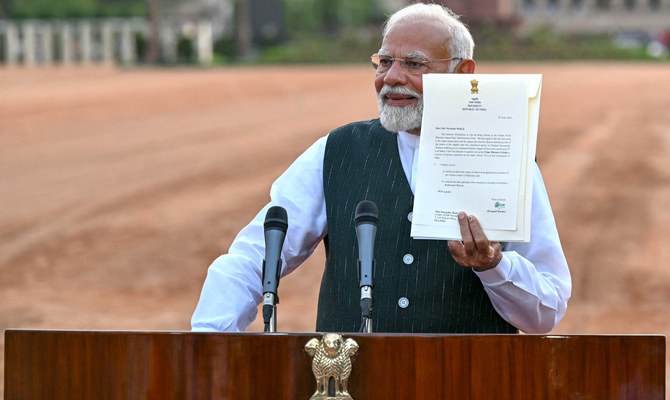
India's Prime Minister Narendra Modi shows a letter by President Droupadi Murmu requesting him to form the country's new government as he was elected for his third term following the nation's general election, in New Delhi on June 7, 2024. (AFP)
Short Url
Updated 10 June 2024
Follow

India PM Modi to take oath for third term on Sunday

  • Composition of Modi’s Cabinet to be revealed during swearing-in ceremony
  • Modi was formally elected leader of India’s winning coalition on Friday

NEW DELHI: India’s incumbent Prime Minister Narendra Modi and his Cabinet will take an oath of office for a third term on Sunday, after he was elected leader of the coalition that won the most seats in the recent general vote.

Modi’s Hindu-nationalist Bharatiya Janata Party has governed India as part of the National Democratic Alliance over the past decade. While the coalition won the election last week, for the first time since 2014, the BJP has lost its absolute majority in parliament, making it dependent on allies to form a government.

The composition of the Cabinet will be revealed when Modi and his ministers are sworn in.

“The swearing-in ceremony of Prime Minister Shri Narendra Modi and the Council of Ministers following the General Elections 2024 is scheduled on 09 June 2024,” the Prime Minister’s Office said in a statement.

“On the occasion, leaders from India’s neighbourhood and Indian Ocean region have been cordially invited as distinguished guests.”

Among the guests were listed the presidents of Sri Lanka and the Maldives, the vice president of Seychelles, and the prime ministers of Bangladesh, Mauritius, Nepal, and Bhutan.

“The visit of the leaders to attend the swearing-in ceremony of Prime Minister Shri Narendra Modi for his third consecutive term is in keeping with the highest priority accorded by India to its ‘Neighbourhood First’ policy and ‘SAGAR’ vision,” the statement said, referring to Security and Growth for All in the Region — Modi’s geopolitical framework of maritime cooperation in the Indian Ocean region.

The statement did not mention India’s rivals — China and Pakistan.

While Beijing had congratulated Modi, Islamabad said on Friday that congratulations would be “premature” as his government has not been formed yet.

On Friday, Modi was formally elected leader of the NDA, after securing support from two key allies — the Telugu Desam Party in southern Andhra Pradesh state and Janata Dal (United) in eastern Bihar state.

“NDA has become synonymous with good governance in the past 10 years, and we have worked to make the country touch new heights of success. This is the most successful alliance in India’s history,” Modi said after coalition members backed him as prime ministerial candidate.

“We were neither defeated nor are we defeated.”

The final results from India’s marathon, six-week election, which began on April 19, were released on Wednesday. The BJP won 240 seats, while 272 were needed for a majority.

The NDA coalition bagged 293 seats in the 543-member lower house of parliament.

It was challenged by an alliance of two dozen opposition parties — the Congress Party-led Indian National Developmental Inclusive Alliance, or INDIA, which has 232 seats.


Isolated Kremlin critics lament lost future at Nemtsov memorial

Updated 4 sec ago
Follow

Isolated Kremlin critics lament lost future at Nemtsov memorial

  • Hundreds used to flock to the makeshift memorial on the anniversary of his death
  • Since Russia ordered troops into Ukraine it has intensified a crackdown on dissent, with almost no opposition to the Kremlin visible on the street

MOSCOW: On a bridge next to the Kremlin on a drizzly Friday morning, a lone Russian police officer stood looking at the half-dozen bunches of flowers laying in memory of slain opposition figure Boris Nemtsov.
The symbolism was almost too much.
Four years into Moscow’s full-scale offensive on Ukraine, which has seen President Vladimir Putin eradicate all forms of dissent and usher in strict military censorship laws that have silenced his critics, few Russians dared, or wanted, to pay tribute.
Nemtsov, a longtime Putin opponent, was shot and killed on February 27 2015, meters from the Kremlin’s red walls. He was 55.
Hundreds used to flock to the makeshift memorial on the anniversary of his death, which came on Friday.
This year, there was barely a trickle. Those who turned up were visibly nervous.
“So few people, they’ve all forgotten,” lamented one elderly man, who refused to give his name.
“Everybody is afraid,” a woman standing nearby added.
Since Russia ordered troops into Ukraine it has intensified a crackdown on dissent, with almost no opposition to the Kremlin visible on the street.
AFP reporters on Friday morning saw only around a dozen mourners alongside Western ambassadors laying red carnations.
“Keep moving, don’t gather in a crowd, don’t block the way for other citizens,” a police officer said through a megaphone.
Three days after Russia launched its offensive on Ukraine in 2022, protesters had staged an impromptu rally against the war at the memorial on the anniversary of Nemtsov’s death.
Nemtsov’s supporters have always accused Chechen leader and key Putin ally Ramzan Kadyrov of ordering his killing.
Kadyrov has rejected the claims.
Five Chechens were convicted of a contract killing but investigators never said who it was ordered by.

- ‘Everything is persecuted’ -

For his followers, Nemtsov is a totemic figure in Russian political life — seen as a once-future leader who might have taken the country on a different path.
“I come here every year,” said 79-year-old scientist Sergei at the bridge on Friday.
“Russia should have had — though unfortunately it didn’t work out — a leader exactly like Nemtsov,” he told AFP, declining to give his surname.
“Right now everything here is suppressed, everything is persecuted, people are sitting in prisons.”
A physicist by education, Nemtsov rose to fame in the 1990s as a young, liberal provincial governor, and was widely tipped to take over from Boris Yeltsin.
He gave his hesitant backing to Putin when the ex-KGB spy was tapped to enter the Kremlin instead, but became an early — and fierce — opponent of what he cast as the Russian leader’s creeping authoritarianism.
He had largely lost popularity and was only a marginal figure in Russian politics when he was killed in 2015. Still, his murder shocked the country and the world.
“The hopes of the whole country were pinned on him — of all the people who wanted it to be free here,” said Olga Vinogradova, a 66-year-old volunteer who tends to the pop-up memorial to Nemtsov on the bridge.
“When this man was killed, naturally, all of us were, we were all just executed at that moment. Because our hopes were destroyed,” she said.
“With this memorial, we remind people that there was a different path for Russia. And that there was a real person who could have led us down this path.”

- ‘Forced out’ -

Nemtsov had strongly opposed Putin’s 2014 annexation of Crimea from Ukraine and Moscow’s military backing for pro-Russian separatists in eastern Ukraine.
He was also a close and early ally of Alexei Navalny, who died in 2024 in an Arctic prison in what his supports say was a poisoning.
Open opposition to the Kremlin is unheard of inside Russia since the first days of the Ukraine offensive — when riot police cracked down hard on the thousands that took to the streets to protest.
All major critics of the Kremlin are in exile, prison or dead.
Those that remain have been silenced.
“Many have been forced out of the country, some have been killed,” said Gleb, a 23-year-old photographer.
A movement or person like Nemtsov was “impossible” to imagine right now, he said.
Still, he held on to a slither of hope.
“But everything can change at any moment.”