

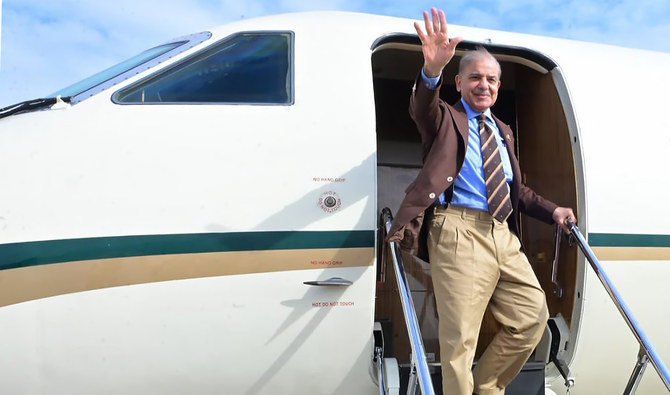

ISLAMABAD: Prime Minister Shehbaz Sharif concluded his five-day “milestone” visit to China on Saturday, which included several high-profile meetings with top political and business leaders, after announcing plans to send 1,000 Pakistani students to a top Chinese agricultural facility for advanced training before his departure.
His engagements across various Chinese cities aimed at upgrading the China-Pakistan Economic Corridor (CPEC), a flagship of the Belt and Road Initiative (BRI), through which Beijing has pledged over $60 billion to the South Asian country.
The visit was particularly timely since Pakistan has been trying to navigate a prolonged economic crisis by actively pursuing foreign investments and enhanced trade opportunities, while also seeking yet another International Monetary Fund (IMF) bailout to keep economic reforms on track.
During his time in Beijing, Sharif met with Chinese President Xi Jinping and Premier Li Qiang, who both reaffirmed their support for Pakistan’s efforts to become a regional hub of trade and connectivity.
“Prime Minister Muhammad Shehbaz Sharif’s five-day visit to China has proven to be a significant milestone in strengthening the relationship between Pakistan and China, enhancing bilateral trade, strategic partnerships and initiating the second phase of CPEC,” a statement circulated by his office announced shortly before he returned to Pakistan.
The statement highlighting the prime minister’s gratitude to the Chinese leadership for extending warm hospitality.
“China’s advancements in information technology, agriculture, minerals and other sectors are exemplary,” the statement quoted him as saying. “The economic partnership between China and Pakistan will benefit the peoples of both countries.”
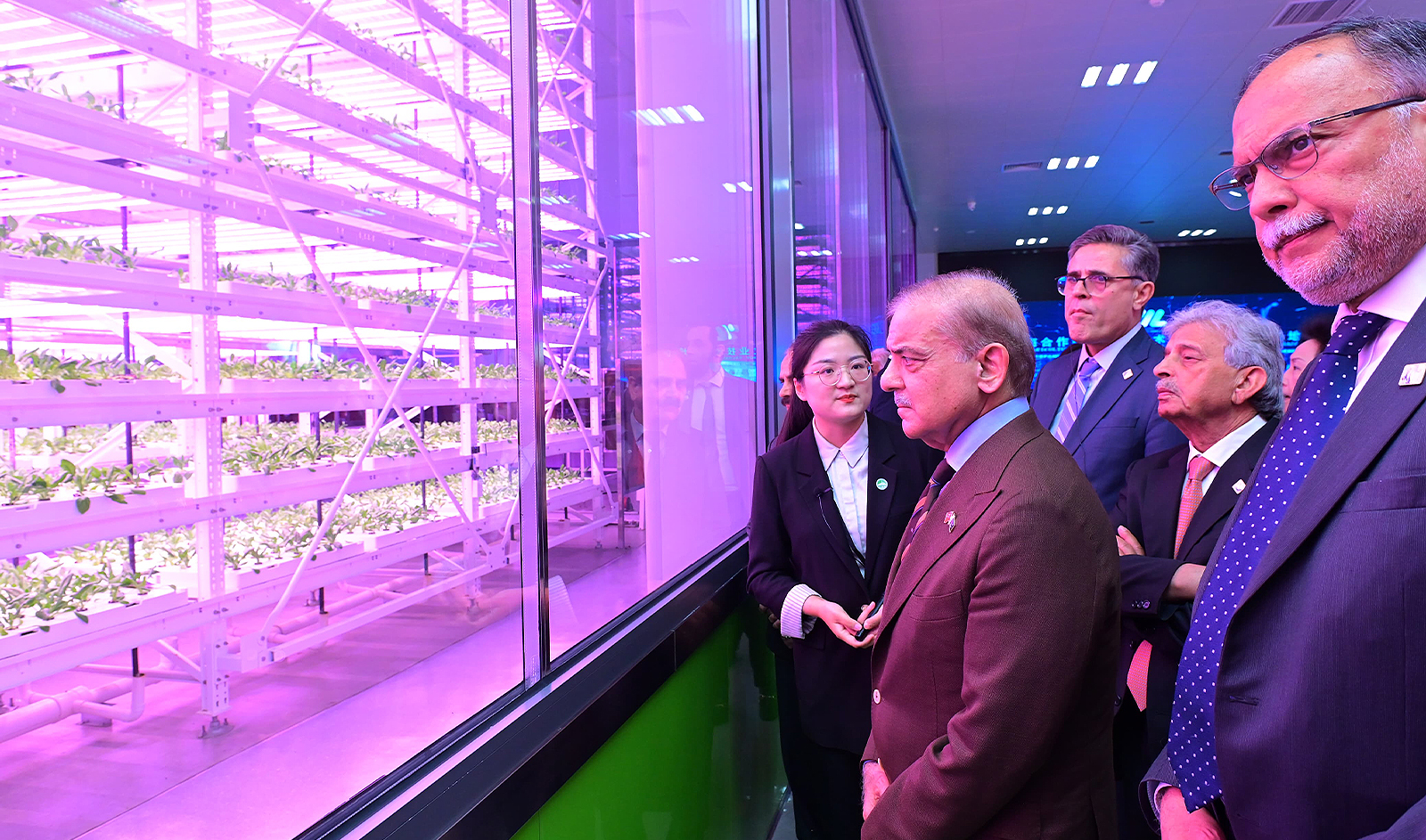
Pakistan Prime Minister Shehbaz Sharif a plant incubator during his visit to Yangling Agricultural Demonstration Base in the northwestern Chinese city of Xi’an on June 8, 2024. (Government of Pakistan)
Earlier, Sharif visited to the Yangling Agricultural Demonstration Base in Xi’an, which collaborates with 26 countries in agricultural research, and toured the facility. He went to the Pakistan Pavilion, where his country’s export products were displayed.
“Pakistan is an agricultural country and the government is striving to increase per acre production through innovation in agriculture,” he said. “Enhancing the export of Pakistani agricultural products and their processing is a top priority for the government.”
He promised to send 1,000 Pakistani students to the northwestern Chinese city on government expense for their advanced training in the field of agricultural production.
Sharif instructed his country’s envoy to China and other officials to finalize the project with the Chinese authorities concerning the sending of Pakistani students. He invited Northwest Agriculture and Forestry University to open a campus in his country, assuring its management of his administration’s full support.
He went to the Terracotta Warriors Museum in Xi’an along with the Pakistani delegation, where they were briefed on the preservation and restoration of China’s historical heritage and the promotion of tourism, according to his office.
He visited various parts of the museum and appreciated the beauty of the ancient Chinese heritage and craftsmanship.
“Great nations like China protect their historical heritage,” he said. “The skill of Chinese craftsmen from 200BC is admirable.”
As the prime minister spent his day in Xi’an, his other team members continued to hold meetings with representatives of Chinese companies in Beijing.
Pakistan’s investment minister Abdul Aleem Khan in Beijing on Saturday held an important session with China’s 60-year-old semi-state CZK Huarui Group involved in making international investments in various sectors.
During their interaction, it was decided the Chinese business group would invest in artificial intelligence, science and technology, modern agriculture, health care, logistics and infrastructure.
Both sides also discussed the possibility of enhancing e-commerce in Pakistan through Chinese cooperation, calling it “the dire need of the hour.”


