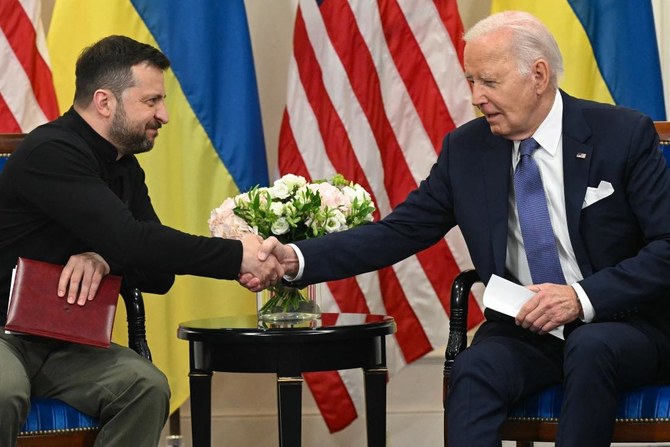
PARIS: US President Joe Biden on Friday for the first time publicly apologized to Ukraine for a monthslong holdup in American military assistance that let Russia make gains on the battlefield, as Ukrainian President Volodymyr Zelensky appealed for bipartisan US support “like it was during World War II.”
Speaking in Paris, where they both attended ceremonies marking the 80th anniversary of the D-Day landings, Biden apologized to the Ukrainian people for the weeks of not knowing if more assistance would come while conservative Republicans in Congress held up a $61 billion military aid package for Ukraine for six months.
Still, the Democratic president insisted that the American people were standing by Ukraine for the long haul. “We’re still in. Completely. Thoroughly,” he said.
Zelensky pressed for all Americans to support his country’s defense against Russia’s invasion, and he thanked lawmakers for eventually coming together to approve the weapons package, which has allowed Ukraine to stem Russian advances in recent weeks.
“It’s very important that in this unity, United States of America, all American people stay with Ukraine like it was during World War II,” Zelensky said. “How the United States helped to save human lives, to save Europe. And we count on your continuing support in standing with us shoulder to shoulder.”
The United States is by far Kyiv’s biggest supplier of wartime support, and Ukraine is trying to fend off an intense Russian offensive in eastern areas of the country. The push is focused on the Ukrainian border regions of Kharkiv and Donetsk, but Ukrainian officials say it could spread as Russia’s bigger army seeks to make its advantage tell.
The offensive is seeking to exploit Kyiv’s shortages of ammunition and troops along the roughly 1,000-kilometer (620-mile) front line.
That shortfall in weaponry came after US military aid was held up in Congress for six months before Biden in April signed the $61 billion package into law.
The slow pace of delivery of pledged Western weaponry has long frustrated Zelensky, as has Biden’s hesitation over supplying more hardware for fear of provoking Russian President Vladimir Putin. That has caused tension in their relationship.
The US will send about $225 million in military aid to Ukraine, US officials said Thursday. The latest package includes munitions for the High Mobility Artillery Rocket System, or HIMARS, as well as mortar systems and an array of artillery rounds, officials said.
Easing their stance amid Russia’s most recent onslaught and with Ukraine’s army reeling, some NATO allies including the US said last week they would allow Ukraine to use weapons they deliver to Kyiv to carry out limited attacks inside Russia.
That step brought a furious response from the Kremlin, which warned that Europe’s biggest conflict since World War II could spin out of control.
Biden and Zelensky attended the anniversary events of D-Day in Normandy, northern France, on Thursday, along with European leaders who have supported Kyiv’s efforts in the war. Biden pledged “we will not walk away” from Ukraine, drawing a direct line from the fight to liberate Europe from Nazi domination to today’s war against Russian aggression.
Ukraine depicts its fight against the Kremlin’s forces as a clash between Western democratic freedom and Russian tyranny. Russia says it is defending itself against a menacing eastward expansion of the NATO military alliance.
In a 20-minute speech Friday at the National Assembly, the lower house of the French parliament, Zelensky drew a parallel with the sacrifices made during World War II and his country’s current fight.
“This battle is a crossroads,” Zelensky said. “A moment where we can now write history the way we need it. Or we can become victims of history as it suits … our enemy.”
Zelensky, who spoke in Ukrainian, was frequently interrupted by lawmakers’ applause and cheers. He prompted a standing ovation when he said in French: “Dear France, I thank you for standing by our side as we defend life.”
French President Emmanuel Macron, meanwhile, announced late Thursday that France will provide Ukraine with its Mirage combat aircraft.
Macron has been a vocal supporter of Ukraine. He said in February that putting Western troops on the ground in Ukraine is not “ruled out.”
Zelensky began a day of meetings in Paris with an official welcome ceremony at the golden-domed Invalides monument, site of Napoleon’s tomb.
During the day, Zelensky was due to visit the Nexter arms manufacturer in Versailles, which makes the Caesar self-propelled howitzers that are among the weapons provided by France to Kyiv’s forces.
He was also to meet with Macron at the Élysée Palace.
Zelensky’s foreign trips aim to keep Ukraine’s plight in the public eye, secure more military help for its fight against Russia’s invasion and lock in long-term Western support through bilateral alliances.
France and Ukraine in February signed a 10-year bilateral security agreement. Zelensky has since signed similar bilateral agreements with many European countries.


![]()

Biden apologizes to Ukraine’s Zelensky for monthslong holdup to weapons that let Russia make gains
Short Url
https://arab.news/pc4xf
Biden apologizes to Ukraine’s Zelensky for monthslong holdup to weapons that let Russia make gains
- Zelensky pressed for all Americans to support his country’s defense against Russia’s invasion
- The United States is by far Kyiv’s biggest supplier of wartime support
For US Muslims, immigration crackdown fears, new war worries and anti-Muslim rhetoric cloud Ramadan
- National groups are sharing know-your-rights guidance for mosque leaders. Leaders also point to harsh anti-Muslim vitriol during the current election season
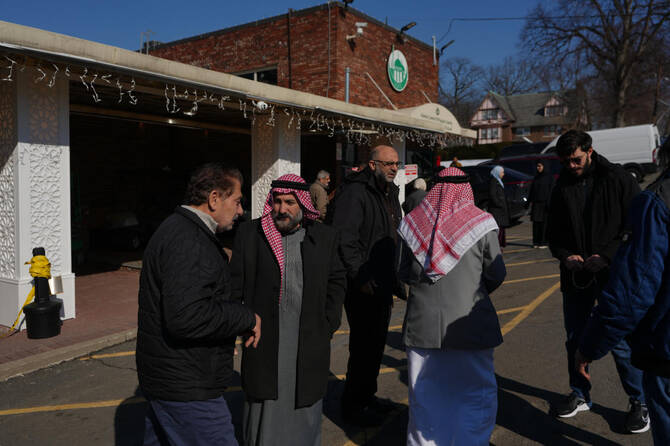
PATERSON: Midway through Ramadan, Muslims across the United States are striving to maintain the holy month’s traditional mix of prayers and festive spirit under a cloud of worrisome events.
The federal government’s immigration crackdown has affected many of their communities. Virulent anti-Muslim rhetoric is surging. And now the Middle East — where many have loved ones — is buffeted by the Iran war.
In Paterson, New Jersey — home to one of the country’s highest per capita Muslim populations — 18-year-old Haneen Alatiyat regrets that fear and uncertainty are keeping many community members from gathering to embrace Ramadan’s communal traditions.
“The meaning of the holiday is to be together with the people you love,” said Alatiyat, who is half Palestinian, half Jordanian.
“Unfortunately, because of the ICE raids that are happening, people don’t want to do that,” she added, speaking outside the Islamic Center of Passaic County in Paterson about Immigration and Customs Enforcement actions happening under President Donald Trump. It’s the mosque where she worships every year with family during Ramadan.
Paterson’s Palestinian community — one of the largest outside the Middle East — had been grieving loved ones and trying to help the survivors of the war on Gaza even before the latest anxiety-fueling developments.
“This Ramadan has already been heavy for many families in our community with the immigration crackdowns,” said Rania Mustafa, executive director of the Palestinian American Community Center in Clifton, New Jersey.
“Now, as the war on Iran started, many people here are experiencing another layer of fear and grief,” she added.
Impact of Minnesota crackdown
In Minnesota, where many are reeling from the recent large-scale immigration crackdown, Ramadan came amid a powerful mix of emotions, according to Imam Yusuf Abdulle. He is executive director of the Islamic Association of North America.
Many feel “blessed that we are alive and well,” said Abdulle. “Also, we feel like we’re … bruised, affected, devastated economically, psychologically.”
Abdulle’s organization is an umbrella group for a number of Islamic centers, including some in Minnesota.
Abdulle said the Abubakar As-Saddique Islamic Center in Minneapolis, where he’s on the board, has canceled hosting communal iftar, the sunset meals that break the daily fast, and instead is serving only dates and water. He attributed the change to the economic hit that many of the community’s businesses that typically would have sponsored such meals took during the crackdown, as people stayed away.
“Eating together and sharing stories while eating, it was beautiful,” he said. “I hope that comes back.”
Even after withdrawal of most of the roughly 3,000 immigration officers, some community members — especially asylum-seekers and refugees — remain cautious about venturing out, including to the mosque, Abdulle said.
“The fear … is very much there and it will be there for a while.”
Yet family nurse practitioner Munira Maalimisaq sees reason to be thankful amid the stresses. She works as CEO of Inspire Change Clinic, which serves marginalized communities in Minnesota.
“Even with the challenges, there’s a strengthened sense of community, resilience, and hope alongside the usual spiritual reflection, prayer, and charity that Ramadan brings,” she said.
Know your rights message
Coinciding with Ramadan, some Muslim groups have issued know-your-rights guidance for navigating immigration enforcement interactions, including for mosques. The Muslim Public Affairs Council, for example, created a safety guide.
MPAC official Dahlia M. Taha said the included guidance for imams aims to help them address congregants’ fears without causing panic or spreading misinformation.
Questions from imams, she said, have included: Can houses of worship be subject to enforcement operations? How to reassure people without giving legal advice? How to address immigration anxiety while keeping Ramadan spiritually centered?
“There is a deep sense of community and peace that always comes with Ramadan,” said Taha, adding that many mosques are well-attended and families are gathering.
Nonetheless, “people are carrying fear, anxiety, and uncertainty alongside our faith,” she said. “Devotion and concern are existing side by side. I think everyone is just exhausted.”
Ibrahim Dyfan, executive director of Masjid Al Shareef, a 2,000-strong mosque in Long Beach, California, said his community, like other Muslim congregations, is coping with stress related to rising Islamophobia, immigration enforcement and the Middle East conflicts.
The mosque also boosted security for prayer services during Ramadan, he said.
“All we can do is continue praying and fasting,” he said. “This, like everything else, will pass. At the same time, we also need to pay attention to what is happening around us, and take the necessary precautions.”
Islamophobia in politics
A wave of anti-Muslim language intensified in Republican campaigns early this election year, most prominently in Texas, which held its primaries Tuesday. Gov. Greg Abbott, who clinched the GOP nomination for a fourth term, helped lead efforts to stop a Muslim-centered planned community near Dallas.
In Congress, several bills have been introduced recently targeting Shariah — the framework that guides Muslims, including on prayer and ethical conduct. Rep. Randy Fine, R-Fla., in a recent social media post, compared Muslims unfavorably to dogs, prompting the Council on American-Islamic Relations and some Democratic members of Congress to call for his resignation.
Muslim American leaders view the vitriol as election-year scaremongering — more intense now than in recent campaign seasons. Their alarm was only partially eased by recent election victories for Muslim candidates, notably Zohran Mamdani becoming mayor of New York.
“Every election year, you see an increase in anti-Muslim bigotry in certain parts of the country, where politicians see Muslims Americans a useful political football,” said CAIR’s national deputy director, Edward Ahmed Mitchell. “We expect that — but it’s so much worse than usual this time.”
War worries emerge
In Paterson, according to Rania Mustafa, many families worry about relatives in conflict-wracked parts of North Africa and the Middle East, including those in Gaza struggling to access sufficient food supplies.
But she is proud of her community’s perseverance.
“Despite what’s going on in the world, Ramadan reminds us of the strength and resilience of our community,” she said. “People are still gathering for prayer, sharing meals, checking on one another, and supporting families who are struggling.”
As the sun set on a section of Paterson’s Main Street renamed “Palestine Way” — flanked by Palestinian and US flags — people arrived at homes and restaurants to break the fast on a recent evening. Some rushed to pastry shops, others headed to the Palestine Hair Salon.
Raed Odeh, the salon’s owner and top barber, lamented how the Middle East’s tumult and the US immigration crackdown were dampening what should be a joyful month.
“This is not only affecting those who don’t have documents, this is also affecting everyone else around,” said Odeh, Paterson’s deputy mayor, as he shaved a client’s beard.
Like other city leaders, he urged the release of Leqaa Kordia, a Palestinian woman and Paterson resident who has been held in an immigration jail for a year after attending a protest in New York. Recently, Kordia said she suffered a seizure, an episode she linked to “inhumane” conditions inside the detention facility.
At a time of turmoil, Odeh said he shares the hope of many — regardless of their ethnicity or religion — during Ramadan: “Of course, everybody is hoping for peace.”
The federal government’s immigration crackdown has affected many of their communities. Virulent anti-Muslim rhetoric is surging. And now the Middle East — where many have loved ones — is buffeted by the Iran war.
In Paterson, New Jersey — home to one of the country’s highest per capita Muslim populations — 18-year-old Haneen Alatiyat regrets that fear and uncertainty are keeping many community members from gathering to embrace Ramadan’s communal traditions.
“The meaning of the holiday is to be together with the people you love,” said Alatiyat, who is half Palestinian, half Jordanian.
“Unfortunately, because of the ICE raids that are happening, people don’t want to do that,” she added, speaking outside the Islamic Center of Passaic County in Paterson about Immigration and Customs Enforcement actions happening under President Donald Trump. It’s the mosque where she worships every year with family during Ramadan.
Paterson’s Palestinian community — one of the largest outside the Middle East — had been grieving loved ones and trying to help the survivors of the war on Gaza even before the latest anxiety-fueling developments.
“This Ramadan has already been heavy for many families in our community with the immigration crackdowns,” said Rania Mustafa, executive director of the Palestinian American Community Center in Clifton, New Jersey.
“Now, as the war on Iran started, many people here are experiencing another layer of fear and grief,” she added.
Impact of Minnesota crackdown
In Minnesota, where many are reeling from the recent large-scale immigration crackdown, Ramadan came amid a powerful mix of emotions, according to Imam Yusuf Abdulle. He is executive director of the Islamic Association of North America.
Many feel “blessed that we are alive and well,” said Abdulle. “Also, we feel like we’re … bruised, affected, devastated economically, psychologically.”
Abdulle’s organization is an umbrella group for a number of Islamic centers, including some in Minnesota.
Abdulle said the Abubakar As-Saddique Islamic Center in Minneapolis, where he’s on the board, has canceled hosting communal iftar, the sunset meals that break the daily fast, and instead is serving only dates and water. He attributed the change to the economic hit that many of the community’s businesses that typically would have sponsored such meals took during the crackdown, as people stayed away.
“Eating together and sharing stories while eating, it was beautiful,” he said. “I hope that comes back.”
Even after withdrawal of most of the roughly 3,000 immigration officers, some community members — especially asylum-seekers and refugees — remain cautious about venturing out, including to the mosque, Abdulle said.
“The fear … is very much there and it will be there for a while.”
Yet family nurse practitioner Munira Maalimisaq sees reason to be thankful amid the stresses. She works as CEO of Inspire Change Clinic, which serves marginalized communities in Minnesota.
“Even with the challenges, there’s a strengthened sense of community, resilience, and hope alongside the usual spiritual reflection, prayer, and charity that Ramadan brings,” she said.
Know your rights message
Coinciding with Ramadan, some Muslim groups have issued know-your-rights guidance for navigating immigration enforcement interactions, including for mosques. The Muslim Public Affairs Council, for example, created a safety guide.
MPAC official Dahlia M. Taha said the included guidance for imams aims to help them address congregants’ fears without causing panic or spreading misinformation.
Questions from imams, she said, have included: Can houses of worship be subject to enforcement operations? How to reassure people without giving legal advice? How to address immigration anxiety while keeping Ramadan spiritually centered?
“There is a deep sense of community and peace that always comes with Ramadan,” said Taha, adding that many mosques are well-attended and families are gathering.
Nonetheless, “people are carrying fear, anxiety, and uncertainty alongside our faith,” she said. “Devotion and concern are existing side by side. I think everyone is just exhausted.”
Ibrahim Dyfan, executive director of Masjid Al Shareef, a 2,000-strong mosque in Long Beach, California, said his community, like other Muslim congregations, is coping with stress related to rising Islamophobia, immigration enforcement and the Middle East conflicts.
The mosque also boosted security for prayer services during Ramadan, he said.
“All we can do is continue praying and fasting,” he said. “This, like everything else, will pass. At the same time, we also need to pay attention to what is happening around us, and take the necessary precautions.”
Islamophobia in politics
A wave of anti-Muslim language intensified in Republican campaigns early this election year, most prominently in Texas, which held its primaries Tuesday. Gov. Greg Abbott, who clinched the GOP nomination for a fourth term, helped lead efforts to stop a Muslim-centered planned community near Dallas.
In Congress, several bills have been introduced recently targeting Shariah — the framework that guides Muslims, including on prayer and ethical conduct. Rep. Randy Fine, R-Fla., in a recent social media post, compared Muslims unfavorably to dogs, prompting the Council on American-Islamic Relations and some Democratic members of Congress to call for his resignation.
Muslim American leaders view the vitriol as election-year scaremongering — more intense now than in recent campaign seasons. Their alarm was only partially eased by recent election victories for Muslim candidates, notably Zohran Mamdani becoming mayor of New York.
“Every election year, you see an increase in anti-Muslim bigotry in certain parts of the country, where politicians see Muslims Americans a useful political football,” said CAIR’s national deputy director, Edward Ahmed Mitchell. “We expect that — but it’s so much worse than usual this time.”
War worries emerge
In Paterson, according to Rania Mustafa, many families worry about relatives in conflict-wracked parts of North Africa and the Middle East, including those in Gaza struggling to access sufficient food supplies.
But she is proud of her community’s perseverance.
“Despite what’s going on in the world, Ramadan reminds us of the strength and resilience of our community,” she said. “People are still gathering for prayer, sharing meals, checking on one another, and supporting families who are struggling.”
As the sun set on a section of Paterson’s Main Street renamed “Palestine Way” — flanked by Palestinian and US flags — people arrived at homes and restaurants to break the fast on a recent evening. Some rushed to pastry shops, others headed to the Palestine Hair Salon.
Raed Odeh, the salon’s owner and top barber, lamented how the Middle East’s tumult and the US immigration crackdown were dampening what should be a joyful month.
“This is not only affecting those who don’t have documents, this is also affecting everyone else around,” said Odeh, Paterson’s deputy mayor, as he shaved a client’s beard.
Like other city leaders, he urged the release of Leqaa Kordia, a Palestinian woman and Paterson resident who has been held in an immigration jail for a year after attending a protest in New York. Recently, Kordia said she suffered a seizure, an episode she linked to “inhumane” conditions inside the detention facility.
At a time of turmoil, Odeh said he shares the hope of many — regardless of their ethnicity or religion — during Ramadan: “Of course, everybody is hoping for peace.”
Latest updates


© 2026 SAUDI RESEARCH & PUBLISHING COMPANY, All Rights Reserved And subject to Terms of Use Agreement.