

Sindh press clubs demand action as report says 10 journalists killed across province

Pakistani journalists hold a protest demonstration in solidarity with Palestinian counterparts in Karachi, Pakistan on May 3, 2024. (AFP/File)
Short Url
Updated 06 June 2024
Follow

Sindh press clubs demand action as report says 10 journalists killed across province

  • Pakistan-based media watchdog launches report which says from 2018-2023, 10 journalists killed in Sindh
  • Journalists say Sindh continues to remain one of Pakistan’s most concerning regions for their safety 

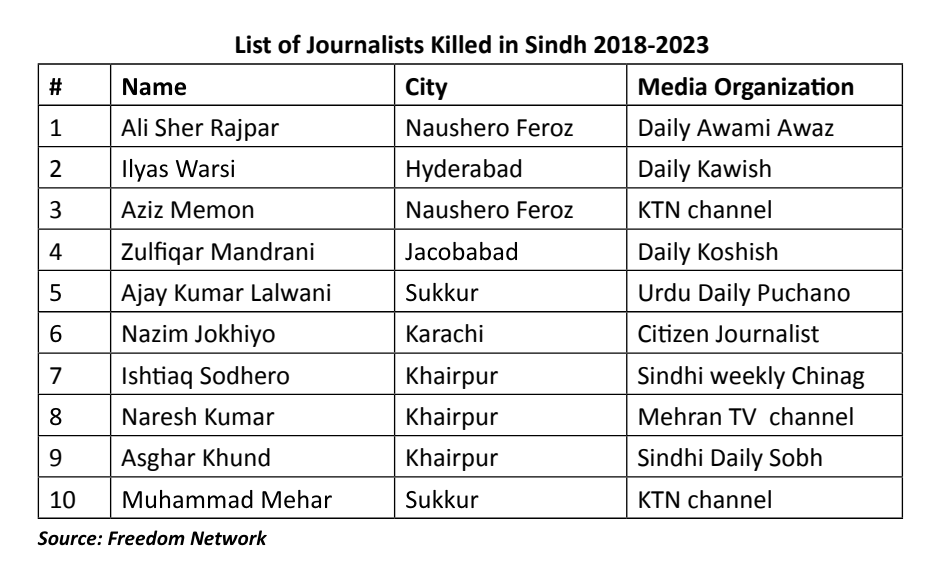
KARACHI: Journalist unions and press clubs across Pakistan’s Sindh on Thursday urged the government to take urgent action to ensure freedom of expression and that journalists remained safe in the province, citing a report that said 10 media workers have been killed in the past five years there. 

Representatives of press clubs and journalist unions from Sindh’s Sukkur, Khairpur, Hyderabad and Karachi cities attended the launch of a special report, titled: “Journalism in the Shadow of Violence” at the Karachi Press Club. The report was launched by Pakistan-based media and development sector watchdog, Freedom Network. The event was organized by the Sindh chapter of the Pakistan Journalists Safety Coalition (PJSC). 

As per the report, 184 incidents of violence against journalists took place in Sindh between 2018 and 2023, whichincluded the killings of 10 journalists in the province. Freedom Network Executive Director Iqbal Khattak said the report described the current situation of media freedoms and journalists’ safety in Sindh.

“Sindh continues to remain one of the most concerning regions for the safety of journalists in Pakistan, even though the province has a special legislation to combat impunity in crimes against journalists,” Khattak said, according to a press release by the PJSC. 
President of the PJSC’s Sindh chapter, Amir Lateef, said the targeting of journalists in the province has increased alarmingly, especially in northern Sindh, which has witnessed a disturbing rise in physical attacks against journalists.

“The issue is that the state is not supporting journalists,” Lateef said. “We will use the report’s findings to lobby with government officials and policymakers to ensure that they support the journalist community against safety risks.”

Senior journalist Mazhar Abbas demanded media owners also be held accountable or the safety of their workers while Khan Muhammad, president of the Khairpur Press Club, said journalists in rural Sindh require support against legal and physical threats.

Imdad Buzdar, president of the Sukkur Press Club, called on journalists to unite for a constant struggle for their rights while Sajjad Khanzada, the Hyderabad Press Club’s president, said brazen attacks on journalists will continue until their perpetrators are brought to justice.

Khattak had earlier shared details of the report, the PJSC said, adding that it shows low-income backgrounds of critical journalists, the lack of enforcement of labor laws in the news industry and the lack of digital safety skills create pressures for local journalists. This, the PJSC said, makes them vulnerable to threats and forces them to take undue risks.


Pakistan’s defense minister backs army spokesman’s criticism of Imran Khan

Updated 5 sec ago
Follow

Pakistan’s defense minister backs army spokesman’s criticism of Imran Khan

  • Khawaja Asif calls the military’s response to Khan’s recent remarks ‘measured’
  • He accuses Khan’s PTI party of ‘changing its identity’ by siding against Pakistan

ISLAMABAD: Pakistan’s Defense Minister Khawaja Asif on Saturday defended a scathing news conference by the military’s spokesman a day earlier, in which the latter accused former prime minister Imran Khan of promoting an anti-state narrative that he said had become a national security threat.

Lt. Gen. Ahmed Sharif Chaudhry, who heads the military’s media wing as director general of Inter-Services Public Relations (ISPR), addressed journalists on Friday in response to Khan’s latest social media post accusing Chief of Defense Forces Field Marshal Asim Munir of being responsible for “the complete collapse of the constitution and rule of law in Pakistan.”

During the briefing, Chaudhry described the incarcerated former premier as a “narcissist” and a “mentally ill individual,” though he said it up to the government to determine how it wanted to deal with him.

Asked about the military’s viewpoint against Khan and his Pakistan Tehreek-e-Insaf (PTI) party, Asif told reporters in the city of Sialkot the former premier had long used harsh language against state institutions and political opponents.

“When this kind of language is used for individuals as well as for institutions, then a reaction is a natural outcome,” he said. “The same thing is happening on the Twitter accounts being run in his [Khan’s] name. If the DG ISPR has given any reaction to it, then I believe it was a very measured reaction.”

The minister said Khan and PTI leaders had continued to target the army despite the sacrifices made by soldiers in the fight against militancy and during the four-day conflict with India in May.

He said PTI should recognize those sacrifices by supporting “our soldiers and martyrs” rather than “the terrorists.”

“Imran Khan speaks on every issue. Why did he not speak [in favor of the military] during the war [with India]?” Asif said. “Even during the war he kept targeting the military leadership. He continued to use inappropriate language for them.”

“People whose conduct is like this, whose language does not spare even the martyrs, how can they say ... that the DG ISPR should not say this or should not say that?” he continued. “He absolutely should.”

Asif added that Khan and his party had “changed their identity,” adding they were no longer standing with Pakistan.

PTI has not officially responded to his comments yet.