

Israel ran secret influence campaign targeting US lawmakers with fake social media accounts and news sites, investigation finds

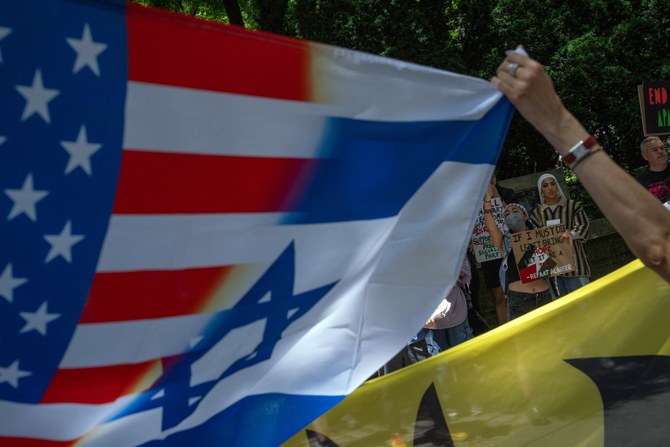
Accounts shut down by Meta in May had “accumulated more than 40,000 followers across X, Facebook, and Instagram,” but many followers appeared to be bots, failing to generate a significant audience. (AFP/File)
Short Url
Updated 05 June 2024
Follow

Israel ran secret influence campaign targeting US lawmakers with fake social media accounts and news sites, investigation finds

  • Campaign was organized and funded by Israel’s Ministry of Diaspora Affairs, documents reveal
  • Fake accounts have pushed AI-generated pro-Israeli comments under key US lawmakers’ posts

LONDON: Israel has been conducting a covert lobbying campaign aimed at influencing US lawmakers and the American public about the Gaza war, according to a report by The New York Times published on Wednesday.

The campaign, organized and funded by Israel’s Ministry of Diaspora Affairs, aimed to garner support for Israel’s actions in the conflict, as revealed by officials involved and related documents.

“Israel’s role in this is reckless and probably ineffective,” said Achiya Schatz, executive director of FakeReporter, an Israeli misinformation watchdog that identified the effort in March.

He added that running an operation that interferes in US politics is “extremely irresponsible.”

The documents cited by The New York Times indicate that the ministry allocated about $2 million for the operation and hired Stoic, a political marketing firm in Tel Aviv, to execute the campaign.

Launched in October, the campaign employed hundreds of fake social media accounts on platforms such as Facebook, Instagram and X to post AI-generated pro-Israeli comments targeting key American lawmakers.

Democrat Representative Hakeem Jeffries, the House minority leader from New York, and Senator Raphael Warnock of Georgia, appeared to have been key targets.

Three fake English-language news sites featuring pro-Israel articles were also part of the influence campaign.

Despite these efforts, FakeReporter noted that the campaign did not achieve a “widespread impact.”

Accounts shut down by Meta in May had “accumulated more than 40,000 followers across X, Facebook, and Instagram,” but many followers appeared to be bots, failing to generate a significant audience.

Israel’s Ministry of Diaspora Affairs denied involvement, stating it had no connection to Stoic. However, four current and former members of the ministry contradicted this claim, confirming the ministry’s involvement.

If verified, this would be the first known campaign by the Israeli government to directly influence US lawmakers.

Countries such as Iran, China, North Korea, Russia and the US have previously been linked to similar tactics aimed at influencing public opinion and creating controversy.

Israel has been striving to gain public support following its military invasion of Gaza last October, a response to the Hamas Oct. 7 attack.

With global support at minimal levels, Israel has resorted to such tactics to sway public opinion, particularly in the US, where the Biden administration’s support for Israeli actions has faced growing discontent.

Last October, an Arab News investigation revealed that an Israeli state advertising campaign appeared on many X users’ feeds, despite the platform’s ad policy guidelines prohibiting such content.


Israeli court overturns conviction of officer who assaulted Palestinian journalist, citing ‘Oct. 7 PTSD’

Updated 25 February 2026
Follow

Israeli court overturns conviction of officer who assaulted Palestinian journalist, citing ‘Oct. 7 PTSD’

  • Judge sentenced Yitzhak Sofer to 300 hours of community service, saying officer “devoted his life to Israel’s security” and conviction was “disproportionate to severity of his actions”
  • Footage shows Sofer throwing photojournalist Mustafa Alkharouf to the ground, and repeatedly beating and kicking him while he covered Palestinian gatherings near Al-Aqsa Mosque

LONDON: An Israeli court overturned the conviction of a border police officer who assaulted a Palestinian journalist, ruling his actions were influenced by post-traumatic stress disorder from serving during the Oct. 7 2023 attacks.

On Tuesday, the Jerusalem Magistrate’s Court sentenced officer Yitzhak Sofer to 300 hours of community service for assaulting Anadolu Agency photojournalist Mustafa Alkharouf in occupied East Jerusalem in December 2023.

Footage shows Sofer and other officers drawing weapons, throwing Alkharouf to the ground, and repeatedly beating and kicking him while he covered Palestinian gatherings near Al-Aqsa Mosque amid heavy restrictions.

Alkharouf was hospitalized with facial and body injuries. His cameraman, Faiz Abu Ramila, was also attacked.

Sofer had been convicted in September 2024 of assault causing bodily harm (acquitted of threats) and initially faced six months’ community service, as recommended by Mahash, the Justice Ministry’s police misconduct unit.

Judge Amir Shaked accepted the defense request to cancel the conviction, replacing it with community service.

He cited Sofer’s PTSD from responding to the Oct. 7 Hamas-led attack, noting the officer had “no prior criminal record” and had “devoted his life to Israel’s security.”

“The court cannot ignore this when considering whether the defendant’s conviction should stand,” he said, adding that while the incident is “serious and does cross the criminal threshold,” the conviction in place could cause Sofer harm “disproportionate to the severity of his actions.”

The ruling comes amid surging attacks on journalists in the West Bank, East Jerusalem and Gaza since Israel’s war on Gaza began.

The Committee to Protect Journalists reported Israel responsible for two-thirds of the 129 media workers killed worldwide in 2025, the deadliest year on record, citing a “persistent culture of impunity” and lack of transparent probes.

Reporters Without Borders called the Israeli army the “worst enemy of journalists” in its 2025 report, with nearly half of global reporter deaths in Gaza.

Foreign journalists face raids, arrests and intimidation. In late January 2026, Israel’s Supreme Court granted a delay on ruling a ban on foreign media access to Gaza.