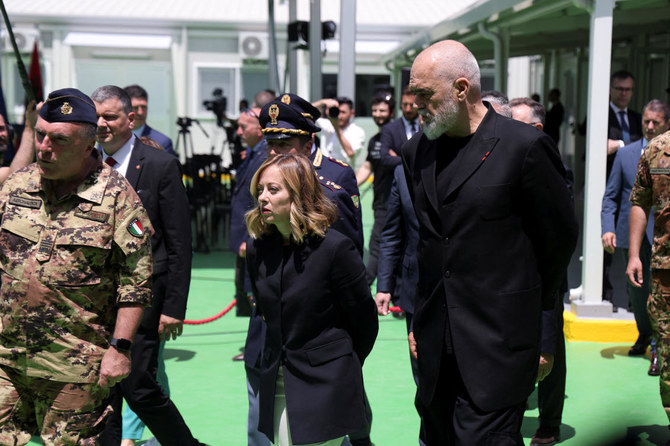
SHENGJIN: Italian Premier Giorgia Meloni traveled to Albania Wednesday to tour migrant centers and thank its government for agreeing to host thousands of asylum-seekers while Italy processes their claims.
Meloni denied her day trip was a campaign stop on the eve of the European Parliament election in which migration is a big issue. She said it was part of her job to govern and blasted criticism of the visit as typical opposition maneuvering.
Meloni and Albania’s Prime Minister Edi Rama in November signed a five-year deal in which Albania agreed to shelter up to 3,000 migrants rescued from international waters each month while Italy processes their asylum claims. With asylum requests expected to take around a month to process, the number of asylum-seekers sent to Albania could reach up to 36,000 in a year.
“They (Italians) are grateful to the government, they are grateful to the Albanian people for this important effort of friendship that they are making to give us a hand,” said Meloni at a news conference.
Meloni has defended the controversial plan as a necessary component of her crackdown on migration, aiming to deter would-be refugees from paying smugglers to make the dangerous Mediterranean crossing. Human rights groups and opposition lawmakers have warned that refugee protections could be compromised.
Meloni considered the deal with Albania “extremely innovative” and said it attracted the interest of 15 out of 27 EU members who are asking the European Commission if “the union (could) follow the Italian model in the agreement with Albania.”
“The most useful element of this project is that it can represent an extraordinary tool of deterrence for illegal migrants destined to reach Europe,” she said.
Meloni, accompanied by Interior Minister Matteo Piantendosi and about three dozen journalists, kicked off her visit to the tiny Western Balkan nation at Gjader, a former military airport, 80 kilometers (50 miles) north of the capital, Tirana, where work for one of the two migrant centers has started.
Meloni next visited the port of Shengjin, 20 kilometers (12 miles) southwest of Gjader, where a reception center with housing units and offices is set in an area covering 4,000 square meters (4,800 square yards) and surrounded by a 5-meter (yard) high metal fence with barbed wires on top.
Meloni confirmed a two-month delay in the opening of the centers, saying that was due to unforeseen structural reinforcements that were necessary at one of the sites. She said that on Aug. 1 both centers would be operational and ready to host the first 1,000 migrants. A regular ferry link to Italy will begin in mid-September.
Meloni and her right-wing allies have long demanded European countries share more of the migration burden, and have held up the Albania agreement as an innovative solution to a problem that has vexed the EU for years.
Meloni, of the far-right Brothers of Italy party, has also championed her so-called Mattei Plan to fund projects in African countries along migrant routes in exchange for better controls, while pressing ahead with plans to run migrant centers in Albania.
The two processing centers in Albania will cost Italy more than 670 million euros (about $730 million) over five years. The cost of taking 36,000 migrants to Italy is 136 million euros ($148 million), almost the same as the amount to be spent in Albania, according to Meloni.
The facilities would be fully run by Italy while it fast-tracks migrants’ asylum requests. They are expected to become fully operational later this year.
Both centers are under Italian jurisdiction while Albanian guards will provide outside security.
Italy would welcome the migrants if they are granted international protection or organize their deportation from Albania if refused.
Those picked up within Italy’s territorial waters, or by rescue ships operated by nongovernmental organizations, would retain their right under international and EU law to apply for asylum in Italy and have their claims processed there.
Data from the Italian Interior Ministry show the number of migrants arriving in Italy is way down compared to the same period last year: As of Tuesday, 21,574 people had arrived in Italy via boat so far this year, compared to 51,628 during the same period in 2023.
Albania is not a European Union member, and the idea of sending asylum seekers outside the bloc is controversial. The deal was endorsed by European Commission President Ursula von der Leyen as an example of “out-of-the-box thinking,” but has been widely criticized by rights groups.
Rama, of Albania’s left-wing governing Socialist Party, has said the deal is a sign of gratitude on behalf of Albanians who found refuge in Italy and “escaped hell and imagined a better life” following the collapse of communism in the 1990s Albania.
“Italy has been helpful and served Albania many many times and if we have the possibility to be helpful to Italy ... let’s exploit this opportunity,” said Rama.
Tirana has refused other countries’ requests for deals similar to that of Italy, according to Rama.
Italy’s center-left opposition has called the deal an expensive exercise in propaganda ahead of European elections and a shameful bid to turn Albania into Italy’s “Guantánamo.”
A group of 30 Albanian opposition conservative lawmakers took the case to the Constitutional Court in an unsuccessful effort to block the Italy-Albania deal on the grounds of human rights.


![]()

Italian Premier Giorgia Meloni visits Albania to thank country for hosting migrant centers
Short Url
https://arab.news/cwd2v
Italian Premier Giorgia Meloni visits Albania to thank country for hosting migrant centers
- PM Meloni, accompanied by Interior Minister Matteo Piantendosi and about three dozen journalists, kicked off her visit to the tiny Western Balkan nation at Gjader
- PM Rama, of Albania’s left-wing governing Socialist Party, has said the deal is a sign of gratitude on behalf of Albanians who found refuge in Italy and ‘escaped hell and imagined a better life’


Latest updates


© 2026 SAUDI RESEARCH & PUBLISHING COMPANY, All Rights Reserved And subject to Terms of Use Agreement.