MUMBAI: Indian Prime Minister Narendra Modi was set to meet his allies on Wednesday to discuss forming the government, a day after his Hindu nationalist party lost its outright majority in parliament in a surprise election verdict.
Modi’s Bharatiya Janata Party (BJP) won 240 seats on its own in the general election, 32 short of the halfway mark in the 543-member decision-making lower house, according to official results announced late on Tuesday.
India’s NSE Nifty 50 and S&P BSE Sensex were down about 0.1 percent each in early trade after dropping about 6 percent each on Tuesday as the weaker-than-expected mandate for Modi triggered record foreign outflows and spooked investor sentiment on worries over the pace of reforms.
Volatility rose to the highest since March 2022 on Tuesday, before easing a bit on Wednesday.
The weakened majority for Modi’s alliance could pose challenges for the more ambitious elements of the government’s reform agenda, ratings agency Fitch said.
However, it added: “Despite the slimmer majority, we do expect broad policy continuity to persist, with the government retaining its focus on its capex push, ease of doing business measures, and gradual fiscal consolidation.”
The National Democratic Alliance (NDA) led by the BJP won 293 seats, more than 20 ahead of the 272 needed to form a government, but Modi would now have to depend on disparate regional parties whose political loyalties have wavered over the years.
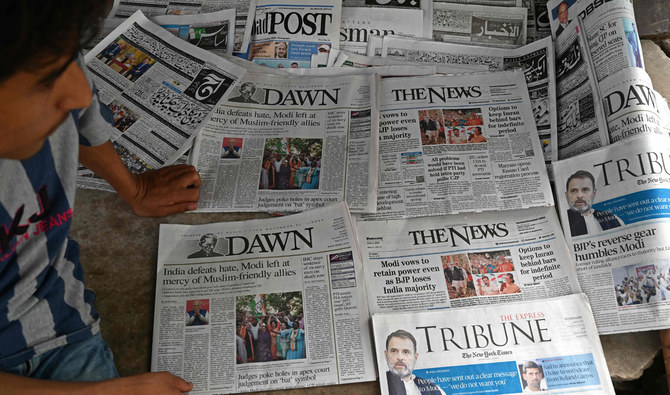
Newspaper said Modi’s halo had dimmed, with the Indian Express’s banner headline reading “India gives NDA a third term, Modi a message.”
Modi’s own victory in his seat of Varanasi, considered one of the holiest cities for Hindus, was subdued, with his margin of victory down from nearly 500,000 votes at the last general election in 2019 to a little over 150,000.
But this reduced victory may not necessarily mean reform paralysis, the chairman of a government finance panel, Arvind Panagariya, said in an editorial in the Economic Times newspaper.
“Despite the reduced majority in parliament, the necessary reforms are entirely feasible. Delivering sustained growth at a accelerated pace can only strengthen the government’s hand in the coming years,” he said.
The opposition INDIA alliance led by Rahul Gandhi’s centrist Congress party won 230 seats, more than forecast. Congress alone won 99, almost double the 52 it won in 2019 — a surprise jump that is expected to boost Gandhi’s standing.
The INDIA alliance was also expected to meet on Wednesday in New Delhi, and discuss a future course of action.
But any efforts at government formation by the opposition were likely stymied by two of the BJP’s key allies endorsing Modi and saying their pre-poll alliance with the party was intact.


![]()

India’s Modi, allies to meet after humbling election verdict
Short Url
https://arab.news/beurb
India’s Modi, allies to meet after humbling election verdict
- Modi’s BJP won 240 seats, 32 short of halfway mark in 543-member decision-making lower house
- Modi would now have to depend on disparate regional parties whose political loyalties have wavered
Latest updates


Recommended


© 2026 SAUDI RESEARCH & PUBLISHING COMPANY, All Rights Reserved And subject to Terms of Use Agreement.