

US defers to Pakistani courts on ex-PM Khan’s charges after diplomatic cable conviction overturned

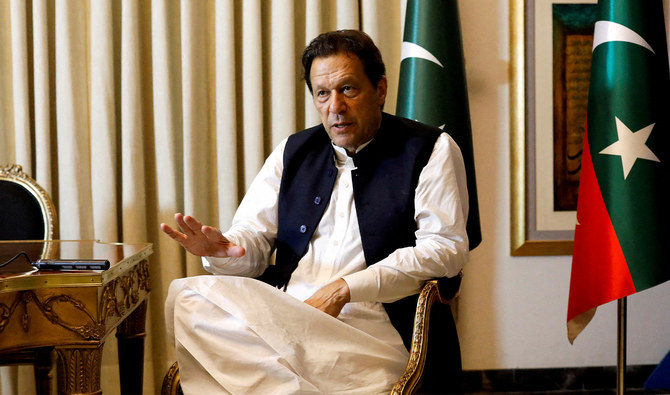
Former Pakistani Prime Minister Imran Khan speaks with Reuters during an interview, in Lahore, Pakistan on March 17, 2023. (REUTERS/File)
Short Url
Updated 04 June 2024
Follow

US defers to Pakistani courts on ex-PM Khan’s charges after diplomatic cable conviction overturned

  • Khan was given 10 years in prison for sharing the contents of the cable, originating in Washington, with his followers
  • The Pakistan government has expressed its reservation over the decision, but it has so far not filed an appeal against it

ISLAMABAD: The United States said on Monday it was up to Pakistani courts to decide on all charges against former premier Imran Khan, following the overturning of his conviction in a case involving a diplomatic cable from Washington, which Khan claimed proved his administration was toppled by the US.

Khan and his close aide, Shah Mahmood Qureshi, were given 10 years in prison for sharing the contents of the classified cable, sent to Islamabad by Pakistan’s ambassador in Washington, with their followers weeks ahead of the no-trust vote in April 2022 that brought down their government.

The former premier said the cable mentioned threatening language used by a senior American official, Donald Lu, who warned Pakistan of dire consequences if Khan survived the no-confidence vote.

The US has repeatedly denied the allegation in the past, calling it a “lie.”

“The legal proceedings against [Imran Khan] are something for the Pakistani courts to decide in – I’d say in accordance with their laws and constitution,” State Department Spokesman Matthew Miller while responding to a question about Khan’s acquittal in a media briefing.

The former Pakistan PM continues to remain in prison after being convicted in another case in which he is accused of contracting an illegal marriage.

Asked about the marriage case and the law governing his conviction, Miller reiterated the same position.

“When you come to these laws in Pakistan and this court case, it is something for the Pakistani courts to decide,” he said. “And you just saw, to this question, charges against him thrown out by the courts.”

Khan and Qureshi were acquitted in the diplomatic cable case on Monday after the Islamabad High Court announced its verdict in the matter.

The Pakistan government expressed its reservations over the decision, but it has not filed an appeal against it as yet.


How do Pakistan and Taliban Afghan militaries stack up as tensions flare?

Updated 7 sec ago
Follow

How do Pakistan and Taliban Afghan militaries stack up as tensions flare?

  • Pakistan fields 660,000 active troops, 465 combat aircraft and 170 nuclear warheads, dwarfing Taliban forces
  • Afghan Taliban command about 172,000 personnel with limited air capability and no nuclear arsenal

Cross-border fighting between Pakistan and Afghanistan intensified ‌overnight, with both sides claiming heavy losses and the Pakistani defense minister saying his country was in an “open war” with its neighbor.

As tensions ​persist, here is a look at how Pakistan dwarfs Afghanistan’s military forces and arsenals, according to data from the London-based International Institute for Strategic Studies.

OVERVIEW
Pakistan’s armed forces benefit from good recruitment and retention, bolstered by equipment from its main defense partner China. Islamabad continues to invest in its military nuclear programs and is also modernizing its navy and air ‌force.

The capability of ‌the Afghan Taliban’s armed forces, meanwhile, ​is ‌declining, ⁠with ​a fall ⁠in their ability to use foreign equipment that the Islamist group seized when it returned to power in the landlocked country in 2021.
A lack of international recognition for the Taliban administration has also hurt military modernization.

PERSONNEL
Pakistan has 660,000 active personnel in its defense forces, of whom 560,000 are in the ⁠army, 70,000 are in the air force, and 30,000 ‌are in the navy.

The ‌strength of the Afghan Taliban’s military ​is thinner, with only 172,000 active ‌personnel. The group has, however, announced plans to expand ‌its armed forces to 200,000 personnel.

FIGHTING VEHICLES AND ARTILLERY
Pakistan has more than 6,000 armored fighting vehicles, and over 4,600 pieces of artillery.

The Afghan forces also possess armored fighting vehicles, including Soviet-era main battle tanks, ‌armored personnel carriers and autonomous underwater vehicles, but their exact number is unknown.

The precise number of ⁠artillery they ⁠possess, which is of at least three different types, is similarly not known.

AIR FORCE
Pakistan has a fleet of 465 combat aircraft and more than 260 helicopters that include multi-role, attack and transport choppers.

Afghanistan has no fighter jets and no real air force to speak of. It is known to possess at least six aircraft — some of them dating back again to the Soviet era — and 23 helicopters, although it is not possible to assess how many are ​in flying condition.

NUCLEAR ARSENAL
While Pakistan ​is a nuclear-armed country and has 170 warheads, Afghanistan does not have a nuclear arsenal.