

Somalia to expel Ethiopian troops unless Somaliland port deal scrapped, official says

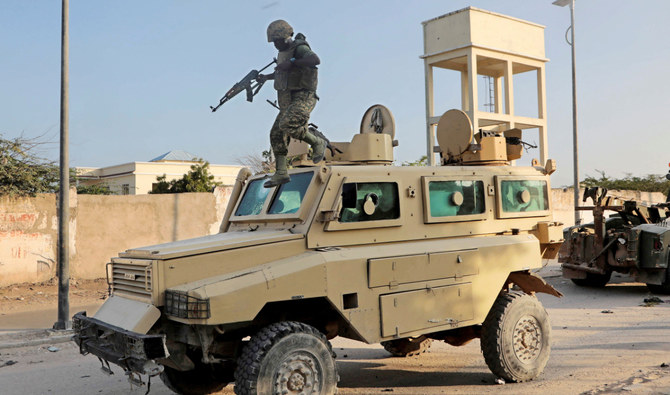
A soldier serving in the African Union Mission in Somalia jumps off a military vehicle near the scene of an explosion in Mogadishu. (Reuters)
Short Url
Updated 03 June 2024
Follow

Somalia to expel Ethiopian troops unless Somaliland port deal scrapped, official says

NAIROBI: Somalia will expel thousands of Ethiopian troops stationed in the country to help with security by the end of the year unless Addis Ababa scraps a disputed port deal with the breakaway region of Somaliland, a senior Somali official said on Monday.

Security experts and foreign diplomats said the move risks further destabilizing Somalia as local forces would be unable to fill the security vacuum, which would likely be exploited by fighters from Al-Shabab — an affiliate of Al-Qaeda.

At least 3,000 Ethiopian soldiers are stationed in the Horn of Africa country as part of an African Union peacekeeping mission fighting Al-Shabab, which controls large portions of Somalia, while an estimated 5,000-7,000 are stationed in several regions under a bilateral agreement.

Relations between Mogadishu and Addis Ababa nosedived earlier this year after landlocked Ethiopia agreed to lease 20 km of coastline from Somaliland — a part of Somalia which claims independence and has had effective autonomy since 1991, but has failed to win international recognition.

Ethiopia offered Somaliland possible recognition in exchange for being allowed to set up a naval base and commercial port — a move Mogadishu has called illegal.

“If they do not repeal the (agreement) before the end of June, or when the new mandate of the mission is decided, all Ethiopian troops, ATMIS and bilateral, will have to go,” Somalia’s National Security Adviser Hussein Sheikh-Ali told Reuters by phone.

“Ethiopia cannot be an ally and at the same time an aggressor.”

Spokespeople for the Ethiopian government and the Ethiopian National Defense Forces did not respond to requests for comment.

The African Union Transition Mission in Somalia, which is mandated by the UN Security Council, is due to fully withdraw and hand over security responsibilities to the Somali state by the end of 2024.

But the Somali government has requested several times for the withdrawal of troops to be slowed down, citing setbacks on the battlefield. 

The troops come from Burundi, Djibouti, Uganda, Kenya and Ethiopia.


Changes to US security strategy ‘largely consistent’ with Russia’s vision: Kremlin

Updated 58 min 7 sec ago
Follow

Changes to US security strategy ‘largely consistent’ with Russia’s vision: Kremlin

  • Kremlin’s spokesman Dmitry Peskov said that the current US administration was “fundamentally different from the previous ones”

MOSCOW: Russia has welcomed changes in the US National Security Strategy, saying the adjustments that marked a radical departure from Washington’s previous policy were “largely consistent” with Moscow’s vision.
Washington’s new National Security Strategy, published early Friday, took aim at allies in Europe, calling it over-regulated, lacking in “self-confidence” and facing “civilizational erasure” due to immigration.
The document stated that the United States would also prevent other powers from dominating but added: “This does not mean wasting blood and treasure to curtail the influence of all the world’s great and middle powers.”
Commenting on the new US strategy, the Kremlin’s spokesman Dmitry Peskov said that the current US administration was “fundamentally different from the previous ones.”
“The adjustments we’re seeing, I would say, are largely consistent with our vision,” Peskov said in an interview with state TV station Rossiya aired Sunday.
“President Trump is currently strong in terms of domestic political positions. And this gives him the opportunity to adjust the concept to suit his vision,” Peskov added.
The publication of the updated security strategy came as officials from Kyiv held talks in Florida with Trump’s envoys on the US-drafted plan to end the near four-year war in Ukraine.
Three days of talks produced no apparent breakthrough.
President Volodymyr Zelensky committed to further negotiations toward “real peace,” as Russia in the early hours of Saturday launched another series of drone and missile strikes at Ukraine.
Zelensky is due to meet with European leaders — French President Emmanuel Macron, British Prime Minister Keir Starmer and German Chancellor Friedrich Merz — in London on Monday to take stock of the negotiations.