JACOBABAD/LARKANA: Raheem Bakhsh, a brick kiln worker in Pakistan’s Jacobabad district, used to work eight hours previously. This year, however, Bakhsh is forced to take a pay cut and reduce his working hours to five or six, as the temperature in Jacobabad district crossed 50° Celsius last week while Pakistan remains in the throes of a severe heat wave.
Throughout May 2024, the temperatures in the northern districts of Pakistan’s southern Sindh province remained 6-8°C higher than their monthly average. Pakistan’s National Disaster Management Authority (NDMA) last week warned the heat waves would persist across parts of Sindh and Punjab in June, with temperatures likely to remain above 48 degrees Celsius.
Increased exposure to heat, and more heat waves, have been identified as one of the key impacts of climate change in Pakistan, with people experiencing extreme heat and seeing some of the highest temperatures in the world in recent years. The South Asian country of more than 241 million, one of the ten most vulnerable nations to climate change impacts, has also witnessed untimely downpours, flash floods and droughts in recent years.
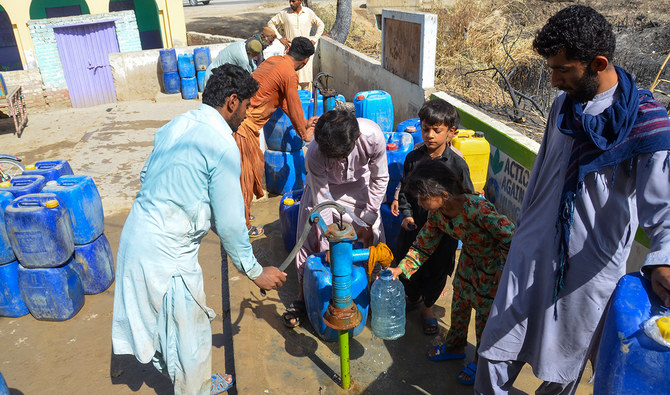
Jacobabad and other northern districts of Sindh are known for their sweltering temperatures every summer. This year around, as the weather gets warmer and harsher, residents of the district are making some necessary changes to their daily routine.
Bakhsh, who has been laboring as a brick kiln worker for the past 40-45 years, told Arab News last year was very hot but this year “is even hotter.”
“The extreme heat has slowed down our work,” he lamented. “Previously we worked for eight hours, but now we work for only five to six hours. The hot weather is causing us losses every day. Our health is also deteriorating as we become weaker with each passing day. We are laborers, where will we go?“
The same is the case for Mahjabeen Shabbir Abro, a social worker for a non-governmental organization (NGO) in Jacobabad. As the mercury soars in the district, Abro has increased her water intake and rescheduled her job timings to avoid the peak sun hours.
Previously, she used to work from 9:00 a.m. to 5:00 p.m. The intense heat has forced her to change her timings from 07:00 a.m. To 11:00 p.m.
“Previously as a field-based worker, we didn’t feel the need for water that much nor did we feel unconscious,” Abro told Arab News. “However, this heat is making us feel unconscious and we have to use ORS [Oral Rehydration Solution] as much as possible. If we used to have just one sachet of ORS, we now take two to three ORS sachets per day.”
Abdul Riaz, a 20-year-old laborer, said he would spend the upcoming Eid-Al-Adha festival in Balochistan’s cooler pastures searching for work without his family, and away from his one-year-old son.
“Here in Jacobabad, it is too hot, and there is too much joblessness,” Riaz said. “I am going to Balochistan for work in grape farming. I will spend four to five months there so that I can earn and send money back home to my children,” he added.
According to him, Ibrahimzai area in Balochistan is a cooler place where he can find work at grape gardens.
“I often go there in different seasons to work in grape gardens,” Riaz said.
Dr. Ram Chand, the Sindh government’s focal person for heat stroke response centers in Jacobabad, noted that while the temperature had soared past 50 degrees Celsius in May, no deaths from heat stroke had taken place. While the district headquarters civil hospital has increased its heat stroke response centers from one last year to four this year, people were taking more precautions against the heat wave, he said.
“Due to mass awareness, people are taking necessary precautions, such as drinking more liquids, juices, ORS, and water,” Chand told Arab News. “And we’ve seen no heat stroke deaths this year or last year.”
But while that may be a silver lining for Chand, it isn’t necessarily for others. Khadim Hussain, a farmer at Mohenjo Daro in the neighboring Larkana district in Dhandh village, says the harsh climate won’t let him plant seeds.
“In the past, we used to sow rice seeds in June,” Hussain told Arab News. “Now it is so hot, with hot winds blowing, that if we start sowing seeds now, they will burn out, and we would face a huge loss.”


![]()

In northern Sindh, residents struggle to adapt as Pakistan sizzles under heat wave
Short Url
https://arab.news/yf9rx
In northern Sindh, residents struggle to adapt as Pakistan sizzles under heat wave
- Some laborers migrate to cooler areas, other reduce working hours as temperature in Jacobabad district in Sindh soars to over 50 degrees Celsius
- Health experts and doctors advise people to stay indoors, drink plenty of juices and water as South Asia experiences severe heat wave
Latest updates


© 2026 SAUDI RESEARCH & PUBLISHING COMPANY, All Rights Reserved And subject to Terms of Use Agreement.