

UN forecasts La Nina could help lower temperatures this year

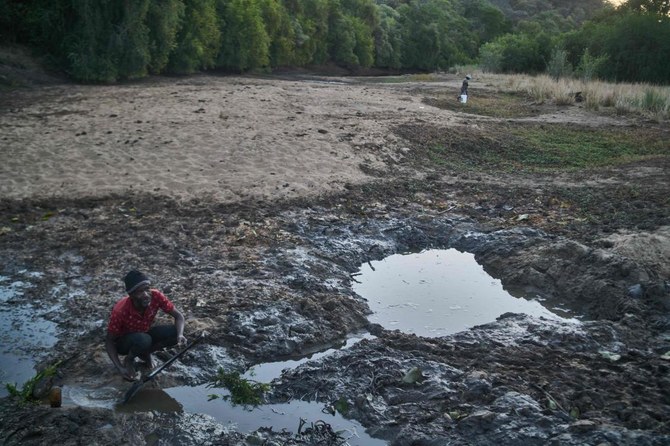
The WMO warned that global temperatures would continue to rise in the long term due to human-induced climate change resulting in extreme weather worse and upend seasonal rainfall. (AFP)
Short Url
Updated 03 June 2024
Follow

UN forecasts La Nina could help lower temperatures this year

  • The WMO warned that global temperatures would continue to rise in the long term due to human-induced climate change resulting in extreme weather worse and upend seasonal rainfall

GENEVA: The return of the cooling La Nina weather phenomenon this year should help lower temperatures somewhat after months of global heat records, the United Nations’ weather agency said Monday.
The impact is likely to be felt in the next few months because the warming El Nino weather pattern — which has helped fuel a spike in global temperatures and extreme weather around the world since mid-2023 — “is showing signs of ending,” the UN’s World Meteorological Organization said in its latest update.
The WMO warned, however, that global temperatures would continue to rise in the long term due to human-induced climate change, which continues to make extreme weather worse and upend seasonal rainfall and temperature patterns.
La Nina refers to the cooling of the ocean surface temperatures in large swathes of the tropical Pacific Ocean, coupled with winds, rains and changes in atmospheric pressure.
In many locations, especially in the tropics, La Nina produces the opposite climate impacts to El Nino, which heats up the surface of the oceans, leading to drought in some parts of the world and triggering heavy downpours elsewhere.
The WMO said there was a “60 percent” chance of La Nina conditions in the period from July to September and a “70 percent” likelihood during August-November.
The chances of El Nino redeveloping are negligible, it added.
Every month since June 2023, when El Nino returned, has set a new high temperature record, and 2023 was by far the warmest year on record globally.
The WMO said the planet would continue to heat up overall from the use of fossil fuels that produce greenhouse gases.

“The end of El Nino does not mean a pause in long-term climate change, as our planet will continue to warm due to heat-trapping greenhouse gases,” WMO deputy secretary general Ko Barrett stressed.
“Exceptionally high sea surface temperatures will continue to play an important role during next months.”
Much of the planet’s excess heat from climate change is stored in the oceans.
In the United States, the National Oceanic and Atmospheric Administration has already factored the expected La Nina into its forecasts for this year’s Atlantic hurricane season.
The NOAA said it expected four to seven major hurricanes in the Atlantic between June and November.
“The upcoming Atlantic hurricane season is expected to have above-normal activity due to a confluence of factors, including near-record warm ocean temperatures in the Atlantic Ocean, development of La Nina conditions in the Pacific, reduced Atlantic trade winds and less wind shear,” the NOAA said on May 23.
The WMO noted that the past nine years had been the warmest on record, even with the cooling influence of a La Nina event that lasted from 2020 to early 2023.
The latest El Nino, which peaked in December, was one of the five strongest on record.
“Our weather will continue to be more extreme because of the extra heat and moisture in our atmosphere,” Barrett said.
The WMO has made it a priority to ensure that all regions of the world are covered by early warning systems by 2027, particularly the least well-equipped, such as Africa.
“Seasonal forecasts for El Nino and La Nina, and the anticipated impacts on the climate patterns globally, are an important tool to inform early warnings and early action,” Barrett said.


Faced with Trump, Greenlanders try to reassure their children

Updated 58 min ago
Follow

Faced with Trump, Greenlanders try to reassure their children

  • Since Trump returned to the White House last year with a renewed ambition to seize Greenland, international politics has intruded into the Arctic island’s households

NUUK: In a coffee shop in Greenland’s capital Nuuk, Lykke Lynge looked fondly at her four kids as they sipped their hot chocolate, seemingly oblivious to the world’s convulsions.
Since Donald Trump returned to the White House last year with a renewed ambition to seize Greenland, international politics has intruded into the Arctic island’s households.
Dictated by the more or less threatening pronouncements of the US president, it has been an unsettling experience for some people here — but everyone is trying to reassure their children.
Lynge, a 42-year-old lawyer, relied on her Christian faith.
“There’s a lot of turmoil in the world,” she said. “But even if we love our country, we have even higher values that allow us to sleep soundly and not be afraid,” she said.
As early as January 27, 2025, one week after Donald Trump’s inauguration, the Greenlandic authorities published a guide entitled “How to talk to children in times of uncertainty?“
“When somebody says they will come to take our country or they will bomb us or something, then of course children will get very scared because they cannot navigate for themselves in all this news,” said Tina Dam, chief program officer for Unicef in the Danish territory.

- Unanswerable questions -

This guide — to which the UN agency for children contributed — recommends parents remain calm and open, listen to their children and be sensitive to their feelings, and limit their own news consumption.
As in many parts of the world, social media, particularly TikTok, has become the primary source of information for young people.
Today, children have access to a lot of information not meant for them, said Dam — “and definitely not appropriate for their age,” she added.
“So that’s why we need to be aware of that as adults and be protective about our children and be able to talk with our children about the things they hear — because the rhetoric is quite aggressive.”
But reassuring children is difficult when you do not have the answers to many of the questions yourself.
Arnakkuluk Jo Kleist, a 41-year-old consultant, said she talked a lot with her 13-year-old daughter, Manumina.
The teenager is also immersed in TikTok videos but “doesn’t seem very nervous, luckily, as much as maybe we are,” she added.
“Sometimes there are questions she’s asking — about what if this happens — that I don’t have any answers to” — because no one actually has the answer to such questions, she said.

- ‘Dear Donald Trump’ -

The Arctic territory’s Inuit culture also helped, said Kleist.
“We have a history and we have conditions in our country where sometimes things happen and we are used to being in situations that are out of our control,” said Kleist.
“We try to adapt to it and say, well, what can I do in this situation?“
Some Greenlandic children and teenagers are also using social media to get their message out to the world.
Seven-year-old Marley and his 14-year-old sister Mila were behind a viral video viewed more than two million times on Instagram — the equivalent of 35 times the population of Greenland.
Serious in subject but lighthearted in tone, the boy addresses the American president.
“Dear Donald Trump, I have a message for you: you are making Greenlandic kids scared.”
Accompanied by hard stares, some serious finger-wagging and mostly straight faces, he and his sister go on to tell Trump: “Greenland is not for sale.”
“It’s a way to cope,” his mother, Paninnguaq Heilmann-Sigurdsen, told AFP of the video. “It’s kid-friendly, but also serious.
“I think it’s a balance between this is very serious, but also, this is with kids.”