

Netflix drama stirs complex past of Pakistan’s ‘courtesans’

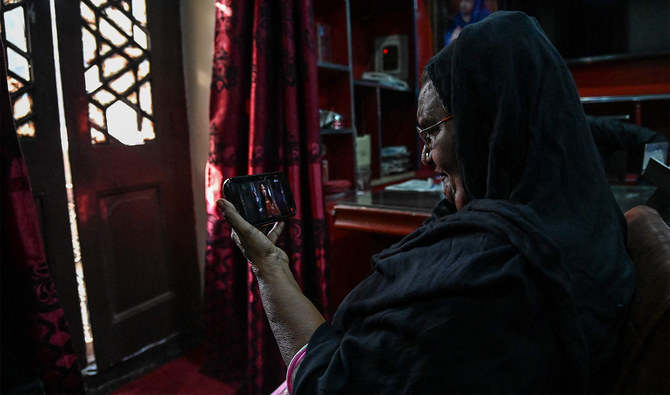
This photograph taken on May 16, 2024 shows Shagufta, a former sex worker with a pseudonym, watching the trailer of "Heeramandi", a Netflix series, on a mobile phone in the royal neighbourhood of Heera Mandi, a red-light zone, in Lahore. (AFP)
Short Url
Updated 03 June 2024
Follow

Netflix drama stirs complex past of Pakistan’s ‘courtesans’

  • Eight-part show portrays courtesans in “royal neighborhood” of pre-partition Lahore
  • Courtesans were at height of their power in Mughal era, from the 1500s to mid-1800s

LAHORE, Pakistan: The Netflix hit “Heeramandi” depicts the plush and powerful lives of courtesans in the 1940s, but there is little glamor for modern Pakistani sex workers in the faded red-light district where the series is set.

The eight-part show — subtitled “The Diamond Bazaar” in English — portrays courtesans in the “royal neighborhood” of pre-partition Lahore, once a hub of culture and political intrigue.

With dazzling Bollywood-style opulence, it shows women consorting with aristocrats, forging influential alliances and rivalries against the backdrop of India’s struggle for independence from British rule.

But in the derelict remains of the neighborhood, 65-year-old former sex worker Shagufta scoffed.

“This is not what Heera Mandi is like,” she told AFP, using a pseudonym to protect her identity.

“Now the girls just put their bodies on display,” explained Shagufta. “There is nothing left in Heera Mandi.”


This photograph taken on May 17, 2024 shows an old building of a restaurant that formerly served as a part of the royal neighborhood of Heera Mandi, a red-light zone, in Lahore. (AFP)

Shagufta can trace back seven generations of women in her family who worked as “tawaifs” in Heera Mandi, and she began dancing and being prostituted at the age of 12.

While courtesans did command respect for their artistry in dance and music during the Mughal period, the show exaggerates the wealth and glamor of the British-ruled era in which it is set.

“It was never like this,” she said.
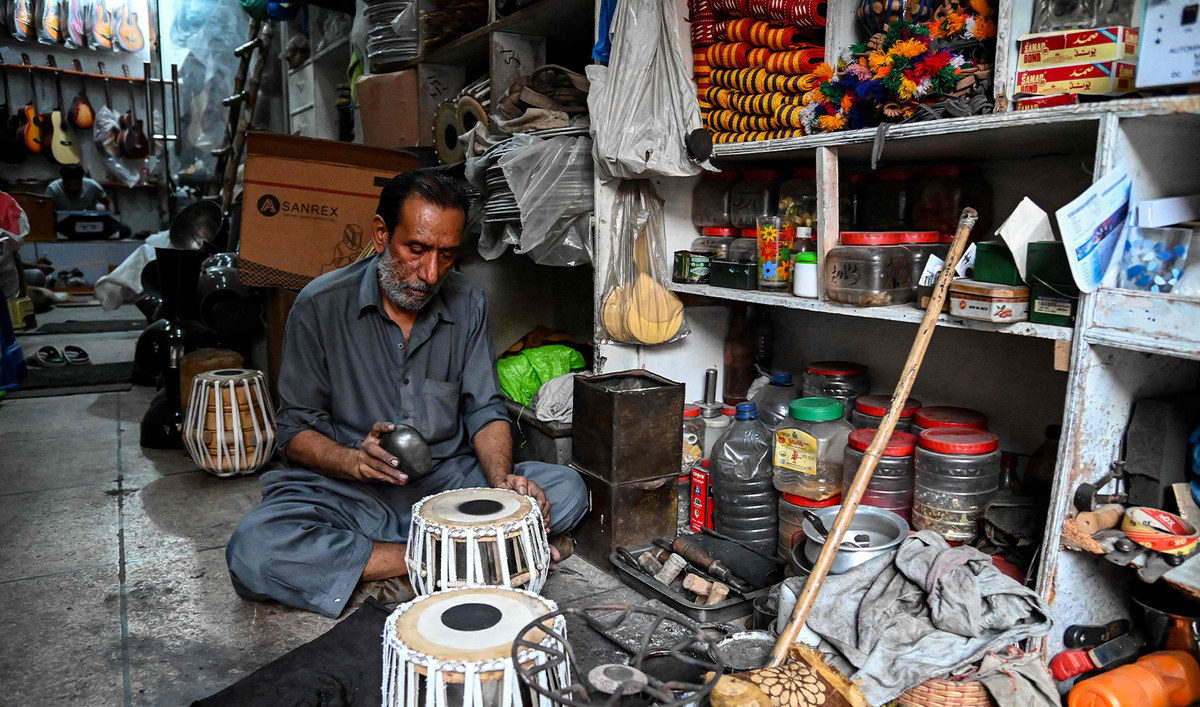


This photograph taken on May 16, 2024 shows a man making a tabla (Indian hand drum) at a music instrument shop near the royal neighborhood of Heera Mandi, a red-light zone, in Lahore. (AFP)

The glittering jewels and swooning melodrama of the show attracted nearly 11 million views in its first three weeks on Netflix, as well as a deluge of interest on social media.

Fascination has been split across Pakistan and India, where TikTok has lit up with videos of influencers dressing in traditional costumes and lip-syncing to the show’s songs and dialogues.

A sequence from a seductive classical dance inspired by the gait of an elephant — considered regal and dignified — has gone viral, with the dancer gracefully moving her hips from side to side.

Some vloggers have performed in front of shops selling shoes and musical instruments that have replaced the once-grand brothels, their crumbling art deco facades framing filthy alleyways.

But whether the show is breaking down barriers around sexuality in deeply conservative Pakistan or simply compounding them with titillation is up for debate.


This photograph taken on May 17, 2024, shows an old building of a restaurant that formerly served as a part of the royal neighborhood of Heera Mandi, a red-light zone, in Lahore. (AFP)

Naveen Zaman, a cultural researcher, is excited about the renewed attention Heera Mandi is getting.

“People are once again talking about the tawaif culture,” he said. “So actually, they are starting researching about these topics which were considered taboo in the past years.”

For Zaman, it is a step toward reviving an uncomfortable history.

“Old connections are being built here,” he said.

The courtesans were at the height of their power in the Mughal era, which lasted from the 1500s to the mid-1800s.

During British rule, Victorian morality codes were threatened by the women’s influence over the adoring local aristocracy, and the “diamond bazaar” was relegated to a red-light zone.

Decades after Pakistan gained independence, the dictatorship of President Zia ul-Haq introduced hard-line Islamic reforms which pushed sex work further into the shadows.

A police crackdown in 2009 finally shuttered Heera Mandi’s brothels and ended the music and dancing with which sex workers entertained their clients.

For 38-year-old Noor — also a pseudonym — the Netflix series does not wash away the stigma of being a sex worker from Heera Mandi.

Unlike in the series, where the term “tawaif” evokes ideas of art and etiquette, sex work in present-day Pakistan is a raw and dispiriting business.

Forced into sex work when she was a child to support her family, Noor is ostracized even by her relatives for the work she does.

“Women in this field are not considered honorable and are not treated with respect. It doesn’t matter how pious they become, they will never be respected. People will always call her a tawaif.”

“Even though in other areas of the city more sex work occurs — because of Heera Mandi’s reputation this place is still notorious,” she said.


This photograph taken on May 16, 2024, shows Noor, a sex worker with a pseudonym, speaking with AFP during an interview in the royal neighborhood of Heera Mandi, a red-light zone, in Lahore. (AFP)

Classical Indian dancer Manjari Chaturvedi has been working to reclaim the storied culture of courtesans for 15 years.

In her New Delhi studio, she called the Netflix series a “missed opportunity” which “could have created a different narrative for women, who were stigmatized for many centuries for the work they did.”

“The saddest thing that a cinema like this does is it again brings sexuality into the foreground rather than the art, and again it brings the same stigma,” Chaturvedi said.


Pakistan’s transportation strike could cause economic losses of $1 billion, warn analysts

Updated 41 min 22 sec ago
Follow

Pakistan’s transportation strike could cause economic losses of $1 billion, warn analysts

  • Traders, textile mill owners say strike has cost $60 million per day in exports, port demurrages, detention charges
  • Analysts warn 10-day strike could threaten economic stability by deepening inflation, widening current account deficit

KARACHI: Pakistan’s ongoing transportation strike has the potential to cause economic losses of up to $1 billion and threaten macroeconomic stability in the country, a leading economist warned this week. 

Transport unions have been protesting against stricter enforcement of axle-load limits — legal caps on how much weight trucks can carry — as well as increases in toll taxes and what they describe as heavy-handed policing on highways and motorways.

The strike, which began on Dec. 8, is now in its tenth day. It has slowed the flow of goods between ports, industrial centers and markets, raising concerns over supply chains in an economy heavily reliant on road transport for domestic trade and exports. Trucking is the backbone of Pakistan’s logistics system, moving food, fuel, raw materials and manufactured goods. 

“We are expecting a tremendous impact of the ongoing transportation strike,” Ahsan Mehanti, CEO of Arif Habib Commodities, told Arab News on Tuesday. 

“I believe that the major impact could be to the tune of $1 billion. And the reason behind that is primarily Karachi being a business hub will be most impacted with the ongoing strike.”

While a section of the transporters, the All Pakistan Goods Transport Association (APGTA) called off the strike after successful talks with the Punjab government on Friday, the rest of the transporters have vowed to continue the disruption. 

Manufacturers and exporters from the textile industry, which earns Pakistan the highest amount in exports, have estimated their daily losses at more than $60 million. 

Kamran Arshad, chairman of the All Pakistan Textile Mills Association (APTMA), said these losses were on account of disruption to exports as well as demurrage and detention charges that affected traders are bound to pay at local ports.

“I have estimated disruption to as much as $60 million ($540 million for nine-day losses) worth of exports and demurrage and detention charges of up to $300 per container per day stuck at ports,” Arshad said.

Arshad lamented that the textile industry was facing a critical situation as raw materials and essential inputs were stuck at ports and not reaching factories. On the other hand, finished export consignments were also unable to reach ports, he said. 

“Containers are stuck at mills, ports and depots and inventories are building up,” the APTMA chief said. “And backlogs are growing by the day.”

Pakistan Textile Exporters Association (PTEA) Patron-in-Chief Khurram Mukhtar calculated Pakistan’s monthly average textile exports at $1.5 billion.

“An eight-day transport shutdown alone has already caused approximately $400 million in export losses, with severe supply chain disruptions on top,” Mukhtar said. 

’BIG HIT’ TO EXPORTS

Prime Minister Shehbaz Sharif has tasked his government to ensure sustained economic growth through an export-driven economy. However, Pakistan’s exports have shown far from promising results, falling by 15 percent to $2.4 billion in November, according to data by the Pakistan Bureau of Statistics (PBS). 

From the July-November period of this fiscal year, the country’s exports declined by six percent to $12.8 billion, while imports surged by 13 percent to $28.3 billion. This widened the trade deficit by 37 percent to $15.5 billion.

Arshad said other than financial losses, the trade industry was suffering from “serious reputational damage” when it came to international buyers due to the strike’s disruptions. 

“Missed delivery schedules result in cancelations and loss of future orders,” he told Arab News. “And once a buyer is lost, it is extremely difficult to regain their confidence.”

Rehan Hanif, president of the Karachi Chamber of Commerce and Industry (KCCI), agreed. 

“Our exports are already in trouble forcing us to run after dollars, so the exports are going to take a big hit,” Hanif explained. 

He urged the government to engage transporters and address their “genuine” demands immediately. 

Information Minister Attaullah Tarar and Finance Adviser Khurram Schehzad did not respond to queries sent by Arab News till the filing of this report. 

Hanif said the prolonged strike had created a huge backlog of cargos at local ports.

“They would have no space for more containers if this strike persisted for a couple of more days,” he said. “Pakistan’s daily losses from the strike are running in billions of rupees.”

POSSIBLE INFLATION SPIKE

However, Karachi Port Trust spokesperson Shariq Amin Farooqui rejected Hanif’s claims, saying that cargo “is coming and leaving” the country’s largest port smoothly. 

Pakistan’s inflation rose by 6.1 percent in November and is expected to fall in the SBP’s target range of 5 to 7 percent this financial year, which is ending in June. 

Pakistan’s current account balance reported a $112 million deficit in October from an $83 million surplus in September, according to the central bank. 

Mehanti warned the strike could pose dangers to Pakistan’s hard-earned macroeconomic stability.

“Inflation will be higher, and the current account deficit will be higher due to challenging economic situation,” he said.