


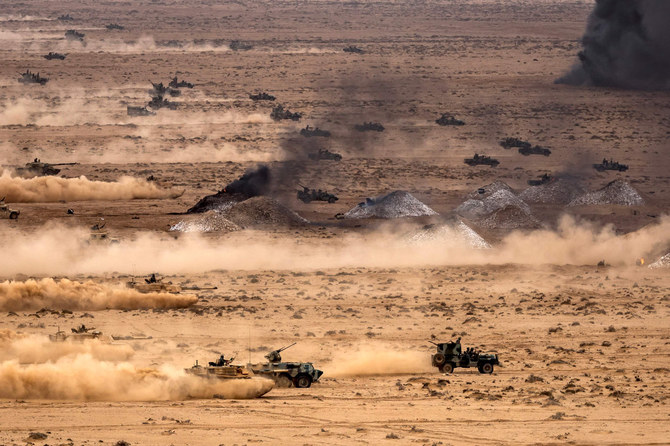

TAN TAN, Morocco: High-ranking military officials from the US and its top African allies watched intently as dust and flames shot up from pieces of the Sahara Desert hit by tank and artillery fire. They looked up as pilots flew F-16s into formation. And they listened intently as Moroccan and American personnel explained how they would set up beachheads to defend the Atlantic coastline in the event of a potential invasion.
The practice scenario was among those discussed during African Lion, the United States’ largest annual joint military exercise on the continent, which concluded Friday in Morocco.
Over the past two weeks, roughly 8,100 military forces from nearly three dozen maneuvered throughout Tunisia, Ghana, Senegal and Morocco as part of the war games held this year as militaries confront new challenges in increasingly volatile regions.
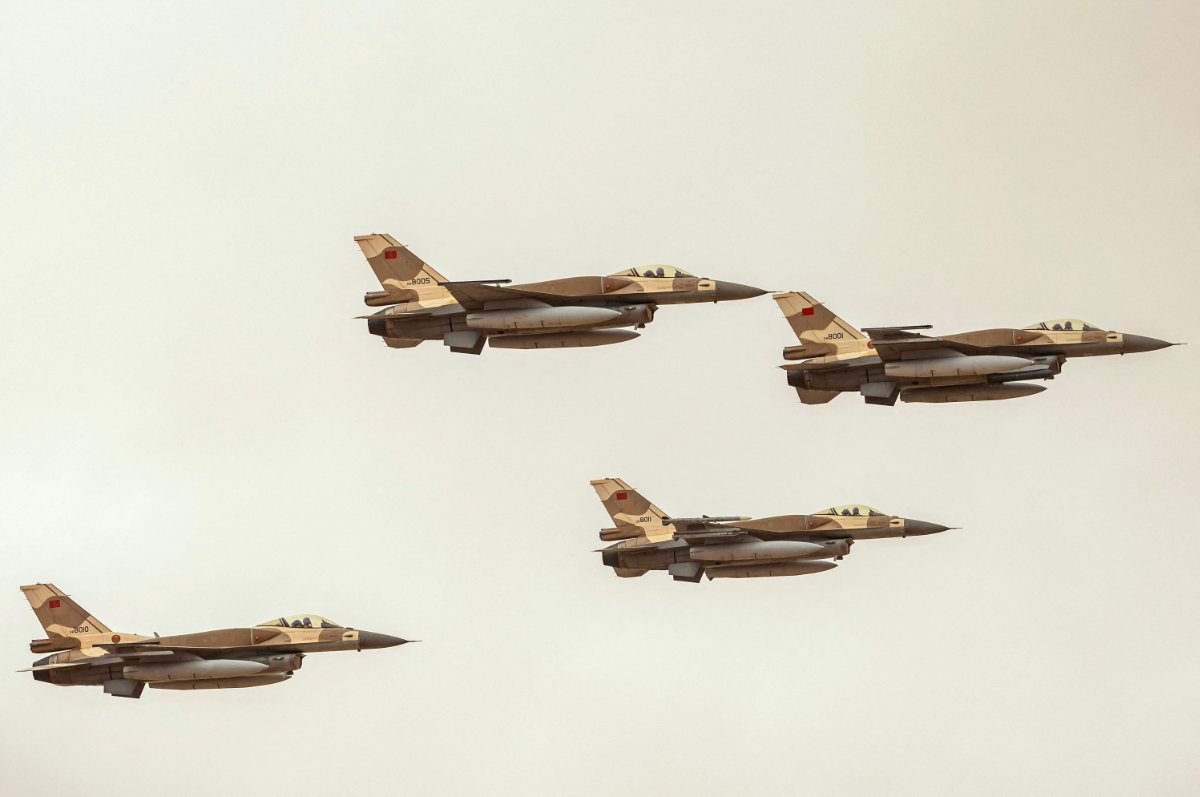
Moroccan F-16 fighter jets fly in formation during in the annual “African Lion” joint military exercise between US and Moroccan forces in the Tan-Tan region in southwestern Morocco on May 31, 2024. (AFP)
Generals from the United States and Morocco, which hosted the finale of the two-week event, celebrated African Lion’s 20-year anniversary and how partnerships between the US and African militaries have expanded since it began.
“This exercise has grown over the years since 2004, not only have the number of multinational service members that we train with, but also the scope of the training as well, which has expanded to more than just security,” said Gen. Michael Langley, the head of the United States’ Africa Command.
But despite the spectacle of live-fire demonstrations and laudatory remarks about partnerships by Langley and Col. Maj. Fouad Gourani of Morocco’s Royal Armed Forces, parts of Africa are getting much more dangerous.
The United Nations earlier this year called Africa a “global epicenter for terrorism.” Fatalities linked to extremist groups have risen dramatically in the Sahel, the region that stretches from Mauritania to Chad.
Since 2020, military officers disillusioned with their governments’ records of stemming violence have overthrown democratically elected governments in Mali, Burkina Faso and Niger and began distancing themselves from Western powers.
From 2021 to 2024, militants killed more than 17,000 people across the three countries, according to data from the Armed Conflict Location & Event Data Project.
The United States is holding steadfast to its strategy of coupling weapons assistance and intelligence sharing with initiatives designed to boost civilian populations and strengthen institutions.
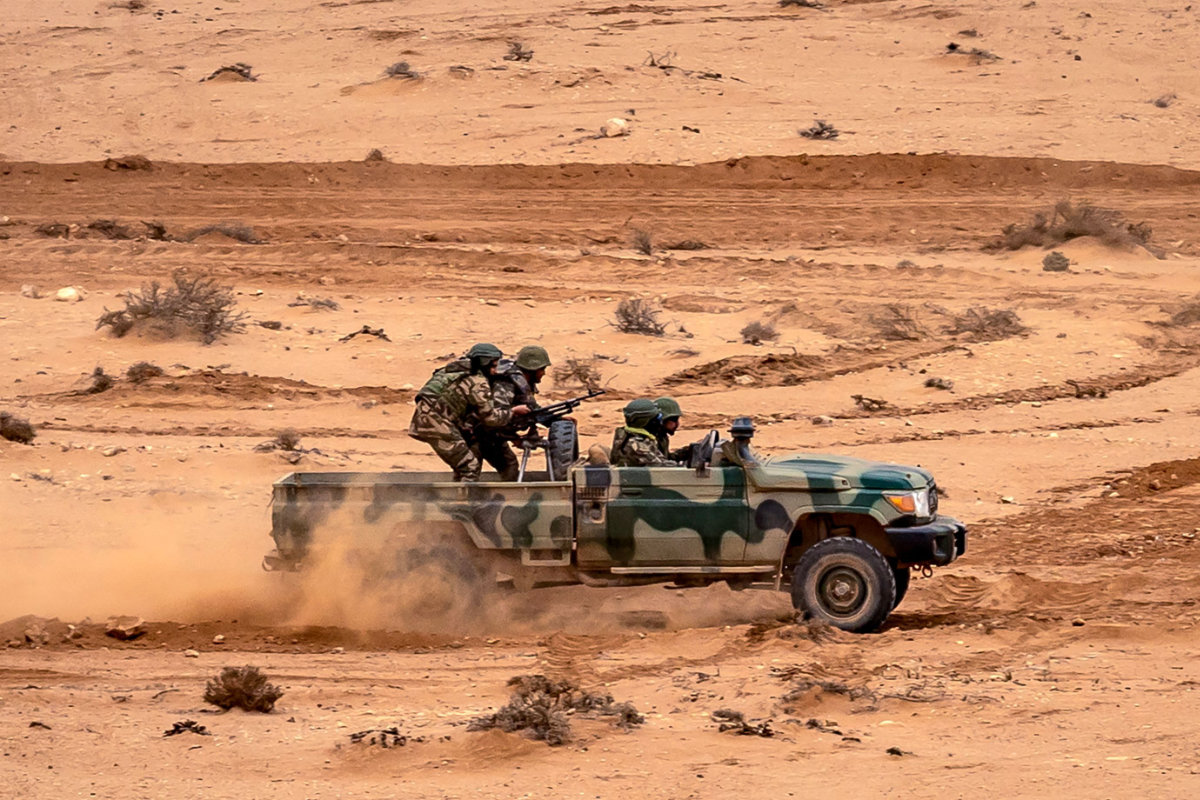
Members of the Moroccan Royal Armed Forces take part in the joint US military exercise “African Lion” in the Tan-Tan region in southwestern Morocco on May 31, 2024. (AFP)
But it faces new competition. Decades after the end of colonialism, Africa has once again become absorbed in fighting among Great Powers, with Western influence waning and countries accepting more economic and military support from Chinese firms and Russian contractors.
At African Lion, the US military showcased part of what it offers countries facing instability inside and just beyond their borders. Besides tanks and bombers, the joint exercises included operations and practice in field hospitals, medical evacuations and humanitarian assistance.
The exercise emphasized a “whole of government” approach to addressing the root causes of instability, ranging from climate change to displacement, rather than solely focusing on military might.
“It’s important that we not only be associated with kicking down doors,” said Col. Kelley Togiola, a command surgeon who helped set up a field hospital alongside Moroccan doctors as part of the exercise. “In times of crises, those relationships matter.”
That strategy differs from what’s being offered by Africa Corps, the descendent of the Russian state-funded private military company Wagner, whose leader Yevgeny Prigozhin died last year. Yet it’s come under scrutiny since military officers with a history of participating in training exercises have risen to positions of power after the ousters of democratically elected leaders in countries such as Guinea and Niger.
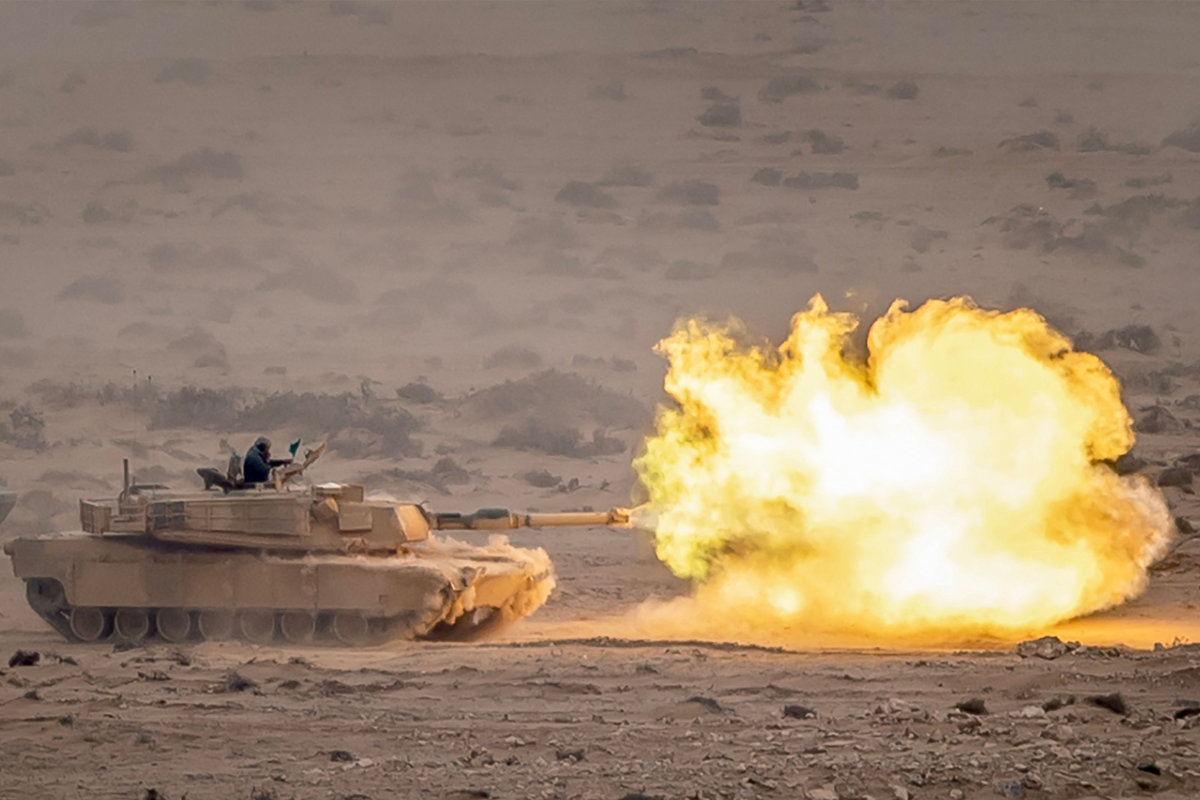
An Abrams tank fires a round during in the annual “African Lion” joint military exercise between US and Moroccan forces in southwestern Morocco on May 31, 2024. (AFP)
Cameron Hudson, an Africa expert at the Center for Strategic and International Studies, said regardless of how much the US military broadens its efforts, its continued focus on counterterrorism will keep empowering military leaders throughout West Africa.
“The nature of security assistance is that it’s much more visible, impactful and manipulated by the recipient for ill,” Hudson said. “When we come in with training and toys, we reinforce within societies these power dynamics that in the long run are not helpful to the consolidation of civilian democratic rule.”
Despite training exercises like African Lion, US military leaders face difficulties prolonging their partnerships in places they’ve long characterized as strategically critical. Countries such as Niger and Chad — which participated in African Lion — have embraced Russian trainers and paramilitaries and pushed for the withdrawal of US troops.
The US military officials note their assessment of the threat of “malign” Russian and Chinese influence but say they can work in countries that accept assistance from geopolitical rivals.
To juggle curbing Russian influence while opposing the overthrow of democratically elected leaders hasn’t worked everywhere, especially as the US military often attaches strings to how countries can implement training and weapons provided.
US law makes governments deposed in military coups ineligible for large portions of assistance, despite the military’s talk of equal partnership and noninterference.
Rachid El Houdaigui, a senior fellow at the Policy Center for the New South, said the growing youth populations in west African countries wanted to forge new political identities and were skeptical of the West after years of insecurity.
“African states consider variety favorable. It allows them to choose and gives them many possibilities,” he said of countries in the Sahel that have opened their doors to Russian and Chinese assistance.


