

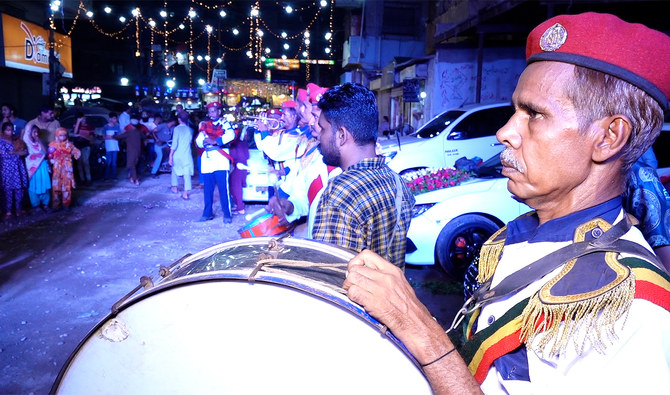

KARACHI: Muhammad Rafiq Abbasi pushed a handcart laden with a water tank that he delivered to a nearby building. After completing the delivery, he entered a small storeroom in a narrow street in Karachi’s old Ramswami neighborhood to pick up a drum. As he struck the instrument, a cloud of dust rose from it, evoking in him memories of a once-glorious past.
Musical bands were traditionally an essential feature of Pakistan weddings. Also referred to as “baajay walas,” these bands played traditional and energetic tunes with the beat of their double-sided drums, also known locally as “dhol” and trumpets to add pomp and zeal to wedding festivities.
However, as music adopted modern themes over the decades and DJing at wedding functions gained popularity, traditional wedding bands remained no longer in demand. Many who used to play popular tunes at weddings and celebratory parties have switched to other professions to keep their families from starving.
“I used to be an artist, what has become of me now,” Abbasi, 60, asked. “I am working as a laborer, going to buildings and delivering water.”
A decade ago, Abbasi owned one of the thirty shops in Karachi’s Ramswami neighborhood that housed bajay walas for nearly six decades. About 10 years ago, dealers of automobile spare parts took over the shops as the business of wedding bands dwindled.
“This entire area used to be known as Baja Gali [street] from here to there,” Abbasi explained. Abbasi said he briefly moved his shop to Karachi’s Garden neighborhood. However, the shops there were too “broken down,” forcing many like him to quit and become laborers instead.
“We have no means now, our belongings are scattered,” he lamented.
Zaheer Ahmed, who tied the knot in 1982, recalled the pomp and show put on by a wedding band when he got married. He recalled a time when bajay walas were a necessary part of every joyous occasion in Pakistan.
“There was an atmosphere for bajay walas at weddings, they were always called upon,” Ahmed told Arab News. “Without them, weddings didn’t feel complete.”
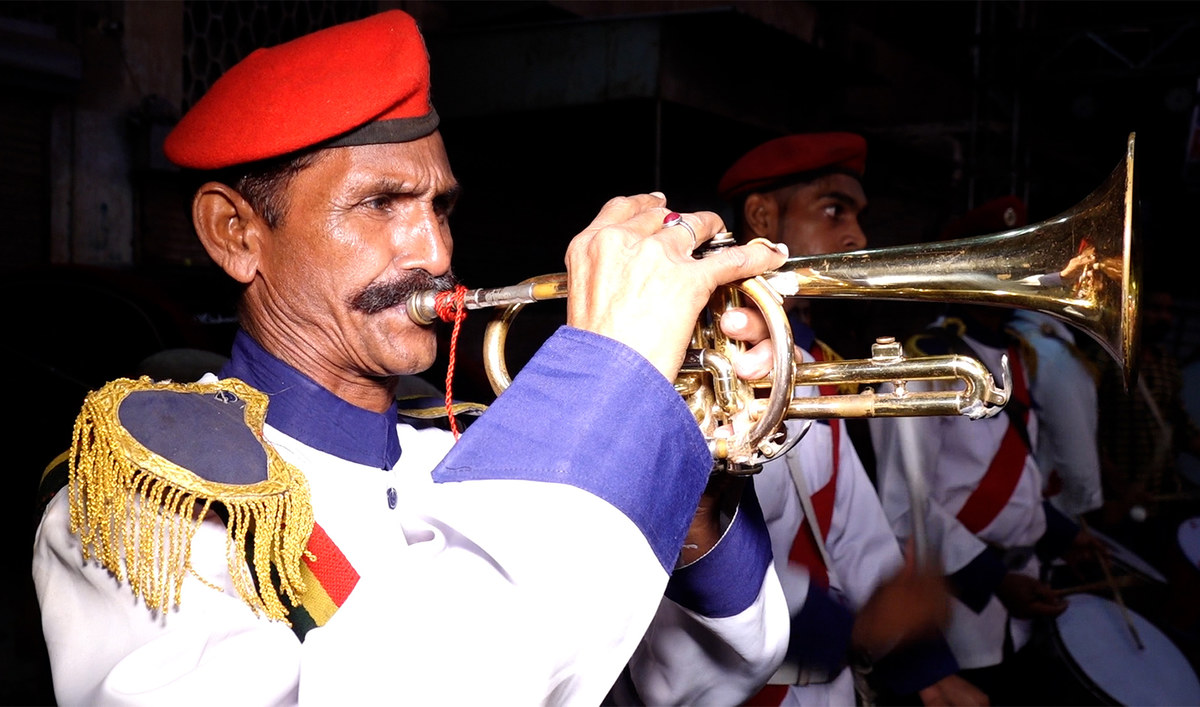
The picture taken on June 1, 2024 shows a musician playing at a wedding in Karachi, Pakistan. (AN photo)
Noor Muhammad Abdul Ghafoor, also known as “Noora,” is one of the few who still operate a band from his small shop in a street opposite Baja Gali. To make ends meet, he provides pick-and-drop services to schoolchildren.
“People used to call us for every joyous occasion, birthdays, parties, someone buying a new house, starting a business, or even inaugurating a petrol pump,” Ghafoor said. “That would be the occasion of happiness.”
However, times have changed since then.
“Now even all the joys have become worthless,” Ghafoor said. “We have this art but nobody looks toward us. Nobody comes to us anymore.”
Shahid Ali is a bandmaster who works for Noora. He leads a team of eight, four drummers and an equal number of trumpet players. With a wave of the traditional bandmaster’s stick, he directs the team to perform popular tunes such as Sehra, Shadmani, Luddy and Bhangra.
Ali blamed solo drummers for the declining business of wedding bands, saying they charged as less as Rs1,000 [$3.60] for an entire performance, putting pressure on wedding bands to lower their rates.
He said wedding bands don’t make much, adding that a client pays between the Rs10,000-12,000 [$35.96-43.15] range. Out of this, Rs4,000 [$14.38] is spent only on commuting.
“After dividing the rest, each band member hardly receives Rs700 [$2.52],” Ali explained. “If something extra happens from the top as people give [tips] we feel some support from it.”
Ali’s father and grandfather were members of musical bands too. He said there was a time when bajay walas were regarded with respect by people and would even be featured in films and dramas.
“It wasn’t about the money, we were just happy,” Ali said. “Now, even that has ended as the TV people have stopped calling us too.”
Ali urged the government to recognize and pay respect to wedding bands, saying that they provide joy to people through their art.
“In my opinion, our government should recognize us and make us sit here,” he said, gesturing toward his head.
“The darkness has fallen, it’s gotten dark so we pray to Allah that there should be a ray of hope.”


